Disclosure: This post contains affiliate links. If you buy through these links, I may earn a small commission at no extra cost to you.
Last winter my friend Hana flew in from Singapore. At Incheon, before she even looked up her hotel, she typed “korean fried chicken near me” into her phone. I laughed at her. Then I remembered I do the exact same thing, and I live here.
That’s what’s odd about it. Korea has so many chicken shops that a 2019 KB Financial Group report counted roughly 87,000 of them nationwide. You’d think searching korean fried chicken near me in Seoul would be pointless, because the answer is always yes, about forty metres away. It isn’t pointless. Most of those shops are fine and a few are wonderful. A lot of them sell frozen wings under a sticky sauce and charge ₩20,000 for it.
I’m Somi. I’m an illustrator, I vlog a little, and I walk about 14,000 steps a day around Hongdae and Yeonnam-dong, so I pass maybe twenty chicken places before lunch. Over five years I’ve built a small and slightly obsessive method for picking the good ones. It also works in LA, London or Kuala Lumpur, because the signs of a good shop are the same everywhere.
This guide takes you through it one step at a time. You’ll learn to read a menu in ten seconds, to tell double-fried chicken from single-fried before you order, to order half-half the first time, and to keep delivery chicken from going soggy. 솔직히, it’s a small thing. But bad fried chicken at midnight feels like a personal betrayal.
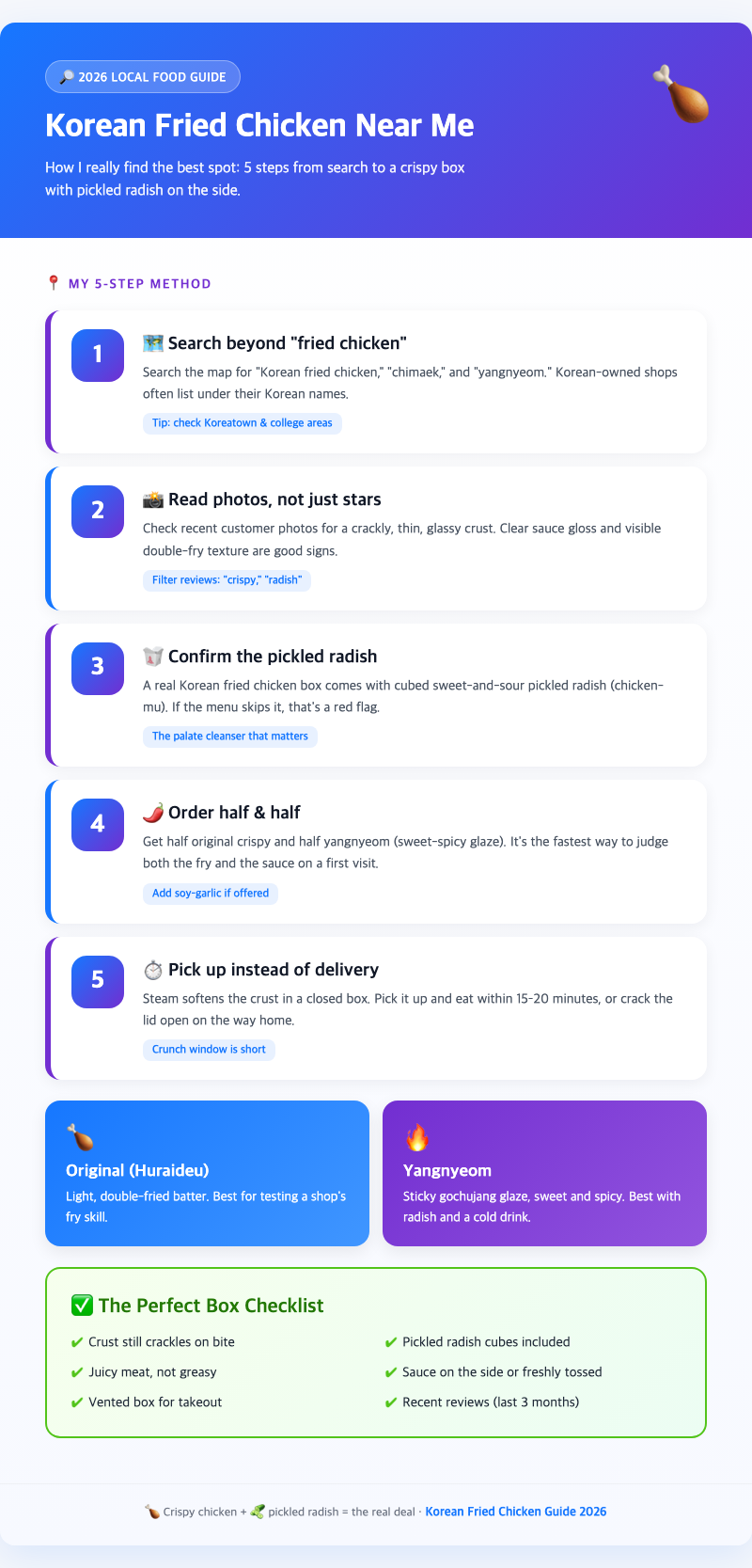
How to Find Korean Fried Chicken Near Me: What You Need First
Before you open a single app, sort out a few basics. This isn’t complicated, but skipping it is how people end up with a ₩22,000 box of disappointment. I know because I’ve done it several times.
Here’s what you need:
- A map app with real reviews. In Korea, use Naver Map or KakaoMap, because Google Maps is patchy here. Abroad, Google Maps and Yelp are fine.
- About 30–40 minutes. Good Korean chicken is fried to order. If a place promises it in 8 minutes, be a little suspicious.
- A budget. In Seoul a whole chicken from a major chain now runs about ₩20,000–₩25,000 (roughly US$14–18), plus a ₩3,000–₩5,000 delivery fee. In the US, a Bonchon or bb.q order for two usually lands somewhere around US$25–40 depending on the city, so check your local menu.
- At least one other person. A whole chicken for one is a bold choice. I respect it, but I don’t recommend it.
- Optional: a beer, or a cola if you don’t drink. We’ll get to why in Step 7.
One honest caveat. I’m writing from Seoul, so my strongest opinions come from Mapo-gu. The rules travel well, but your local Korean shop in Manchester may do things its own way, and sometimes that’s a good thing.
Somi’s rule: give yourself time and a second person, because rushed chicken is almost always worse chicken.
Step 1: Learn the Four Main Styles Before You Search
Learn the styles first, because “Korean fried chicken” isn’t one dish. It’s a family of dishes. When I first moved to Hongdae in 2021, straight out of college, I ordered yangnyeom every time because it was the only word I trusted. I missed out on a lot of good chicken that year.
Here’s the short version. Food writers usually credit sweet-spicy yangnyeom sauce to chef Yun Jong-gye in the early 1980s. Soy garlic became a chain standard after Kyochon, founded in 1991, built an empire on it. The plain fried style, huraideu (the Korean pronunciation of “fried”), is older and simpler, and I think it’s the real test of any shop.
| Style (Korean name) | What it tastes like | Best for | Chain famous for it |
|---|---|---|---|
| Huraideu (후라이드) | Plain, crackly, lightly salted, juicy inside | Testing a new shop’s frying skill | bb.q Golden Olive |
| Yangnyeom (양념) | Sweet, sticky, gently spicy gochujang glaze | First-timers, kids, beer | Pelicana, Mexicana |
| Ganjang / soy garlic (간장) | Salty-sweet, thin glaze, stays crisp longer | Delivery, because it holds up best | Kyochon, Bonchon |
| Padak (파닭) | Fried chicken buried in shredded spring onion and tangy sauce | People who want something fresh with the grease | Many independent hofs |
The practical tip for today: when you search, search the style, not just the category. “Soy garlic chicken” or “yangnyeom chicken” gives you shops that know what they’re doing. “Korean food” gives you a bibimbap place with three wings on the menu.
The common mistake is judging a whole shop by its sauce. Sauce hides a lot. A badly fried, slightly greasy piece of chicken can taste fine under yangnyeom. Under nothing, it can’t hide.
Somi’s rule: if you want to know whether a shop can actually fry, order the plain one.
Step 2: Search With Better Words Than “Near Me”
Type better search terms, because “near me” searches mostly reward whoever pays for ads and has the most reviews. Every time I’ve helped visiting friends, the top result was usually a big chain. Chains aren’t bad, but they’re only the start of the list.
Here’s how to search instead:
- In Korea: open Naver Map and type 치킨 (chikin) plus your neighborhood, for example “연남동 치킨”. Then sort by reviews, not distance.
- Abroad: search “yangnyeom chicken”, “Korean hof” or “chimaek” on Google Maps. A hof is a Korean pub, and hofs often fry better chicken than restaurants that only do chicken as a side.
- Scan the photos, not the stars. Look for customer photos of the cross-section of a piece. You want a thin, bubbly, blistered crust, not a thick bready shell.
- Check the review language. Reviews that say “crispy even after 30 minutes” or “ordered it again” are worth more than any number of “so good!!” posts.
My strong, slightly unpopular opinion: don’t trust a 4.8-star rating. On Korean delivery apps, shops sometimes trade a free side for a review, so ratings get pushed up. The same thing happens on Yelp and DoorDash in other ways. A 4.3 with long, specific, slightly grumpy reviews is usually more honest.
It’s a lot like most “5am Seoul morning routine” videos. I make lifestyle content, and I’ll say it: most of them are staged. The light is perfect, the apartment is spotless, and nobody shows the rent. A five-star chicken photo is staged the same way. Pull the camera back and look at the actual box.
For a broader look at eating out here, my double-fried Korean chicken recipe for home cooks, including the batter ratio I finally got right after three greasy attempts.
Somi’s rule: half-half tells you more about a shop than any review will.
Step 6: Dine In When You Can, and Vent the Box When You Can’t
Eat it at the shop if you possibly can, because steam destroys the crust. This is the step that taught me the most, mostly by failing at it.
My failure: two summers ago, during monsoon season, I ordered a full yangnyeom chicken to my place at 11pm. Rain was hammering down and the rider took 45 minutes. I opened the box to what I can only describe as chicken soup in a glaze. The crust was gone. I was angry at the shop for a week, but it wasn’t their fault. Steam trapped in a closed cardboard box for 45 minutes will do that to any fried chicken in the world.
Here’s what actually helps with delivery:
- Choose soy garlic or plain for delivery. Thin glazes and dry crusts survive. Thick yangnyeom gets soggy fastest.
- Order from close by. Under 2km is my rule, ideally under 15 minutes of riding.
- Open the box the second it arrives and tilt the lid open. Let the steam out before you even get the drinks.
- Ask for sauce on the side if the shop allows it. Many Korean shops do (양념 따로, yangnyeom ttaro).
- Avoid rainy rush hour. Delivery fees often jump by ₩1,000–₩3,000 in bad weather anyway.
Dining in is a different experience. Hongdae is a lot louder than Instagram makes it look, and the hofs around Hongik Univ station exit 9 on a Friday are full of shouting, clinking glasses and music from the street buskers. If you want a calmer chicken night, walk ten minutes into Yeonnam-dong. The shops are smaller, quieter, and they often have a couple of tables out front where you can actually hear your friend.
Somi’s rule: fried chicken loses crunch every minute it spends in a closed box, so eat it fresh or open the lid straight away.
Step 7: Pair It Right and Rescue the Leftovers
Pair your chicken with something cold and fizzy, because the carbonation and the sour radish are there to cut the fat. This pairing even has a name: chimaek, a mash-up of chikin and maekju (beer). Daegu holds a whole chimaek festival every summer.
What I actually drink with it:
- Cass or Terra draft at a hof, about ₩5,000 for 500cc in Mapo-gu now.
- Cola or Chilsung Cider if I’m working the next day. Many shops throw in a free 1.25L bottle with delivery.
- Barley tea, which is underrated, cheap and very good for cutting grease.
I think about this a lot: the cheapest thing on the table, the free radish, does the most work. Its vinegar resets your mouth between pieces. Without it, you’ll tap out around piece five.
Now, leftovers. Never microwave them. Here’s the method:
- Leave the chicken at room temperature for 10–15 minutes first.
- Air-fry at 180°C (356°F) for 4–5 minutes for plain chicken.
- For sauced pieces, use 160°C for 5–6 minutes so the sugar doesn’t burn.
- Rest 1 minute before eating so the crust firms up.
아침에 일어나서, with leftover chicken in the fridge and an air fryer on the counter, I’ll admit it has been breakfast more than once.
If you’re abroad and want sauces at home, gochujang from CJ or Sempio and a bag of Beksul fried chicken powder are easy to Korean street food guide for your next snack night. Last reviewed: 2026.