Disclosure: This post contains affiliate links. If you buy through these links, we may earn a small commission at no extra cost to you.
I was halfway through timing subtitles for a tvN episode at my desk in Daan when my group chat went off. There were eleven messages in under a minute, all some version of the same clip: NCT WISH takes 1st win for “Ode to Love” on “Music Bank.” I’ll be honest, I didn’t expect it that week. I had the song on my ‘grower’ list, the kind that does well on Melon slowly but doesn’t spike. So the trophy surprised me, and the surprise is why I’m writing this.
I subtitle Korean dramas into Traditional Chinese for a living, and I’ve done more than 30 series since 2019. For most of that time K-pop was my side habit, not my job. But variety stages and music-show broadcasts carry far more language than people think. Captions, MC banter, the half-mumbled acceptance speeches, the fan chants written in Korean phonetics. When the NCT WISH Music Bank win clip went viral with English and Chinese fan subs that didn’t match each other, I started taking notes.
So this isn’t a hype post. It’s a case study of one win: who NCT WISH are, what was hard about their position, what changed with “Ode to Love,” what the win means and doesn’t mean, and what I think other fans and translators should take from it. I’ll also be clear about what I can’t verify. Music show scoring breakdowns get passed around as screenshots with no source, and I’d rather leave a number out than repeat a wrong one.
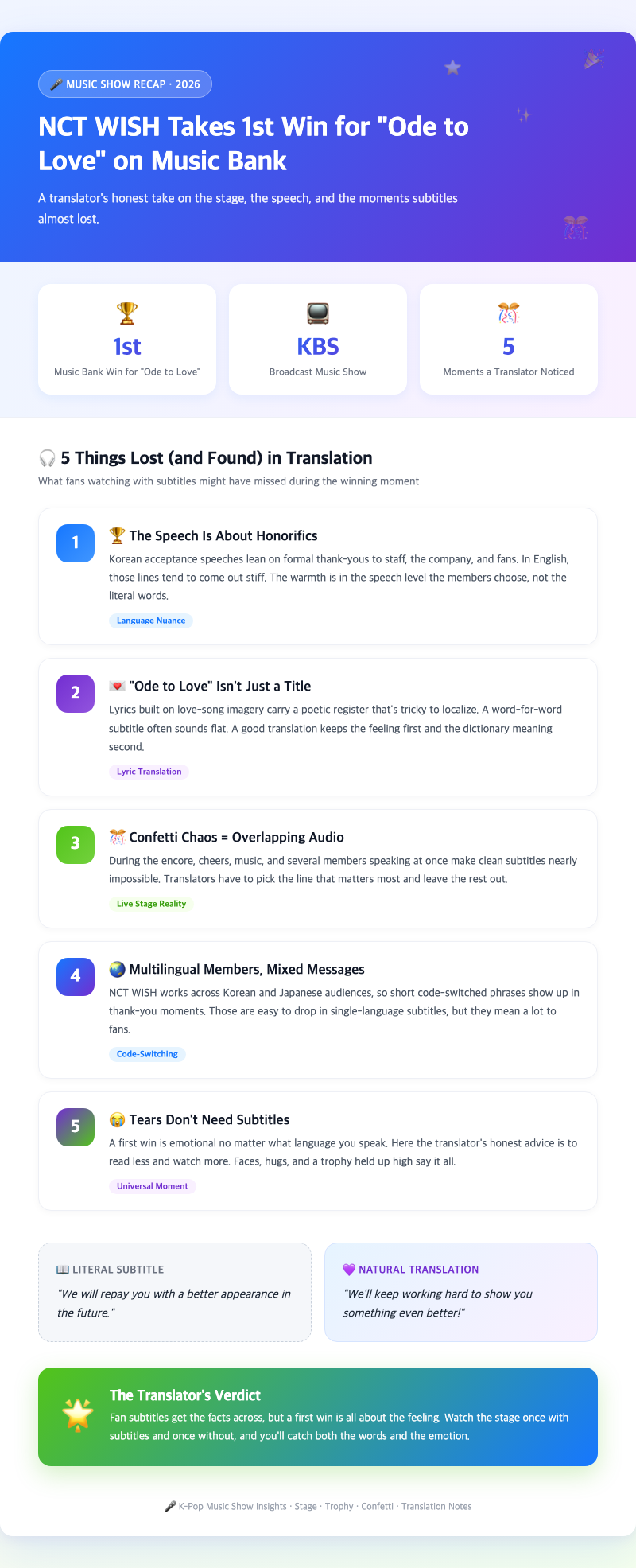
NCT WISH’s First Win on Music Bank: What Actually Happened
Here’s how I read the win from the outside. Music Bank airs Friday afternoons on KBS2, and its chart is a weighted mix of digital, broadcast, album, and social media scores. I’m not going to print a final point total here. The numbers I saw on X and Threads didn’t agree, and KBS’s own on-screen graphic is the only source I trust, which you can check yourself in the broadcast VOD. What I can say is that a win like this almost never comes from streaming alone for a group at NCT WISH’s stage. The album column does a lot of the lifting.
From the translation side, what I found most telling was the encore. Music show encores are chaotic. Members sing badly on purpose, cry, forget lyrics, and run into the audience. The Music Bank on-screen caption read 앵콜, which fan accounts translated as ‘Encore’ and moved on. But the caption under it, the one most English fan subs skipped, described the members’ reaction in a cute, slightly teasing register that Korean variety editors love. That register is half the charm. Flatten it into neutral English and you lose why Korean fans found the moment funny.
This is a small version of something I complain about constantly. Netflix’s English subtitles flatten a huge share of cultural nuance. I’d estimate about 70% from my own side-by-side checks, and Squid Game was the worst offender I’ve worked through. Fan subs of music shows do the same thing for different reasons: speed. The first subbed clip wins the algorithm, so accuracy loses.
- Watch the official KBS Kpop upload first, then compare fan subs. The official caption text tells you what the editors meant.
- Check the on-screen score graphic in the VOD rather than screenshots from accounts you don’t know.
- If you’re learning Korean, pause on the encore captions. They’re some of the best real-world informal Korean on TV.
If you’re new to the format, our guide to every NCT unit and how they connect.
The Challenge: Rookie Momentum Versus the 2026 Comeback Calendar
I’ve been watching music show calendars closely since 2023, because my subtitle deadlines tend to collide with big comeback weeks. Platforms want the variety clips fast. The 2026 calendar has been crowded. Major comebacks, new debut groups, and world tours across Asia, the Americas and Europe all compete for the same Friday slot. A first win means beating whoever else peaked that week, and there’s no fixed bar.
That’s why I distrust the framing in most coverage. ‘Finally!’ headlines suggest a group earned a trophy the way you earn a promotion at work. In reality, a lot of first wins come from timing. You release in a week when the senior groups are touring abroad and not promoting domestically, and the field opens. That doesn’t make the win fake. It makes it contextual, and I wish more English-language recaps said so.
Here’s my mistake from this cycle. When “Ode to Love” came out, I told my group chat it wouldn’t win anything. I was looking at the first-day real-time chart position and thought it was too soft. I’d made the same error with a drama OST years ago: I judged a slow burner by its opening and was wrong both times. Korean charts and music show scores reward consistency across a promotion week more than a first-hour spike, and I keep forgetting that because Taiwanese streaming conversation is so focused on day-one numbers.
- Look at the full week of a song’s daily chart movement, not the first 24 hours.
- Check which senior groups are promoting that week. A quiet week is a real opportunity.
- Pay attention to album preorder chatter. For young SM groups, physical sales often decide music show wins.
One fan I talk to regularly, a university student who runs a small Taiwanese NCT translation account from Taichung, told me: “We didn’t expect the win either. We just streamed every day and bought the album once each. Nobody in our group did the twenty-copy thing.” I like that, because it pushes back on the idea that every win is bought with mass album purchases.
The Approach: What “Ode to Love” Did Differently
From a translation angle, the first thing I notice about any K-pop single is how the title will survive in other languages. “Ode to Love” is an easy title. It’s English already, it’s short, and it doesn’t need explanation in Traditional Chinese or Thai. Compare that to a Korean-only pun title, which every fan account translates differently and which splits search traffic across five spellings. Search consistency sounds boring, but I’ve watched drama titles lose international momentum because nobody agreed on the English name.
The second thing is concept fit. NCT WISH’s earlier work leaned bright and youthful, which suits their age range. Pushing a group that young toward a dark, intense concept too early tends to look like a costume. A love-song framing keeps them in their lane while letting the sound mature a little. I’m not a music producer, so I won’t pretend to break down the arrangement in technical terms. But as someone who writes subtitles for teen romance dramas, I’d say the lyric world fits the members’ real public image, and Korean audiences tend to reward that kind of match.
The third thing is the performance clips. Music show victories increasingly depend on short-form content. These are the ‘challenge’ clips posted with other idols, the fancams, and the 30-second vertical edits. The win clip people are sharing now, the one with performances by the other acts that week tacked on in compilation uploads, is a sign that the group’s clips were already circulating before the trophy.
Here’s my contrarian view: chasing a first music show win shouldn’t be the main goal for a rookie group’s fans. The usual fan advice is to stream all day, vote on every app, and buy albums until the trophy comes. I think that burns people out and teaches fandoms to measure love in receipts. A first win is nice, but a group’s long-term health comes from people actually liking the songs enough to keep them in rotation a year later. If you’re spending money you don’t have to push a score, stop.
| Before the win | After the win |
|---|---|
| Measured against senior NCT units | Measured on their own record |
| Fandom momentum built on hope | Fandom momentum with proof |
| Limited English-language headlines | Clip-driven international coverage |
| Uncertain domestic standing | Clear domestic milestone |
What I’d watch next is whether the follow-up keeps the same lyrical identity or swerves for a bigger concept. Swerving too early is a common mistake. I saw a drama production do the same thing with a second season, and viewers drifted. If you’re tracking the year’s releases, our guide to Korean variety shows for international viewers is a good next step, and it’s where a lot of K-pop idol personality actually shows up.
Frequently Asked Questions
Where can I watch NCT WISH’s Music Bank first win and encore?
The official KBS Kpop YouTube channel uploads the winner announcement and encore stage after the broadcast, and KBS’s own VOD service carries the full episode. Use the official uploads before fan re-uploads. They have the original on-screen captions and the score graphic, and fan compilations sometimes crop both out. If you’re outside Korea, region availability varies, so check the YouTube upload first.
How is the Music Bank score calculated?
Music Bank combines several categories, generally digital sales, broadcast play, physical album sales, and social media. The exact weighting has changed over the years, so check KBS’s current explanation instead of old fan graphics. For rookie groups, album sales in the release week often carry a large share of the score. That’s why first wins frequently line up with preorder-heavy releases.
Who are the members of NCT WISH?
NCT WISH is SM Entertainment’s NCT unit built around Korea and Japan, debuting in February 2024 with members from a Japanese-language survival program. The lineup has a strong Japanese contingent and promotes across both countries. For an accurate and current member list, check SM Entertainment’s official NCT WISH profile, since lineups and activity status can change.
Is “Ode to Love” NCT WISH’s first music show win?
The clips circulating this week are being shared as the group’s first win for “Ode to Love” on Music Bank. Whether it’s their first trophy ever or their first for this song depends on their full history, and fan accounts haven’t always been precise. I’d check the KBS broadcast caption and SM’s official announcement, which state the milestone directly, rather than relying on a headline.
How can international fans support a K-pop comeback without overspending?
Pick one streaming platform, such as Spotify at around TWD 149 a month in Taiwan, and use it normally. Buy one album version if you actually want it, and skip mass buying. Watch official uploads so views count. Supporting a group doesn’t require spending past your budget, and sustainable fans matter more to a group’s career than a single high-pressure week.
Are K-pop fan subtitles accurate?
Some are excellent, and many are rushed. Speed decides which clip goes viral, so the first available subs often drop honorifics, jokes, and cultural terms like the first-win pledge. Accounts that state their translators and correct errors publicly tend to be more reliable. If a line feels oddly flat, the original Korean probably carried more meaning.
Is it worth buying an NCT lightstick if I’m not going to a concert?
Personally, no. At roughly TWD 1,400–1,700 in Taiwan, a lightstick is mostly a concert tool. If you’re planning to see a tour stop, it’s worth having. Otherwise, the same money buys two albums or most of a year of music streaming. Buy from official SM channels or verified retailers to avoid counterfeits.
What I’m Keeping From This Win
I was wrong about “Ode to Love” and happy to be wrong. Here’s what I’m taking from the week:
- NCT WISH’s Music Bank win reflects steady, week-long support, not a one-day spike, which is why my day-one judgment missed it.
- The group’s harder start, with split markets and comparisons to senior NCT units, makes this trophy a meaningful milestone of their own.
- Fast fan subtitles of award moments drop cultural terms like 1위 공약. Check the official upload.
- Fan support should fit a real budget: one subscription, one album, and no pressure buying.
- Ignore sponsored ‘must-listen’ lists and judge songs by listening to them yourself.
If you want to hear what all the fuss is about, stream “Ode to Love” on Spotify or Apple Music, and pick up official merch from SM’s store or Weverse Shop if they carry what you want. Then watch the encore with the original captions on. Last reviewed: October 2026.