Disclosure: This post contains affiliate links. If you book through them, I may earn a small commission at no extra cost to you. It doesn’t change what I recommend, and I say so below when I think a product is overpriced.
Most Seoul travel guide articles I read before my first trip in 2016 were written by people who went once, stayed in Myeongdong and rode a tour bus. I’ve now been to Korea nine times, and this Seoul travel guide is the one I wish someone had handed me at Changi. Look, here’s the deal: on that first trip I spent about SGD 1,900 for six days. On my ninth trip this year I spent about SGD 1,150 for seven days and ate better. The city didn’t get cheaper. I just stopped making the same mistakes.
For context, I’m Marcus. I’m 36, I live in Tampines, and I quit banking in 2022 to write about travel full time at junglemoves.sg. I speak survival Korean, enough to order, haggle a little and apologise when I get on the wrong bus, which has happened. I hate tour buses. I log every trip in a Notion database: every fare, every meal and every top-up. Most of the numbers below come from there, not from memory.
Korea had roughly 16.4 million foreign visitors in 2024, according to the Korea Tourism Organization, and it often feels like all of them are standing in the same five spots. This list is about getting out of that crowd without missing what makes Seoul worth the six-and-a-half-hour flight. I picked these seven moves on three criteria. They have to save real money, cost little or no extra time, and get you somewhere Seoul residents actually spend their weekends. If you’re flying from Singapore or Malaysia, the prices are in SGD and KRW. US and UK readers will find USD alongside.
1. Book Your Seoul Flight on a Tuesday Afternoon
If you’re flying from Singapore, the flight is the biggest single line on your budget, so start there. Across my last four trips I logged Skyscanner searches for Singapore to Incheon at different times of the week. Tuesday afternoon, roughly 2pm to 5pm Singapore time, kept giving me the lowest return fares. My guess is that this is when airlines reprice after the weekend rush of searches. I can’t prove the mechanism, but the pattern has held often enough that I now set a calendar reminder.
Real numbers from my log: a Scoot return SIN–ICN in shoulder season (mid-March, late October) came up at SGD 380–460 on Tuesday afternoons. The same dates searched on a Saturday morning were SGD 470–540. Full-service carriers like Singapore Airlines and Korean Air usually sat at SGD 750–1,000 return in the same weeks. That’s roughly USD 560–750. For US or UK readers, the same rule seems to apply to transpacific fares, though I’ve tested it less.
My mistake: on trip three I booked on a Sunday night because I was excited, and I flew out on a Friday. I paid SGD 610 for a budget carrier with no checked bag. Then I paid another SGD 70 at the counter when my bag came in 4kg over because of K-beauty shopping. Skip that. Here’s what I do now:
- Set a Skyscanner price alert for your dates and check it on Tuesday afternoons.
- Fly out Tuesday to Thursday. Weekend departures from Changi carry a clear premium.
- Buy the checked bag when you book, not at the airport. On Scoot that difference has been SGD 30–50 for me.
- Arrive at Incheon in the morning so you don’t pay for a hotel night you barely use.
The trade-off: the red-eye Scoot arrivals at Incheon around 6am are the cheapest. But you’ll be a zombie until check-in, and honestly, at that price I’ve accepted that the first half-day is a write-off. If you can’t function on airplane sleep, pay the extra SGD 60 for a daytime flight. You can the Korea travel apps I actually use, Naver Map and KakaoT included. Google Maps walking directions in Seoul are still unreliable.
3. Eat at Mangwon Market, Not Myeongdong
Myeongdong is for first-timers. I say that without contempt, because I was one, and the first time I saw that street-food strip at night I loved it. But look at the prices with a banker’s eye. A skewer of grilled lobster tail for 15,000–20,000 KRW (SGD 14–19), egg bread at 3,000 KRW, and cheese-pull hot dogs priced well above what you’d pay elsewhere in Seoul. Some of the cosmetics shops on the main drag mark up hard against the same products at Olive Young two streets away. In one comparison I logged, a sheet-mask bundle was nearly triple the price.
Mangwon Market is where Seoul residents actually eat. It’s a ten-minute walk from Mangwon Station on Line 6, one stop from Hapjeong, so you can easily pair it with Hongdae. On my last visit in March I ate a full lunch for under 15,000 KRW (about SGD 14, USD 10). I had a cup of sweet-spicy dakgangjeong (crispy fried chicken bites) for around 7,000 KRW, a hotteok for 2,000 KRW, and croquettes from one of the many fried-snack stalls at a few thousand won each. Prices are on handwritten signs, aunties shout at you in a friendly way, and nobody is trying to sell you a 20,000 KRW lobster.
A few practical tips from my Notion notes:
- Go between 11am and 1pm on a weekday. On weekends after 3pm the main lane is shoulder to shoulder.
- Bring cash. Most stalls take cards now, but the small ones like cash, and it’s faster.
- Walk five minutes past the market to Mangwon Hangang Park and eat your haul by the river. That’s the local move.
- Learn ‘igeo juseyo’ (this one, please). Pointing plus that phrase gets you through any stall.
The trade-off is atmosphere at night. Mangwon winds down in the evening, and Myeongdong’s neon is genuinely fun for one walk-through. My compromise: do Myeongdong once, on your first night, eat nothing, and buy cosmetics at an Olive Young rather than the street shops. For a deeper food crawl, see my Hongdae versus Myeongdong hotels for budget travellers. Short version: Hapjeong or Mangwon gives you the best value per night. You can compare hotels on Booking.com, but check the map first, because hotels listed as ‘Hongdae’ can be a 20-minute walk from the station.
How I Picked These
This isn’t a list of the most famous sights in Seoul. You know those already. I started with nine trips’ worth of entries in my Notion travel database: 214 logged expenses, 60-odd transit journeys, and notes on every place I went back to versus every place I swore off. I cut anything that was only good on one trip, since one visit can be luck. I cut anything that needed a car, a tour bus or a group of four to make economic sense. I also cut anything I couldn’t price within about 10% from my own receipts.
What remained had to pass three tests. First, it saves real money or real time compared with the default tourist option. Second, a Singapore-based traveller with a normal annual-leave budget can do it. Third, I’d see Seoul residents doing it too. That last test is unscientific, I admit. I’m a solo traveller in my thirties who speaks survival Korean, so families with small kids or travellers with limited mobility will weigh some picks differently. The Namsan walk and the Bukchon hills, for example, are steep. I’ve flagged trade-offs where I know them, and I’ll keep updating prices as I go back.
Frequently Asked Questions
How many days do you need in Seoul for a first trip?
Five full days is the sweet spot for a first visit, in my experience. That gives you a palace-and-hanok day in Anguk, a Hongdae and Mangwon day, a Gangnam or Seongsu day, a half-day at Namsan, and one buffer day for weather or a day trip to Suwon or the DMZ. With three days you’ll rush. With seven you can slow down and add Busan via KTX, about 2.5 hours one way.
What is the cheapest month to fly from Singapore to Seoul?
In my Skyscanner logs, the cheapest fares from Singapore to Incheon showed up in early March, late May to mid-June, and November, outside Singapore school holidays and Korean public holidays like Chuseok. Budget returns dipped to around SGD 350–420 in those windows. December and the cherry-blossom weeks in early April are the most expensive, often SGD 650+ even on budget carriers.
Is the Klook Korea pass worth it for solo travellers?
Usually not. Bundled passes only pay off if you visit three or four paid attractions a day, every day, and most solo travellers don’t. On my test trip I used about SGD 80 of value from a pass that cost around SGD 115. Buy individual tickets on Klook or at the gate for the two or three attractions you actually care about, and use a T-money card for transport.
Is Myeongdong worth visiting at all?
Yes, once, as a first-timer, for an evening stroll and the neon. Just don’t eat or shop much there. Street-food prices run higher than in neighbourhood markets, and some cosmetics shops on the main drag mark up heavily. Buy skincare at Olive Young instead, where pricing is standard and tax refunds are processed in-store. Then spend your actual food budget at Mangwon or Gwangjang Market.
Do I need a K-ETA to visit Korea from Singapore or Malaysia?
Korea has run a temporary K-ETA exemption for several countries including Singapore, but rules have changed several times since 2023, and Malaysian travellers have had different requirements. Check the official K-ETA website a few weeks before you fly, not a blog. Mine included. The application, if needed, is online and normally processed within 72 hours.
Can I use credit cards everywhere in Seoul?
Almost everywhere, from convenience stores to taxis and most cafes. Visa and Mastercard work fine, and I used a multi-currency card for most purchases on my last trip. The exceptions are T-money top-ups (mostly cash), some market stalls, and small street vendors. I carry about 50,000 KRW in cash per day, and that’s always been enough.
What’s the best area to stay in Seoul on a budget?
Hapjeong and Mangwon, on Lines 2 and 6. They’re quieter than central Hongdae, walking distance to both Hongdae and Mangwon Market, and guesthouses or small hotels there often cost 20–30% less than comparable rooms in Myeongdong. Line 2 also connects directly to Gangnam and the Airport Railroad link at Hongik University Station, so getting to and from Incheon is easy with luggage.
My Final Word on Seoul
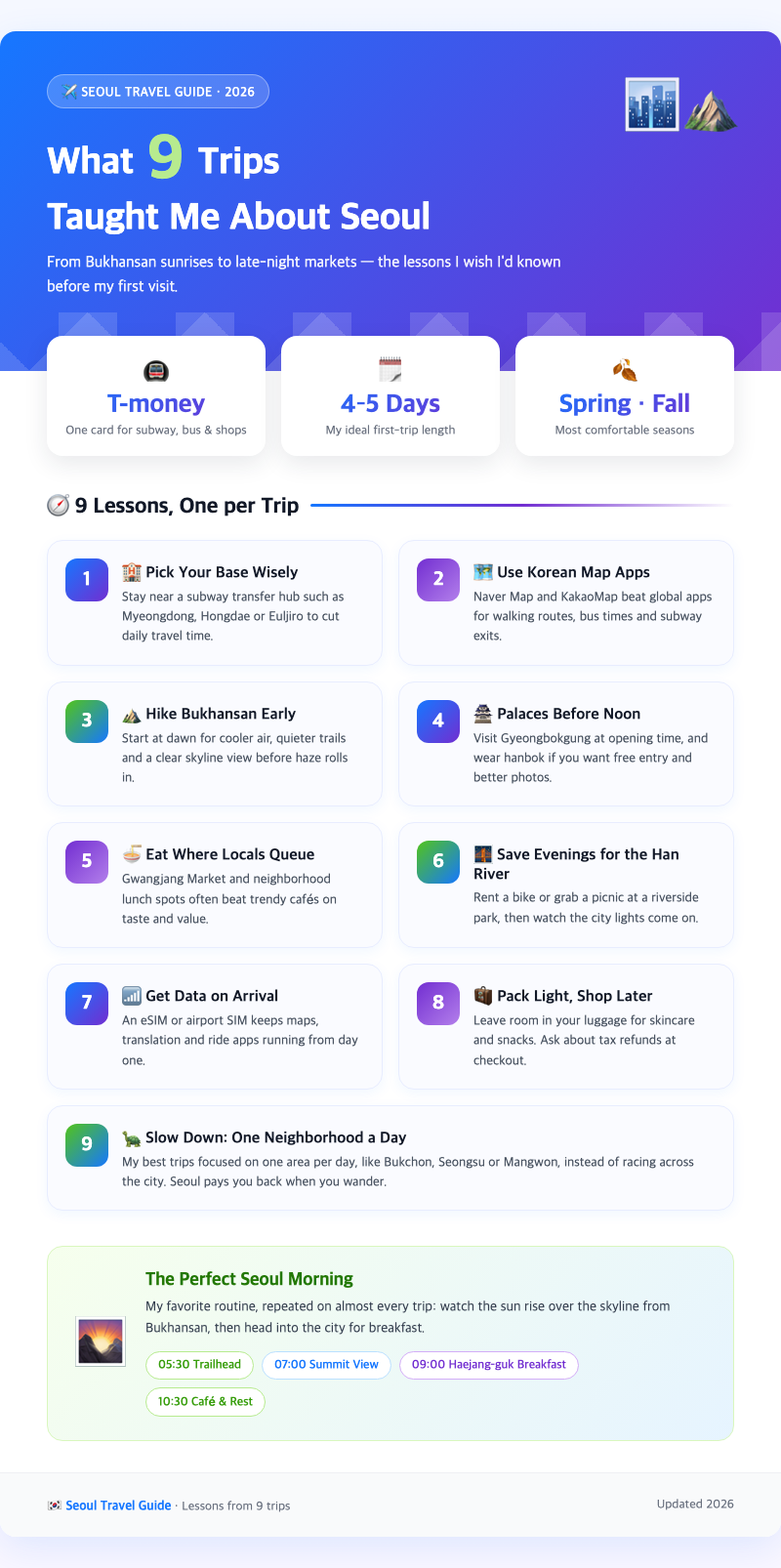
Seoul rewards travellers who move like residents: by bus and subway, eating at markets, and showing up when the crowds haven’t. Here’s what nine trips boil down to:
- Book SIN–ICN flights on Tuesday afternoons and fly mid-week. It saves SGD 60–150 on a single return.
- Use a T-money card, not a bundled pass, unless you’re a group doing paid attractions daily.
- Eat at Mangwon Market and shop Hongdae on a Saturday. Treat Myeongdong as a one-evening walk.
- Visit N Seoul Tower at 11am and save sunset for the free Namsan trail.
- Always check bus routes on Naver Map. Learn from my 20 minutes at the wrong stop in Itaewon.
If you’re planning your trip now, start with the flight: set a Skyscanner alert for your dates this Tuesday. Then read my