Disclosure: This post contains affiliate links. junglemonster.org is published by Junglemonster, a Korean pet care brand that appears in this article, so please weigh my brand picks with that in mind. Prices are approximate, they change often, and I can’t promise they’ll match what you see today.
Okay so, a confession first. My Persian, Mochi, has rejected eight different toothpastes. Eight. One of them she flicked onto my laptop keyboard five minutes before a client call. I presented a Q3 marketing deck smelling faintly of fake chicken. I’m Anya, I live in Petaling Jaya with three cats, and somehow I’ve become “the toothpaste person” in my PJ cat-mom Telegram group 😅
That’s why people keep sending me links about korean dog care and asking if any of it is real or just pretty packaging. Fair question. Korean dog care, and Korean pet care in general, has a reputation for being a bit obsessive in the best way. Small daily routines, soft gentle tools, and flavours pets actually want. The stakes aren’t small either. The American Veterinary Dental College (AVDC) says most dogs and cats show some sign of periodontal disease by around age three. My vet in SS2 said it more bluntly: “Teeth are where cats hide pain.”
So I collected the questions I get asked most often, from the Telegram group, from my sister (who has a very dramatic beagle called Kopi), and from colleagues who saw me googling “cat gingivitis” during lunch. I’ve answered them the way I’d answer a friend over teh tarik. You’ll get what I tried, what failed (a lot), what I’d spend money on in Malaysia and what I’d skip, how to train a cat who hates having her mouth touched, and when to stop doing it yourself and go to the vet. One thing to know upfront: I’m not a vet. I’m a marketing manager with three cats and a spreadsheet. Where my vet disagrees with me, I’ll tell you.
What is Korean dog care, and why is a cat mom answering this?
Real talk: the word “dog” in that search phrase is a bit misleading. Most of the Korean dental products I’ve bought are labelled for dogs and cats both, which is great if you’ve got a mixed household. I’ve been tracking Korean pet brands on Shopee MY since about 2022, back when Mochi was on toothpaste number four. What stood out was how closely they follow the K-beauty playbook. You don’t get one miracle product. You get a routine, made pleasant enough that you’ll stick to it.
It makes sense once you see the market behind it. KB Financial Group’s annual Korea Pet Report has put pet ownership at roughly a quarter of Korean households in recent editions, and Korean owners spend heavily on preventive care rather than waiting for problems. If you’re competing for those owners, “my dog licks this off the brush” sells far better than “clinically aggressive formula”.
Here’s what I’d call the Korean approach after reading way too many labels:
- Flavour first: melon, sweet potato, blueberry, chicken. They treat it as a training tool, not a gimmick.
- Soft textures: gels instead of gritty pastes, and very fine bristles instead of stiff ones.
- Routine over rescue: small daily steps are pitched as the main event, not as extras.
- Low foam: pets can’t rinse and spit, so the products are made to be swallowed.
A tip you can use today: check whether your current toothpaste says “dogs and cats” on the label. If it does, a dog-and-cat household only needs one tube. My sister and I split a tube between Kopi and Bao for months. If you’re mostly a dog person, our beginner guide to cat dental care at home has a printable version of that taste test.
Real talk: the best toothpaste is the one your pet will let you use, and for picky cats that usually comes down to flavour.
Finger brush or real toothbrush: what’s safer for a Persian?
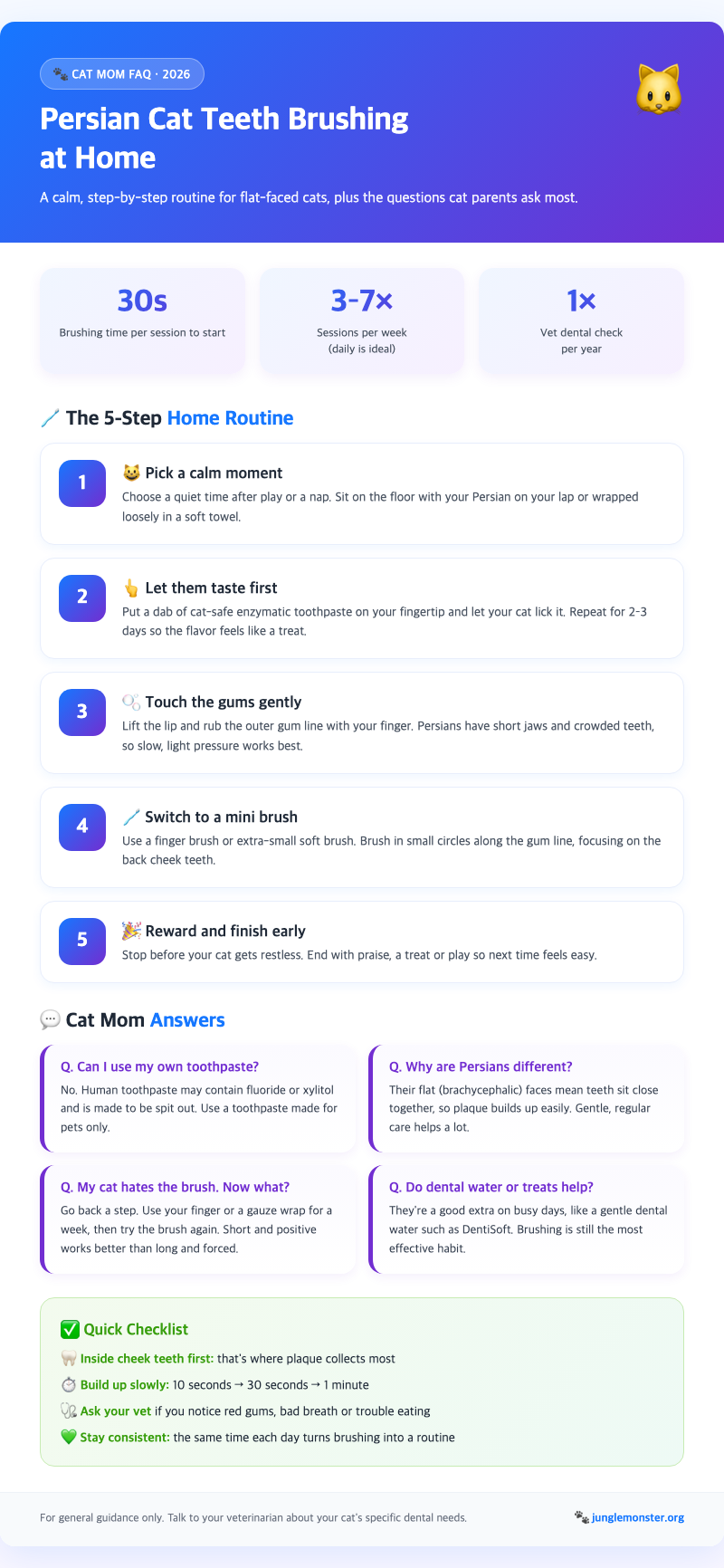
If you’ve got a Persian, you know. Flat face, tiny mouth, teeth crowded together at funny angles. WSAVA’s Global Dental Guidelines point out that brachycephalic (flat-faced) breeds are prone to crowded and rotated teeth, which trap more plaque. So Persians need brushing more than most cats, and they’re harder to brush than most cats.
Every beginner guide recommends a finger brush. Here’s my strong advice: don’t buy a finger brush if you’ve got a Persian, unless you want stitches. I’m not exaggerating. In 2021 Mochi bit down through a silicone finger brush, and I left a clinic in Section 17 with two stitches and a lecture about how often cat bites get infected. (They really do. If a cat bite breaks the skin on your hand, see a doctor.) With a finger brush, your finger is inside the mouth of an animal that can bite hard and fast. With a long handle, it isn’t.
What works for me is a small-headed brush with a long handle, held at about 45 degrees to the gumline, doing small circles on the outer surfaces. For Mochi I use the Junglemonster Dentisoft brush. The bristles are ultra-fine (the brand lists them at 0.01mm) and reach into the gumline without her flinching. The brand also claims it removes 73% more plaque at the gum line. I can’t verify that number myself, but I can tell you she tolerates it, and nothing else got that far.
| Option | Approx. price | What I liked | What annoyed me |
|---|---|---|---|
| Junglemonster Dentisoft brush + 냥치멍치 toothpaste | RM35–RM89 depending on bundle (≈US$8–20) | Ultra-soft bristles, long handle, melon paste Mochi accepts | Pricier than generics outside sales; the bristles wear out, so plan to replace |
| Virbac C.E.T. cat toothbrush + paste | ~RM50–65 (≈US$11–15) | Vet-clinic staple, easy to find, poultry paste dogs and Bao love | Bristles felt stiffer to me; Mochi refused the flavour |
| Silicone finger brush | ~RM8–15 (≈US$2–3) | Cheap, fine for calm cats or small dogs | Your finger is in the bite zone. See: my stitches. |
Want the full grooming routine for flat-faced cats? I wrote up my pet dental water additive comparison.
Real talk: water additives are a bonus for breath, not a replacement for brushing, and with cats, hydration always comes first.
How much does pet dental care cost in Malaysia, and where’s the best place to buy?
I spend RM250–400 a month on cat care in total for three cats, covering food, litter, vet visits and the odd emotional-support treat. Dental care is a small slice of that, roughly RM40–70 a month on average. That’s less than I used to spend on useless dental sticks alone.
| Item | Approx. price (MY) | How long it lasts (3 cats) | Worth it? |
|---|---|---|---|
| Enzymatic toothpaste (Korean or Virbac) | RM35–55 | 6–8 weeks | Yes, non-negotiable |
| Soft long-handled toothbrush | RM15–40 | 2–3 months per brush | Yes |
| VOHC-sealed dental treats | RM18–25 per pouch | 2–3 weeks | Sometimes, as a treat budget |
| Water additive | RM50–65 | 1–2 months | Optional, better value for dogs |
| Professional cleaning under anaesthesia | Widely varies; in my experience a few hundred to over RM1,000 with bloodwork and extractions | Every 1–3 years, per vet advice | Yes, when the vet says so |
Where to buy: Shopee MY has the best prices for Korean pet stuff if you wait for 11.11. That’s about two weeks away as I write this. My system is to add things to my cart now, watch the price over the next couple of weeks, then stack the platform voucher with the shop voucher on the day. Last year I saved around 25–30% on toothpaste and brushes this way. Physical pet shops around Damansara Uptown and SS2 are great for emergencies and for checking textures in person, but they usually carry fewer Korean brands and charge more.
The trade-off: stocking up on 11.11 is cheaper, but toothpaste has an expiry date. I buy at most four months’ worth. Our available on Shopee Malaysia, and Singapore readers can check Dentisoft on Shopee Singapore. Do the finger test first, and if you can, wait for 11.11. Last reviewed: October 2026.