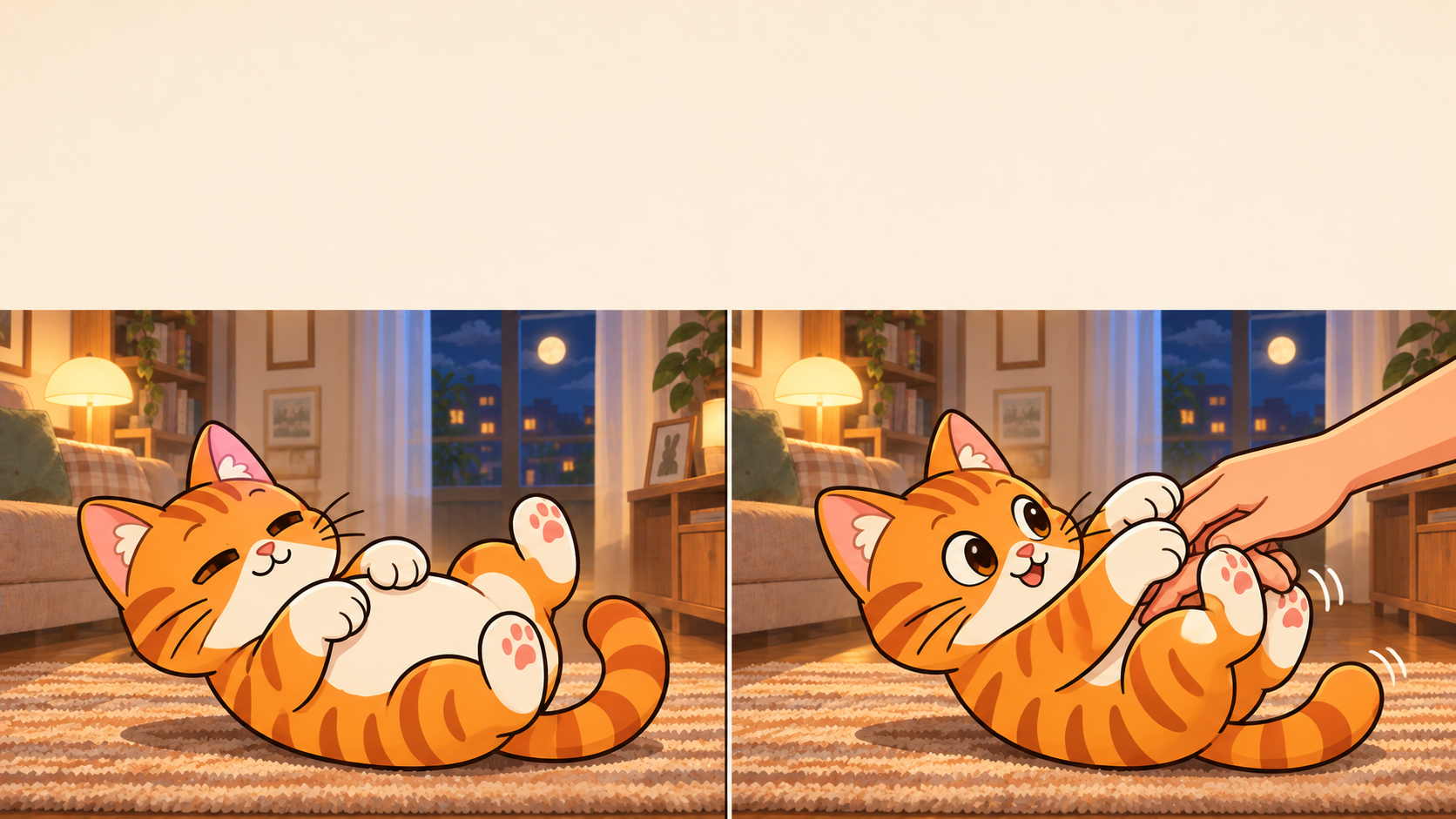
You come home, your cat flops at your feet and shows you her belly, you reach down, and two front paws clamp your hand while the back legs kick. It stings a little, in more ways than one. This guide follows episode 3 of our animated series, the Jungle Pet Encyclopedia, and checks each point against published cat behavior studies and veterinary sources.
Watch the video (9:10) · The video is narrated in Korean. If English captions are not available yet, YouTube’s auto-translated captions can help, and the key points are summarized below.
First: showing the belly may signal comfort, not a request for petting
As for why cats show their belly, it can mean your cat feels safe enough to let her guard down. The video adds that this is different from an invitation to touch her. So the video boils today’s job down to one thing: hold out a single finger and wait for your cat to decide. Video 0:19
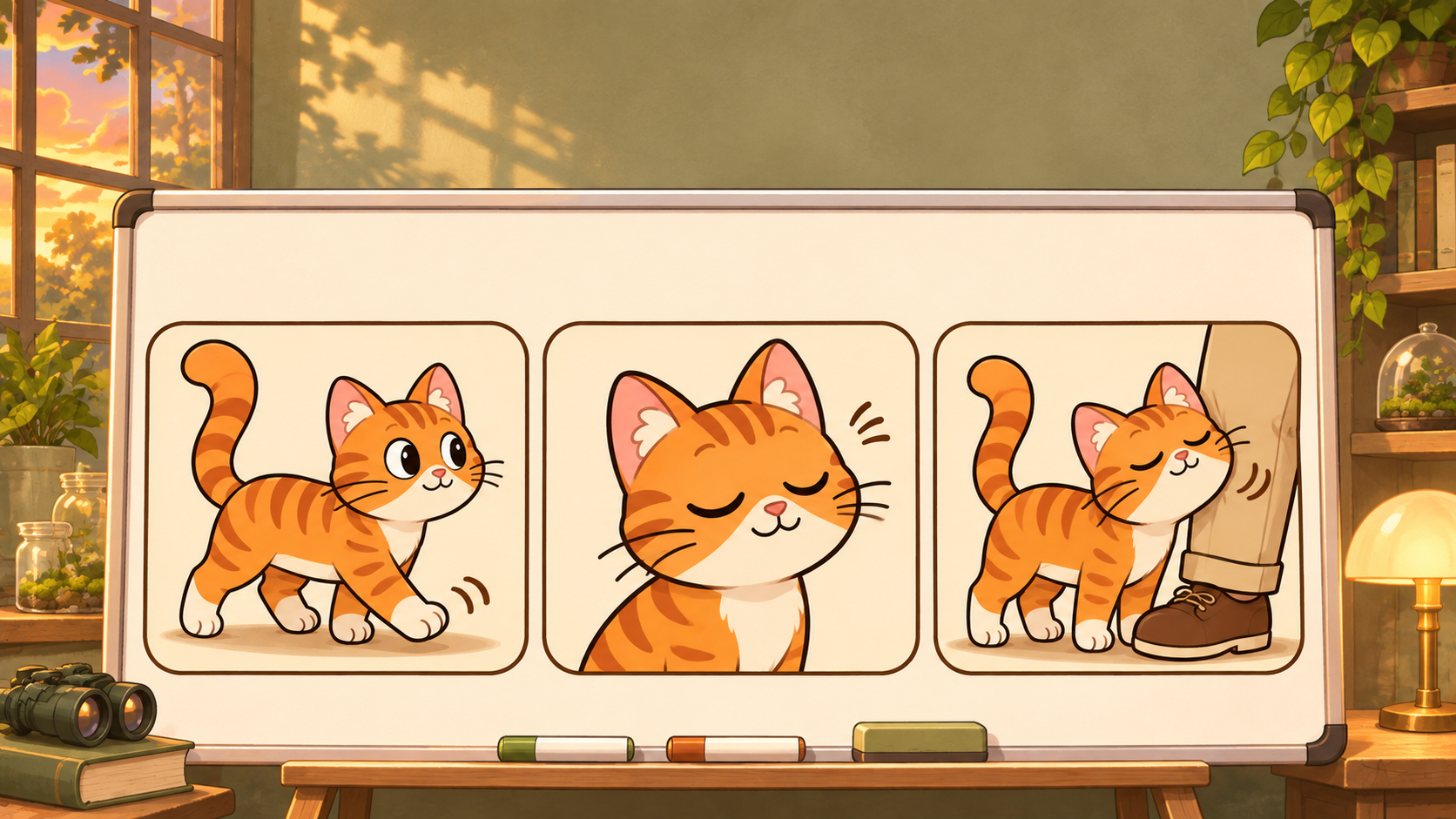
Three signals are commonly read as friendly: walking up with the tail held high, slow blinking, and rubbing her cheek on you. A study of free-ranging cats found that the tail-up posture works as an affiliative signal and often comes right before rubbing. [Source: Cafazzo & Natoli 2009, Behav Processes]
One thing to keep separate from body language: a cat going back and forth to the litter box but passing no urine needs a vet right away. [Source: Cornell Feline Health Center]
1. When you touch: why cats grab and kick
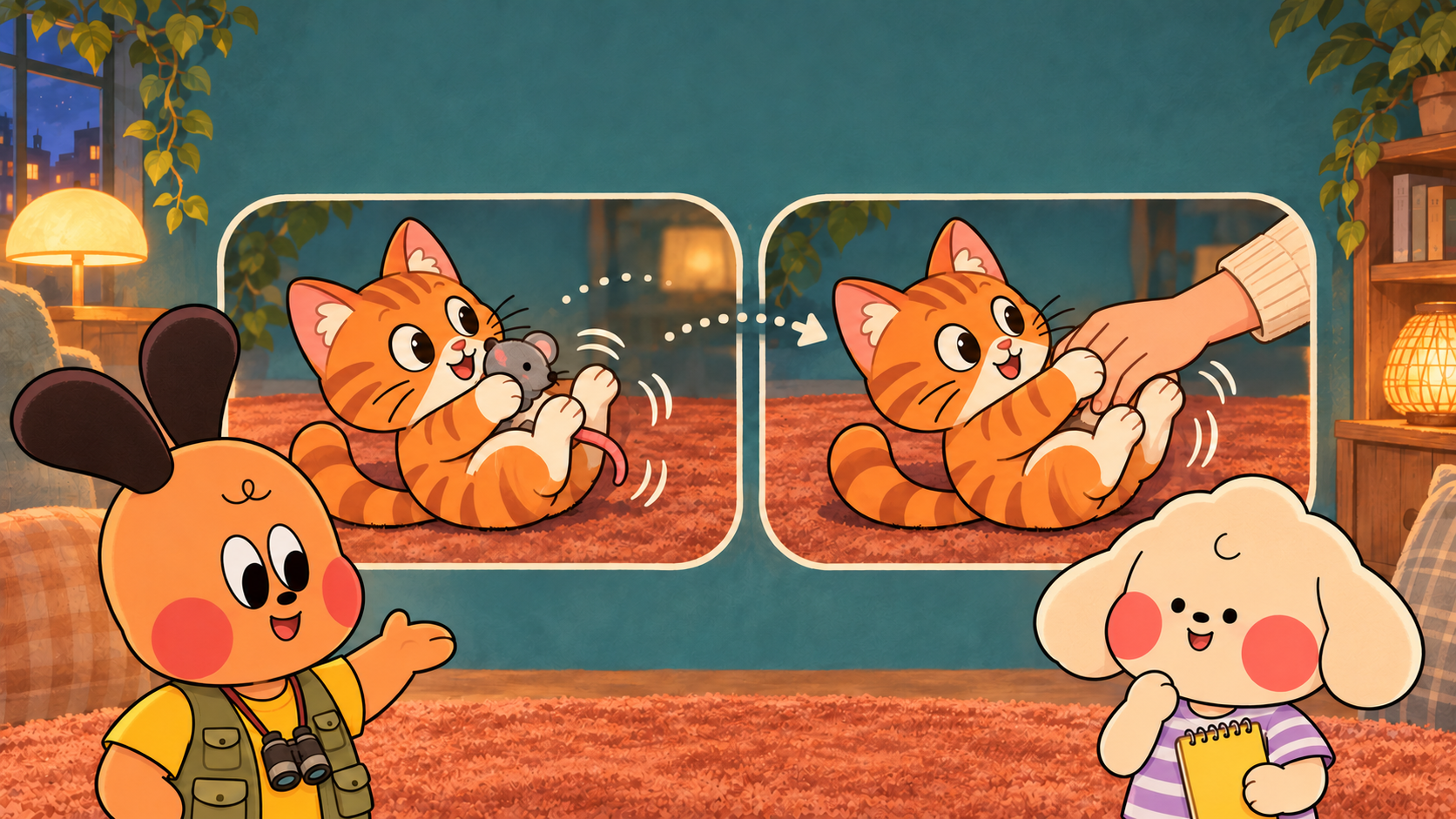
Kongi, the ginger cat in the video, is a composite case put together from several households’ stories. Before the hand landed, her tail and ears were loose. Once the palm touched her belly, the tail tip started thumping and her ears swiveled sideways. Writing it in three boxes (tail, ears, distance) shows the exact moment her mood changed. Video 1:29
Hugging with the front paws while kicking with the back legs is the same move a cat uses on a toy mouse. The belly is a vulnerable area, so a protective reaction can come out in the same shape. It is not a sign she dislikes you. [Source: International Cat Care, Playing with your cat; Handling and interactions]
What you can do
If your hand is already caught, the video’s advice is not to yank it away, since a moving hand can look like prey. Freeze, let her grip soften, then slowly slide your hand out. Skip the scolding and give her a proper play-hunt later with a wand toy, which keeps some distance between her and your hands. [Source: International Cat Care, Playing with your cat] Video 2:12
2. Where cats like to be petted, and a surprise about family
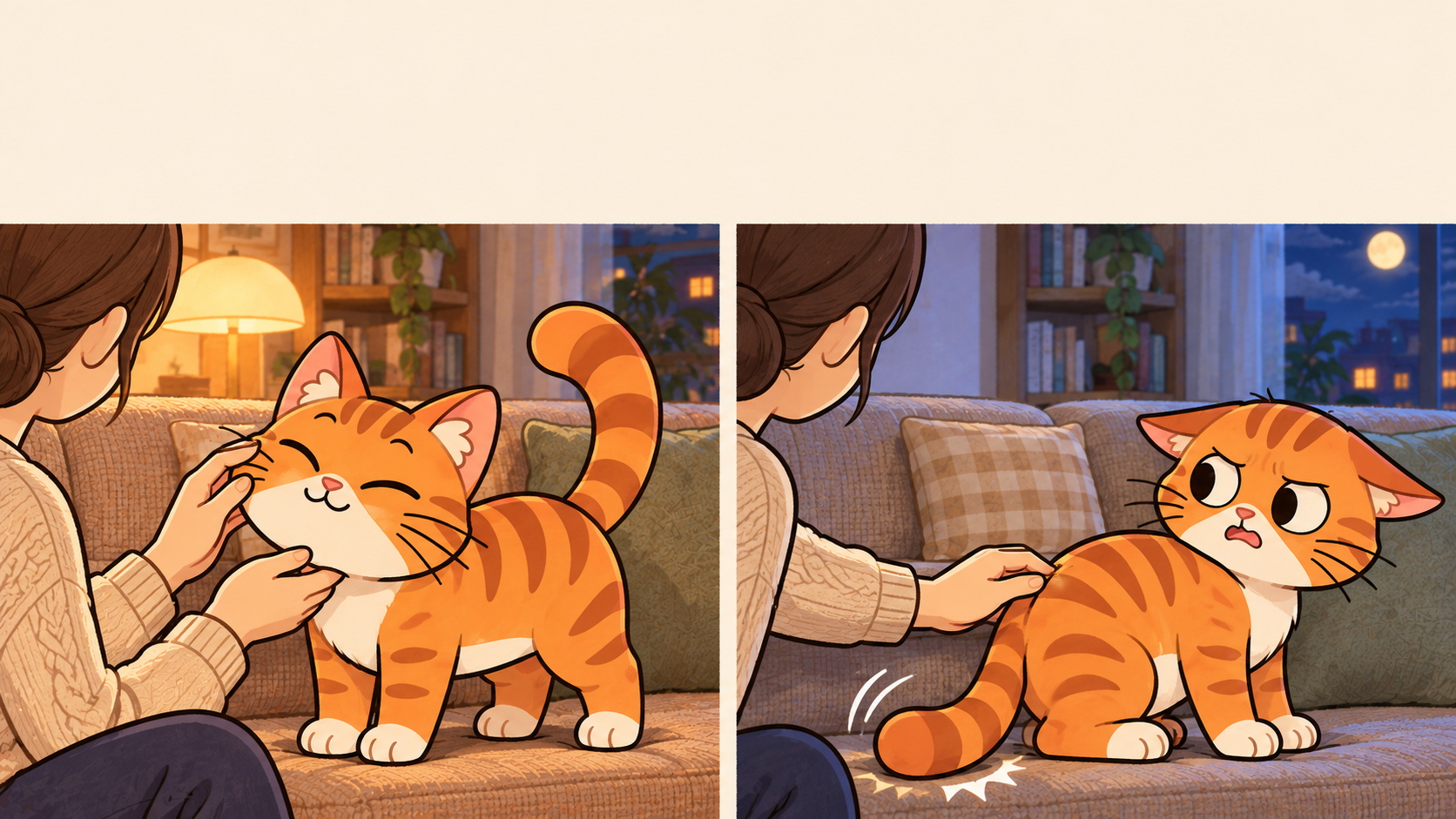
In a study where 34 cats were stroked on different body regions at home, the base of the tail drew the most negative responses. [Source: Ellis et al. 2015, Appl Anim Behav Sci] Video 2:29
The same study found more negative responses when the cat’s own owner did the stroking than when an unfamiliar person did (median negative scores 8.5 vs 5.0). Researchers haven’t pinned down why. One possibility is that people who know a cat well tend to pet longer and in more places. [Source: Ellis et al. 2015]
What to look for
In the video, a visiting friend who only offered the back of a hand got a head rub, while Kongi’s owner got kicked more often. With family, keep it short and let the cat pick the spot. The video’s advice: if your cat comes to you first, gently stroke her cheeks and chin briefly, then pause. [Source: Haywood et al. 2021]
3. Cat tail twitching and other warnings before the kick
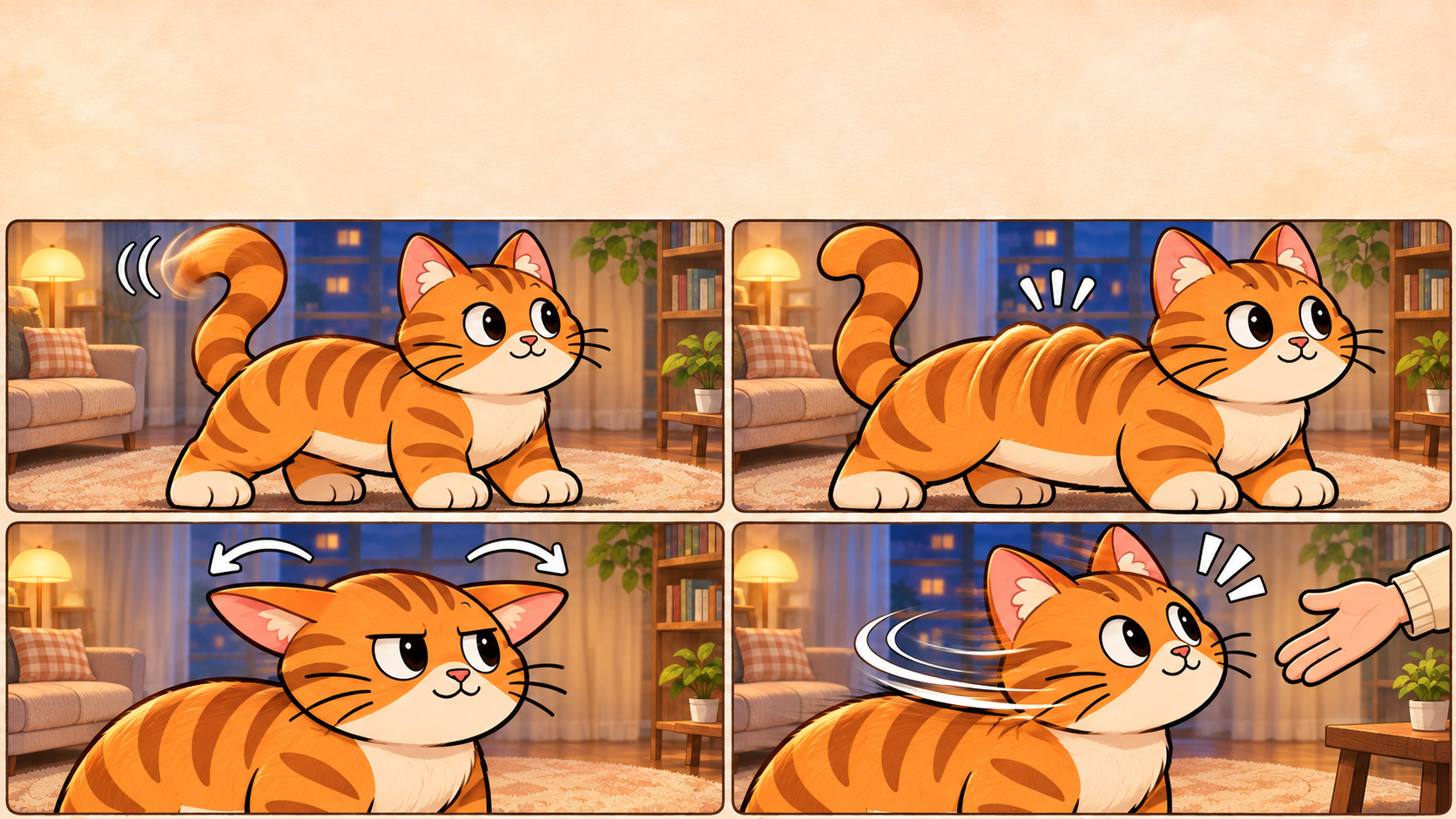
There are often warning signs before a kick. Watch for the tail tip thumping, the skin along the back rippling, ears rotating sideways, and the head whipping round toward your hand. If you see even one, stop petting right there. [Source: International Cat Care, Handling and interactions; Cat Friendly interaction] Video 3:23
And the cat who naps with her back to you? Section 6 explains why that can be a compliment.
4. How to pet a cat: start with one finger
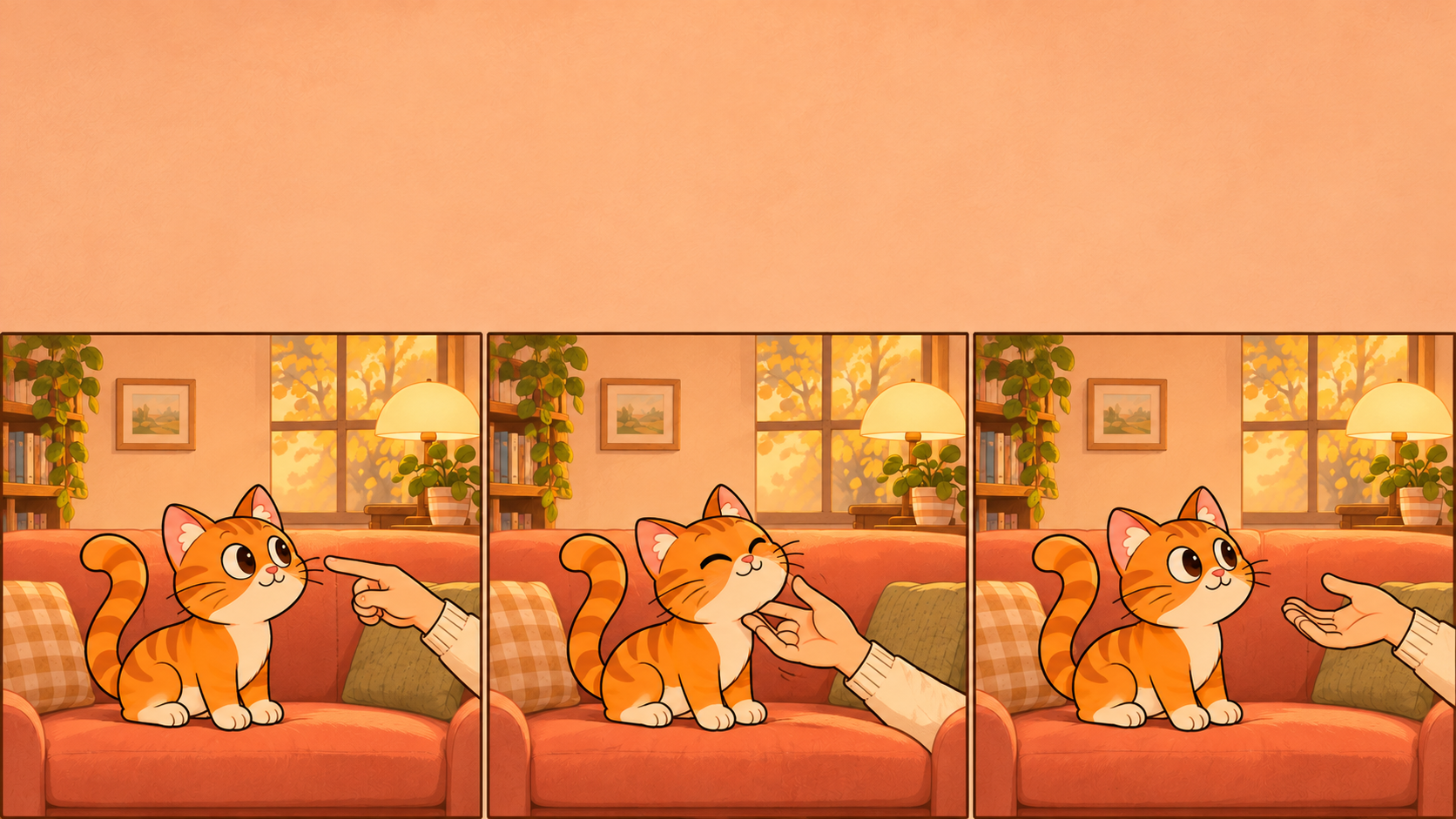
A shelter study with 100 cats and 120 people found that when people got short handling guidance first, cats approached them more and showed fewer signs of aggression and conflict. The guidance boils down to giving the cat choice and control, paying attention to her body language, and touching mainly around the head and cheeks. [Source: Haywood et al. 2021, Front Vet Sci] Video 3:44
What you can do
- Offer: hold one finger out at about nose height and wait.
- Keep it short: if she rubs against it, stroke her cheek and chin about three times, then pause.
- Ask again: if she pushes her head back into your hand, give a little more; if she walks off, that’s it for today.
If she doesn’t come over, that’s fine too. Every cat warms up at her own pace, and even belly-rub fans are happier when you pause and check in.
5. When your cat comes to you: tail up, cheek rubs and the slow blink
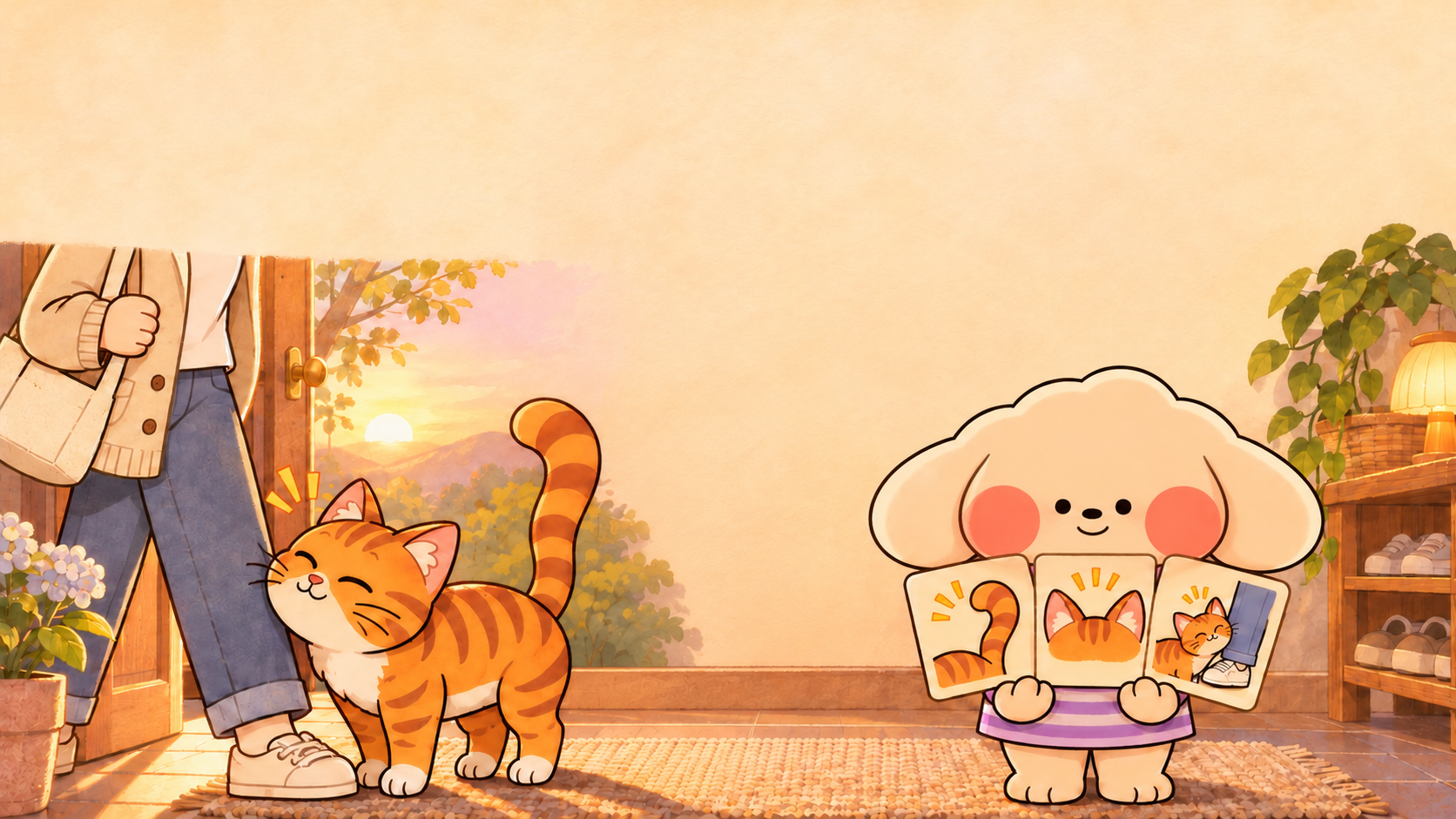
A cat trotting over with her tail up and rubbing her cheek on your leg is a happy greeting. Cheek rubbing mixes your scents, so leave your leg where it is. A puffed-up tail with the body turned sideways is different: that cat is startled, so give her space and wait. [Source: Cafazzo & Natoli 2009; International Cat Care, Cat communication] Video 4:49
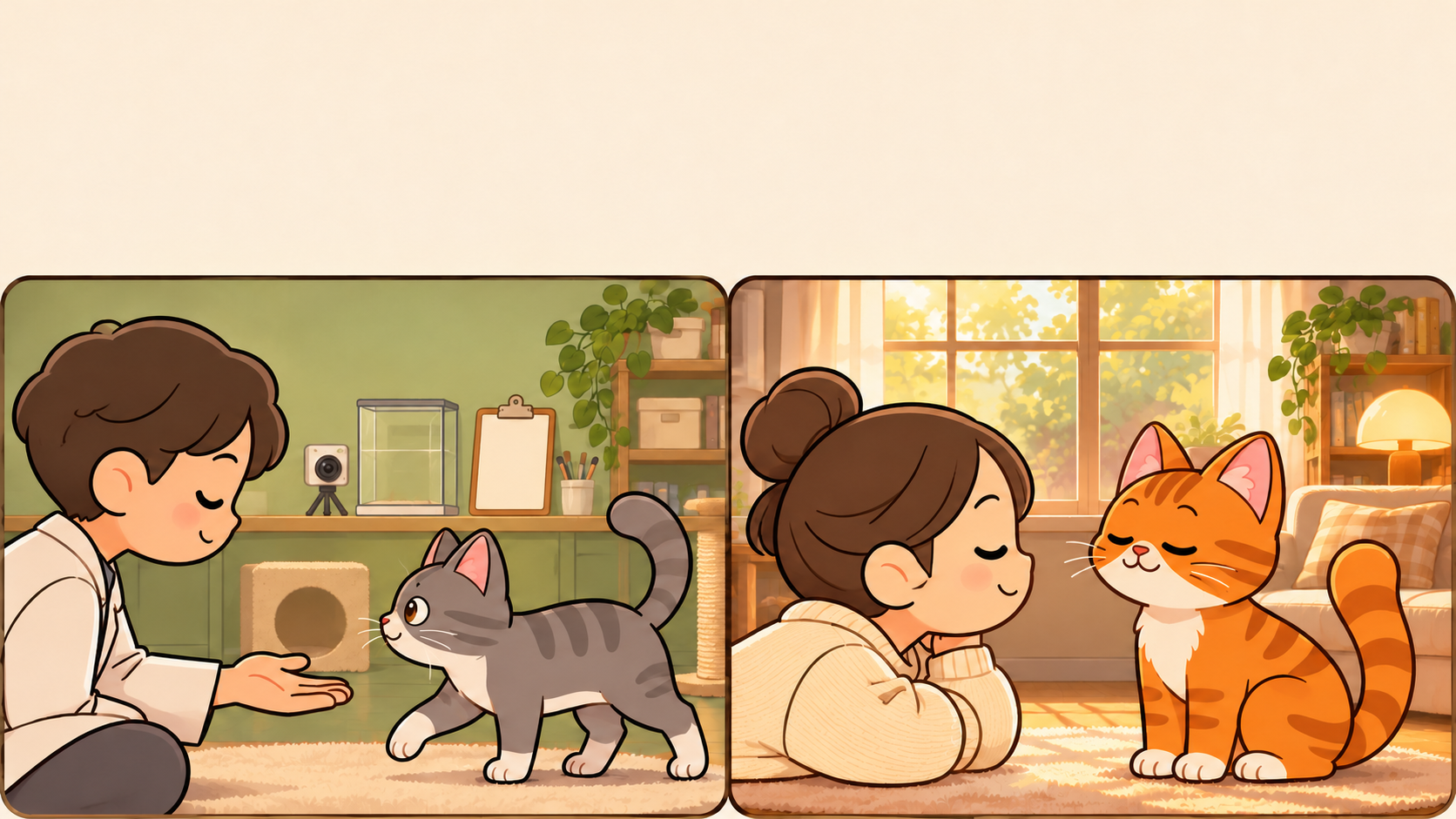
Try the slow blink, often called a cat smile. In experiments, cats narrowed their eyes back when their owners slow-blinked at them, and they approached an unfamiliar researcher more after that person slow-blinked and offered a hand. [Source: Humphrey et al. 2020, Sci Rep] Cats can also tell their own name apart from other words, responding with ear and head movements. [Source: Saito et al. 2019, Sci Rep] Adult cats rarely meow at each other, so a short meow is largely meant for people; answer it briefly. [Source: International Cat Care, Cat communication]
6. When your cat keeps her distance: the back-turned nap
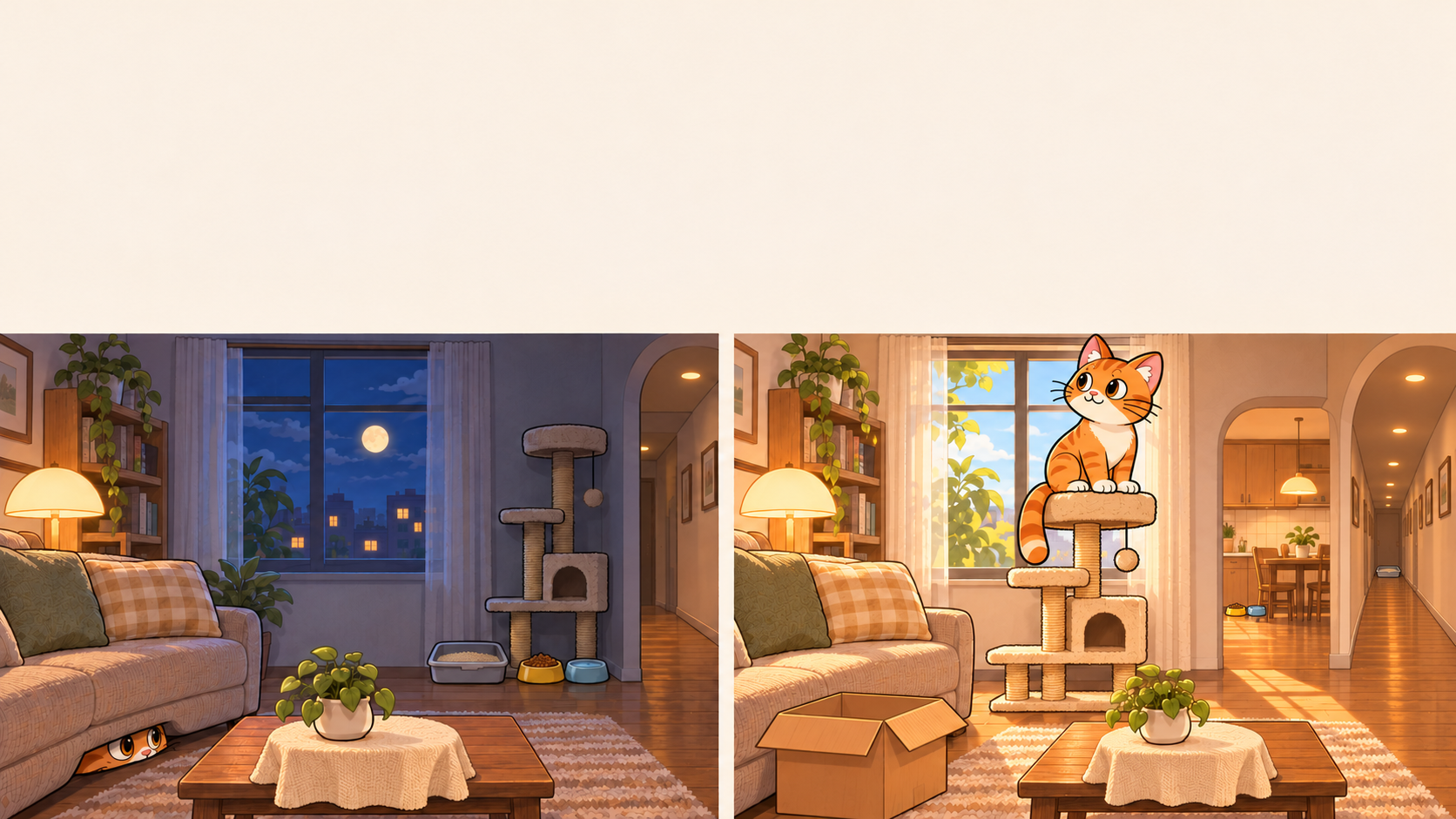
A cat dozing with her back to you in the same room can feel like a snub. Read the three boxes: tail wrapped around her body, one ear turned toward you, eyes closed in the same room. That looks more like trust than rejection, so let her be. Video 6:19
Greeting you at the door and then going straight back to her toys is a good sign too. In an Oregon State University study, 64.3% of 70 kittens and 65.8% of 38 adult cats showed this pattern, classed as secure attachment. That is roughly two in three, from a single study. [Source: Vitale, Behnke & Udell 2019, Curr Biol]
The AAFP/ISFM environmental needs guidelines list a safe place to hide and separated key resources (food, water, litter box) among the basics of a comfortable home. In the video, Kongi climbed to the top of her cat tree the same day it moved from a corner to the window. [Source: AAFP/ISFM Feline Environmental Needs Guidelines 2013] Video 7:33
How to read your cat: 3 moments at a glance
| # | Moment | What to watch | What to do |
|---|---|---|---|
| 1 | When you touch | Tail tip thumping, skin rippling, ears sideways, head turning | Stop at the first sign; if caught, freeze and slide out slowly |
| 2 | When she comes to you | Tail up, cheek rubs, slow blinks (a puffed tail means startled) | Offer one finger; blink slowly back |
| 3 | When she keeps her distance | Wrapped tail, one ear toward you, napping in the same room | Let her be; offer high spots, hiding places, separate resources |
When to call the vet — Go now: repeated trips to the litter box without passing urine. Today: not eating for more than a day. [Source: Cornell Feline Health Center; VCA] If fur becomes thinner, consult your vet about skin conditions, allergies and parasites before assuming stress. [Source: VCA; the sources for sections 1–6 above]
FAQ
Why does my cat kick when I rub her belly?
The grab-and-kick is a play-hunting move, often mixed with protecting a sensitive spot. Freeze your hand until she relaxes, then pull away slowly. [Source: International Cat Care, Playing with your cat]
Where do cats like to be petted?
In the study of 34 cats, stroking the base of the tail drew the most negative responses. The video’s advice is to let the cat approach, then gently stroke the cheeks and chin and pause. [Source: Ellis et al. 2015; Haywood et al. 2021]
What does it mean when a cat slow blinks at you?
It is widely read as a relaxed, friendly signal. Blink slowly back; in one experiment, cats even approached strangers more after a slow blink. [Source: Humphrey et al. 2020]
Next episode · Jungle Pet Encyclopedia #4: what a daily walk does for your dog’s brain. Previous episode: why does my dog sleep at my feet?. Related reading: why do dogs lick? 7 reasons, and the full Jungle Pet Encyclopedia.
What signal did your cat send you today? Tell us in the comments: tail, ears or distance.
Sources (last checked 2026-11-05; papers checked via abstracts and publisher metadata)
- Cafazzo & Natoli (2009) The social function of tail up in the domestic cat, Behav Processes 80:60–66
- Ellis et al. (2015) The influence of body region, handler familiarity and order of region handled on the domestic cat’s response to being stroked, Appl Anim Behav Sci 173:60–67
- Haywood et al. (2021) Providing humans with practical, best practice handling guidelines during human-cat interactions increases cats’ affiliative behaviour and reduces aggression and signs of conflict, Front Vet Sci 8:714143
- Humphrey et al. (2020) The role of cat eye narrowing movements in cat–human communication, Sci Rep 10:16503
- Saito et al. (2019) Domestic cats discriminate their names from other words, Sci Rep 9:5394
- Vitale, Behnke & Udell (2019) Attachment bonds between domestic cats and humans, Curr Biol 29(18):R864–R865
- Ellis et al. (2013) AAFP and ISFM Feline Environmental Needs Guidelines, J Feline Med Surg 15:219–230
- Cornell Feline Health Center — Feline Lower Urinary Tract Disease
- International Cat Care — Handling and interactions
- International Cat Care — Cat Friendly interaction
- International Cat Care — Cat communication
- International Cat Care — Playing with your cat
- International Cat Care — Cat Friendly Homing Information Pack, Chapter 11
- VCA Animal Hospitals — Cat Behavior Problems – Compulsive Disorders in Cats (What is feline psychogenic alopecia?)
Written and reviewed by the Jungle Friends Team · First published 2026-11-08 · Last updated 2026-11-05
This article is not a diagnosis. Please consult your vet; reading body language is about likelihoods, and the same behavior can have other causes.
Kongi is a composite case built from several households’ stories. Images are scenes from the Jungle Friends animation, not photos of real cats. This article was drafted with the help of AI tools and checked by the Jungle Friends team against the sources above.