Disclosure: This post contains affiliate links. If you purchase through these links, we may earn a small commission at no extra cost to you.
I first heard about this drama in February 2025, from an editor who messaged me at 11pm: “Jeju dialect, sixteen episodes, four drops. You will hate subtitling it.” She was right that I would have hated it. In the end the job went to another team, so I watched it as a viewer, crying alone in my apartment off Heping East Road in Daan district. This When Life Gives You Tangerines Netflix review comes from my second viewing, a rewatch I did on purpose in 2026. I watched one act per week over four weeks and kept flipping between the Korean, English and Traditional Chinese subtitle tracks, the way I do when I’m checking someone else’s work.
I’ll be honest about why I’m writing this. Most of the English-language When Life Gives You Tangerines Netflix review pieces I read praised the acting and the tears, which is fair. They also skipped the thing I care about most for work: about half of what makes this show special is in the dialect, and a lot of that doesn’t make it into the English subtitles. I’ve subtitled more than 30 Korean series since 2019, and I’ve lost count of how many times a joke, an honorific or a regional ending has disappeared somewhere between the script and the subtitle file.
Here’s what you’ll get from this post: what the show is actually about, week by week; what the English subs lose, with examples from the title and the Jeju dialect; how it compares with tvN and JTBC dramas I’ve worked on or rewatched; what it costs to watch in Taiwan and elsewhere; and whether it’s worth sixteen hours of your life. Spoilers stay light until the Autumn section, and I’ll warn you before they start.
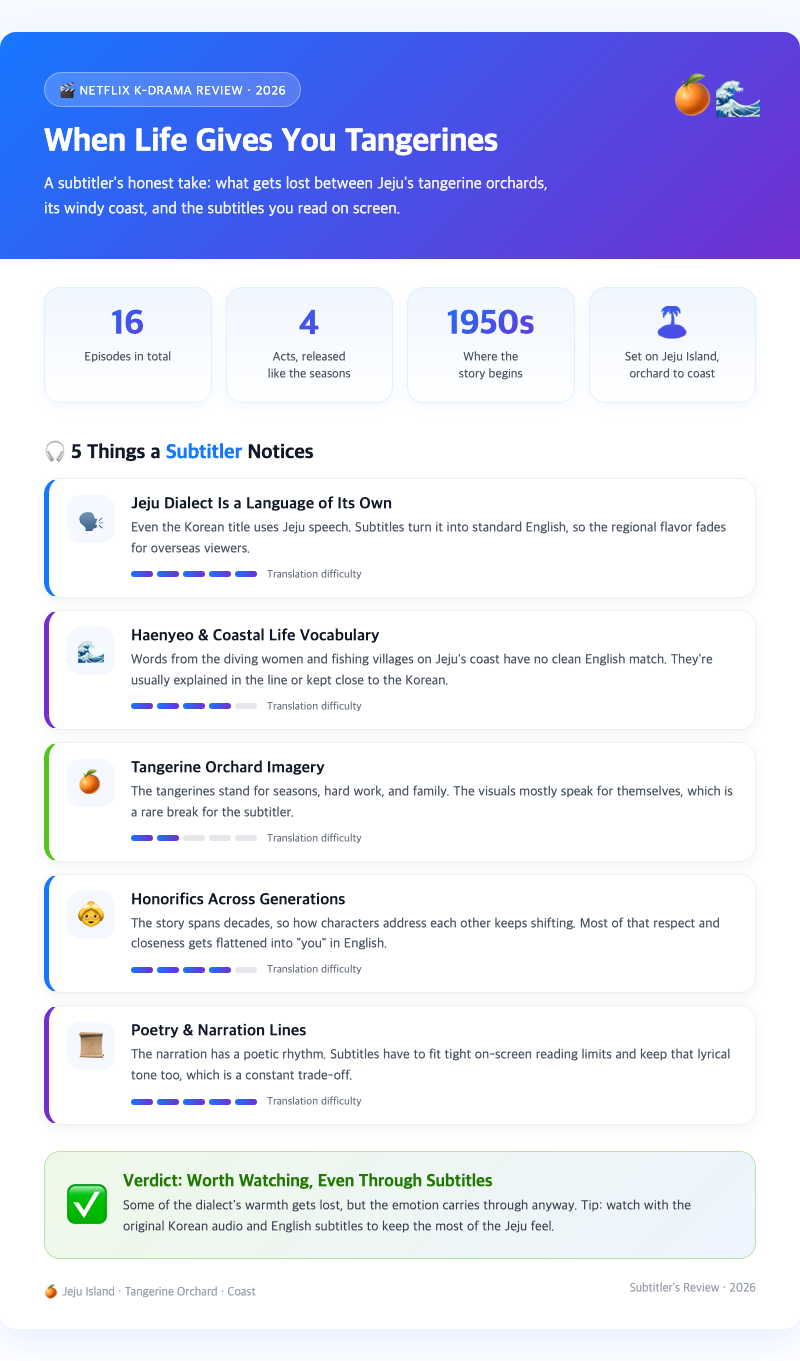
When Life Gives You Tangerines Netflix Review: The Short Version
Before the details, here’s the basic information I’d want from a review. From a production point of view, this show is about as safe a bet as Korean TV gets. Lim Sang-choon wrote When the Camellia Blooms and Fight for My Way. Kim Won-seok directed Misaeng, Signal and My Mister, which I’d call three of the best-made Korean dramas of the last fifteen years. IU plays the young Ae-sun and, later, her daughter Geum-myeong. Park Bo-gum plays the young Gwan-sik. Moon So-ri and Park Hae-joon play the couple in middle age. Netflix released it in four acts named after the seasons, four episodes a week, through March 2025. It then sat in Netflix’s global non-English Top 10 for weeks, which you can check on Netflix’s own Tudum Top 10 site.
From the translation side, two things matter before you press play:
- Switch the audio to Korean. The dubs flatten the Jeju speech completely. Even if you don’t understand any Korean, you can hear how differently the islanders sound from the Seoul characters.
- Watch one act at a time. The four-act structure is how the show is built. Each season of the year covers a different stage of the couple’s life, and watching all of it in one weekend blurs those stages together.
- Keep tissues nearby. I went through a three-pack from PX Mart (TWD 49, roughly USD 1.50) during the Winter act alone.
If you’re new to the creators, my guide to Korean regional dialects in K-dramas has audio clips from Busan, Jeolla and Jeju.
What stuck with me: The Korean title says “thank you for your hard work,” and the English title hides that completely.
Weeks 1 and 2: Spring and Summer, Episode by Episode
I watched Act 1 (Spring) on a Saturday afternoon with the windows open. It was a warm March in Taipei, and a scooter kept starting up downstairs during the quiet scenes, which turned out to be weirdly fitting. Before starting, I bought a bag of ponkan at Dongmen Market for TWD 120 (about USD 3.70), because I’m that kind of person. The smell of tangerine peel on my fingers while Ae-sun ran along the stone walls of her village did more for my mood than any 4K remaster could.
Spring is about childhood and youth. Ae-sun is a poor, sharp-tongued girl who wants to be a poet. Her mother is a haenyeo. Gwan-sik is the quiet boy who has decided, without telling anyone, that his whole life will be about her. Episodes 1 and 2 move slowly in a deliberate way. Kim Won-seok lets shots run long, with wind in the barley and waves hitting black basalt. Episodes 3 and 4 bring the first real heartbreak, and that’s when I noticed how carefully the dialect is used. Characters switch into more standard Korean when they’re performing for authority, and back into Jeju speech when they’re being honest. That switching is invisible in English. In my Traditional Chinese notes I marked eleven scenes where it changes the meaning.
Summer (episodes 5–8) is young marriage, poverty and babies, and the show gets harder to watch. Here’s my sensory note from that week: the sound mix is unusually good. You hear the cicadas, the clatter of a fishing boat, rain on a tin roof. I watched episode 6 on my phone on the MRT between Daan and Zhongxiao Fuxing and missed half of it. Don’t do that. This show needs a quiet room and real speakers or headphones.
- Spring, best for: anyone who loves first-love stories with real stakes rather than misunderstandings.
- Summer, best for: viewers who like seeing domestic life shown as hard work rather than romance.
- Pacing warning: episode 7 drags. I nearly skipped forward, and I’m glad I didn’t, because a small object from that episode pays off in Winter.
For anyone who wants the scenery after the show, a friend’s Crash Landing on You rewatch notes for 2026 cover why that one has aged well.
What stuck with me: This Netflix show is closer to a classic tvN family drama than to anything else Netflix makes, and that’s a compliment.
The Pros and Cons I Can’t Ignore
From the translation side, I judge a drama partly by how hard it fights its translators, and this one fights hard. That’s a sign of real writing. Lazy scripts translate easily because there’s nothing specific in them. Here are my notes from the full four weeks, the good and the bad.
What I loved:
- The dialect as a storytelling tool: who code-switches, when, and why. It’s the best use of regional speech I’ve seen in a Korean production.
- IU’s dual role. Playing the mother and then the daughter isn’t a stunt. It makes you see how Ae-sun’s unlived life gets passed to Geum-myeong.
- Kim Won-seok’s patience. Shots run long, and silence counts as dialogue.
- The haenyeo scenes, which treat the divers as workers with skill and dignity rather than as a postcard image.
- The four-act release, which made Netflix feel like an old weekly broadcast schedule in a good way.
What didn’t work for me:
- The music oversells the emotion in Winter. At least three scenes would hit harder with silence.
- Episode 7 and parts of episode 11 drag.
- Some supporting characters, especially the comic-relief villagers, are types more than people.
- For non-Korean viewers, the English subtitles really do make it a thinner show. That isn’t the drama’s fault, but it is your experience.
The trade-off is real. If you can’t read Korean and don’t want to read up on Jeju beforehand, you’re getting maybe 60–70% of the show. That’s still a better show than most at 100%. Before you start, spend ten minutes reading about Jeju’s haenyeo culture (UNESCO inscribed it on the Intangible Cultural Heritage list in 2016) and about the April 3rd incident. The show doesn’t explain them, and both are in the background of these characters’ lives.
What stuck with me: Its flaws are mostly too much sentiment, never laziness, and I’d always choose that kind of flaw.
How to Watch It in Taiwan (and Elsewhere) Without Wasting Money
It’s a Netflix original, so Netflix is the only legal option. Here’s what that costs where I live, and roughly what it costs readers in other markets. In Taiwan I pay TWD 270 a month (about USD 8.40) for Netflix’s Basic plan. I know the trade-off: Basic tops out at HD 720p on one screen, and this show’s cinematography deserves better. I tested the Premium plan at TWD 390 a month (about USD 12) for one month during the rewatch. The Jeju landscapes do look better in 4K on a big TV. But honestly, at that price, and given I watch mostly on a 14-inch laptop at my desk in Daan, I went back to Basic.
| Option | Taiwan price (monthly) | Approx. USD | Quality | My verdict |
|---|---|---|---|---|
| Netflix Basic | TWD 270 | ~USD 8.40 | 720p, 1 screen | Fine on a laptop |
| Netflix Standard | TWD 330 | ~USD 10.30 | 1080p, 2 screens | Best value for a TV |
| Netflix Premium | TWD 390 | ~USD 12.10 | 4K HDR, 4 screens | Only if you share with family |
| Disney+ (for other K-dramas) | around TWD 270 | ~USD 8.40 | Varies | I cancelled; not needed for this show |
Prices change, so check the current plans in your own country. Netflix lists them on its help center. Readers in Singapore and Malaysia pay in local currency, and US and UK readers will see higher base prices. My money-saving tip is boring but it works: subscribe for one month, watch all 16 episodes over four weekends, then pause. A month costs about what I paid for two Louisa lattes on Yongkang Street (TWD 75 each). If you’re looking at other platforms for Korean content, my watch When Life Gives You Tangerines on Netflix and then look through my