Disclosure: This post contains affiliate links. If you purchase through these links, I may earn a small commission at no extra cost to you.
On my ninth trip to Seoul I worked out that I had spent about KRW 96,000 on transport and attraction tickets I never used. That is roughly SGD 90 gone. The worst of it was a Discover Seoul Pass I activated at 4pm on a rainy Thursday. Look, here’s the deal: most of what you read about which card to buy for Seoul is written by people who went once, on a press trip, with a driver. So this Seoul travel guide does one job. It compares the four cards people actually argue about: the Climate Card, WOWPASS, the plain T-money card and the Discover Seoul Pass.
If you’re flying from Singapore, you probably have five to seven days and a budget you care about. You don’t want to stand at a kiosk in Incheon at 6am working out exchange rates. By the end of this Seoul travel guide you’ll know which card fits your trip length, your itinerary and your travel style, and which one I’d skip. I’ll also cover the mistakes I’ve made, the attractions that are worth paying for, and why I no longer go up N Seoul Tower at sunset. I track every trip in a Notion database, receipts included, so the numbers here come from my own spending. They’re not copied off a brochure. Fares and pass prices do change, so check the official sites before you buy. I flag below where that matters most.
Seoul Travel Guide: Which Card Should You Actually Buy?
I’ve used all four of these cards across nine trips, so I’m not guessing. The official Seoul Metropolitan Government pages and the Korea Tourism Organization (VISITKOREA) both list these products. They describe what each card does. They don’t tell you which one suits you, which is fair, because they’d like you to buy all of them.
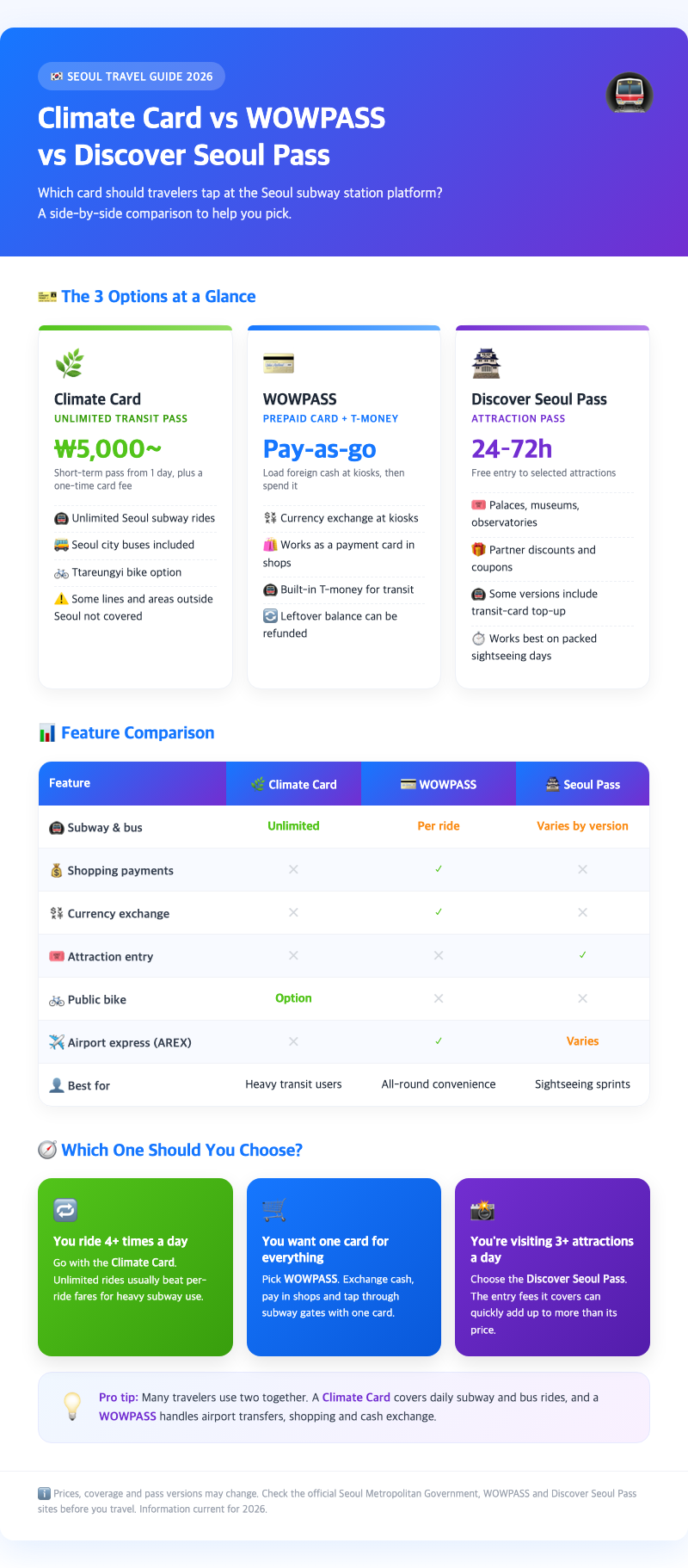
Here’s the comparison I wish someone had given me before trip number one. I put it up front because it answers about 80% of the questions my readers send me.
| Feature | Climate Card (short-term) | WOWPASS | T-money | Discover Seoul Pass | Winner |
|---|---|---|---|---|---|
| Main purpose | Unlimited Seoul subway and bus | Prepaid debit card + T-money transit | Pay-per-ride transit | Attraction entries + transit balance | Depends on trip |
| Upfront cost | KRW 3,000 card + KRW 5,000 to 20,000 pass | Around KRW 5,000 issuance at kiosk | KRW 3,000 to 4,000 at convenience stores | Roughly KRW 50,000+ for 24h (check current) | T-money |
| Unlimited rides | Yes, within Seoul | No | No | No | Climate Card |
| Pay in shops | No | Yes, most card terminals | Only convenience stores, some cafes | No | WOWPASS |
| Airport rail from Incheon | Not covered | Yes (T-money balance) | Yes | Yes (T-money balance) | T-money / WOWPASS |
| Trips outside Seoul | Not covered | Yes | Yes | Mostly no | T-money / WOWPASS |
| Top-up method | Reload pass at station machines | Foreign cash at WOWPASS kiosks | Cash only at stations and stores | Fixed entitlements | WOWPASS |
| Seoul Bike (Ttareungi) | Only on certain 30-day versions | No | No | No | Climate Card |
| Best trip length | 3 to 7 days, Seoul-only | Any length | 1 to 3 days | 1 to 3 intense days | Climate Card |
| Solo budget traveler fit | Excellent | Good | Good | Poor | Climate Card |
- Seoul-only trips with lots of riding: Climate Card.
- Want to keep cash and card fees down: add WOWPASS on top.
- Lots of day trips to Suwon, Incheon or the DMZ: plain T-money.
- Want to see six attractions in 48 hours: run the Discover Seoul Pass numbers first.
If you’re still sorting out the rest of your trip, my Myeongdong shopping tourist traps breakdown.
My take: Treat WOWPASS as a payment tool that happens to do transit, and pair it with a Climate Card for heavy riding.
Plain T-money Card: Boring, Cheap, and Still Useful
My first T-money card from 2014 still lives in the travel wallet I’ve carried since my banking days. It’s the default transit card in Korea, run by T-money Co. and accepted on subways and buses in Seoul and across most of the country. You buy it at GS25, CU or 7-Eleven for around KRW 3,000 to 4,000, depending on the design. Then you top it up with cash.
That’s the catch every first-timer hits: T-money top-ups are cash only. You can’t top up with a Singapore Visa card at a subway machine. I’ve watched people from my own flight stand at the machine in Seoul Station looking at their credit card like it had betrayed them. Carry KRW 10,000 notes. A KRW 20,000 top-up covers about 10 to 12 rides, depending on distance and transfers.
T-money wins in three situations. Short trips (two days or less), trips with lots of day trips out of Seoul, and the first and last legs of every trip. The AREX all-stop train from Incheon to Seoul Station is about KRW 4,000 to 5,000 on T-money, which is far cheaper than the express or a taxi. Recent fares are on the AREX website.
- Buy it at the airport convenience store right after immigration.
- Top up KRW 20,000 to 30,000 in cash.
- Tap in and out every ride, including buses, or you’ll lose the free transfer.
- Save leftover balance for the next trip. It doesn’t expire quickly.
Buses are where T-money earns its keep. I ride bus 273 into Hongdae a lot because it drops me nearer the side streets than the subway does. Tapping out matters there, because transfers within roughly 30 minutes are discounted or free.
My take: Even if you buy a Climate Card, keep a topped-up T-money card for the airport, buses outside Seoul and the trips the Climate Card won’t cover.
Discover Seoul Pass vs Klook Korea Pass: Why I Mostly Skip Both
Here’s my opinion that disagrees with most Seoul travel guides. For most solo travelers, attraction passes are a bad deal. The Discover Seoul Pass is official, sold through the Seoul Tourism Organization. It gives free entry to a long list of attractions (the site says 70+), including N Seoul Tower, palaces and some museums, plus a transit balance. The pass runs on 24, 48 and 72-hour versions. When I last priced the 24-hour pass it was in the KRW 50,000+ range, but check the official site because prices have shifted several times.
The problem is the attractions themselves. Gyeongbokgung costs around KRW 3,000 to enter, and it’s free if you wear hanbok. Many of the museums on the list are free anyway. The National Museum of Korea, for example, charges nothing for its permanent exhibition. To beat the price of the pass, you’d need to pack in N Seoul Tower (around KRW 26,000 for the observatory), a cruise or theme attraction, and two or three more paid sites in one day. That isn’t a holiday. That’s a scavenger hunt.
| Scenario (solo traveler) | Pay individually | Discover Seoul Pass 24h | Cheaper option |
|---|---|---|---|
| Gyeongbokgung + Bukchon walk + N Seoul Tower | About KRW 29,000 | KRW 50,000+ | Individual tickets |
| Palace + tower + Han River cruise + 2 paid museums | About KRW 60,000+ | KRW 50,000+ | Pass, narrowly |
| Mostly markets, cafes, free museums | Under KRW 10,000 | KRW 50,000+ | Individual tickets |
The Klook Korea Pass bundles are the same story, and I’ll be blunt: for solo travelers they’re overpriced. I bought one on trip four. I used two of the five entries. Klook is great for single tickets, though. I book Lotte World (around KRW 62,000 at the gate) and the airport limousine bus through them because they’re often discounted. Book attractions through Klook for up to 30% off individual tickets. Just skip the bundle unless you’ve mapped every entry to a specific day.
My take: Run the numbers against your actual itinerary, and you’ll find that buying individual tickets beats an all-in-one pass for most solo trips.
Side-by-Side: Five Real Trip Types and What I’d Buy
The question I get most on junglemoves.sg isn’t which card is best. It’s which card is best for my specific trip. So here are five trip shapes I’ve done, with what I spent and what I’d buy now. These figures come out of my Notion travel database, per person, transport and paid attractions only.
| Trip type | What I’d buy | Approx. transport cost | Why |
|---|---|---|---|
| 3-day Seoul long weekend | T-money + Climate Card 2-day | KRW 18,000 to 22,000 | Airport legs on T-money, middle days unlimited |
| 5-day first-timer, Seoul only | Climate Card 5-day + T-money | KRW 26,000 to 30,000 | Heavy riding between neighborhoods |
| 7-day with Suwon and DMZ day trips | T-money + Climate Card 3-day | KRW 40,000 to 50,000 | Day trips break the Climate Card |
| Shopping-heavy trip, lots of card payments | WOWPASS + Climate Card | KRW 30,000 plus kiosk fee | Fewer FX fees, easy taps |
| 2-day attraction sprint with family | Run Discover Seoul Pass numbers | Varies | Only scenario a pass might pay off |
Look at the first row. On trip one I bought nothing but a T-money card, and on a 3-day trip I put KRW 36,000 on it, partly because I kept going back to Myeongdong. Locals don’t actually go there for dinner. These days I base myself in Mapo and eat at Mangwon Market, which is two stops from Hongdae on Line 6. The fried chicken, the kalguksu and the hotteok stalls there cost maybe half of what you’d pay in Myeongdong, and the vendors haven’t been worn down by tour groups.
- If your hotel is near a Line 2 station, you’ll ride more than you think, so Climate Card wins.
- If you’re staying in Myeongdong and walking everywhere, T-money is enough.
- If you hate cash, add WOWPASS regardless.
For the eating side of things, see my Seoul day trips without a tour bus post.
My take: Timing your flight search and your attraction visits will save you more than any transit card ever will.
Which Should You Pick? My Final Verdict
After nine trips and more transit receipts than I’d like to admit, here’s my verdict. I’m not hedging this. The Korea Tourism Organization and Seoul Metropolitan Government sell you the options. Which one you pick depends on how you travel, and here’s where I land on each.
Verdict:
Best for 3 to 7 day Seoul-only trips → Climate Card short-term pass
Best for cash-free spending and big shopping trips → WOWPASS
Best for short trips and day trips outside Seoul → plain T-money
Best for packed 1 to 2 day attraction sprints → Discover Seoul Pass (only after you run the math)
Best for solo budget travelers → Climate Card + T-money, and skip the bundles
What’s in my own wallet on trip ten: a Climate Card with a 5-day pass, my old T-money card with KRW 20,000 on it for the AREX and a Suwon day trip, and my YouTrip card instead of WOWPASS, because I already have one. Total transport spend should come in under KRW 45,000 for the week, which is about SGD 42.
- Count your expected rides per day before buying anything.
- List the paid attractions you’ll actually visit, and price them individually.
- Check that your multi-currency card works in Korea before buying WOWPASS.