Disclosure: This post contains affiliate links. If you purchase through these links, I may earn a small commission at no extra cost to you.
On my first trip to Seoul in 2015, I paid 38,000 won for a sheet-mask bundle in Myeongdong. Two streets away, the same bundle was on the shelf at Olive Young for about a third of that. That was the moment I started writing my own Seoul travel guide in a Notion database. It now holds nine trips, three passports’ worth of stamps and more receipts than I’d like to admit. Look, here’s the deal: most Seoul travel guide articles are written by people who went once, stayed in Myeongdong and took the tour bus to Nami Island. I hate tour buses. I left banking in 2022 partly so I could travel the slow, cheap and slightly annoying way, and Korea is where I’ve done the most of it.
This list covers the seven things I’d tell a friend flying out of Changi next month. That means booking flights without overpaying, getting around without a pass you don’t need, eating where Seoulites actually eat, and doing Hongdae, Namsan and Anguk at the right hour instead of the Instagram hour. My criteria were simple. Every item had to save money, save time or get you away from a tourist trap, and I had to have tested it personally on at least two trips. Prices are in Korean won with rough SGD and USD conversions. They’re based on my last visit, so treat them as ballparks rather than gospel.
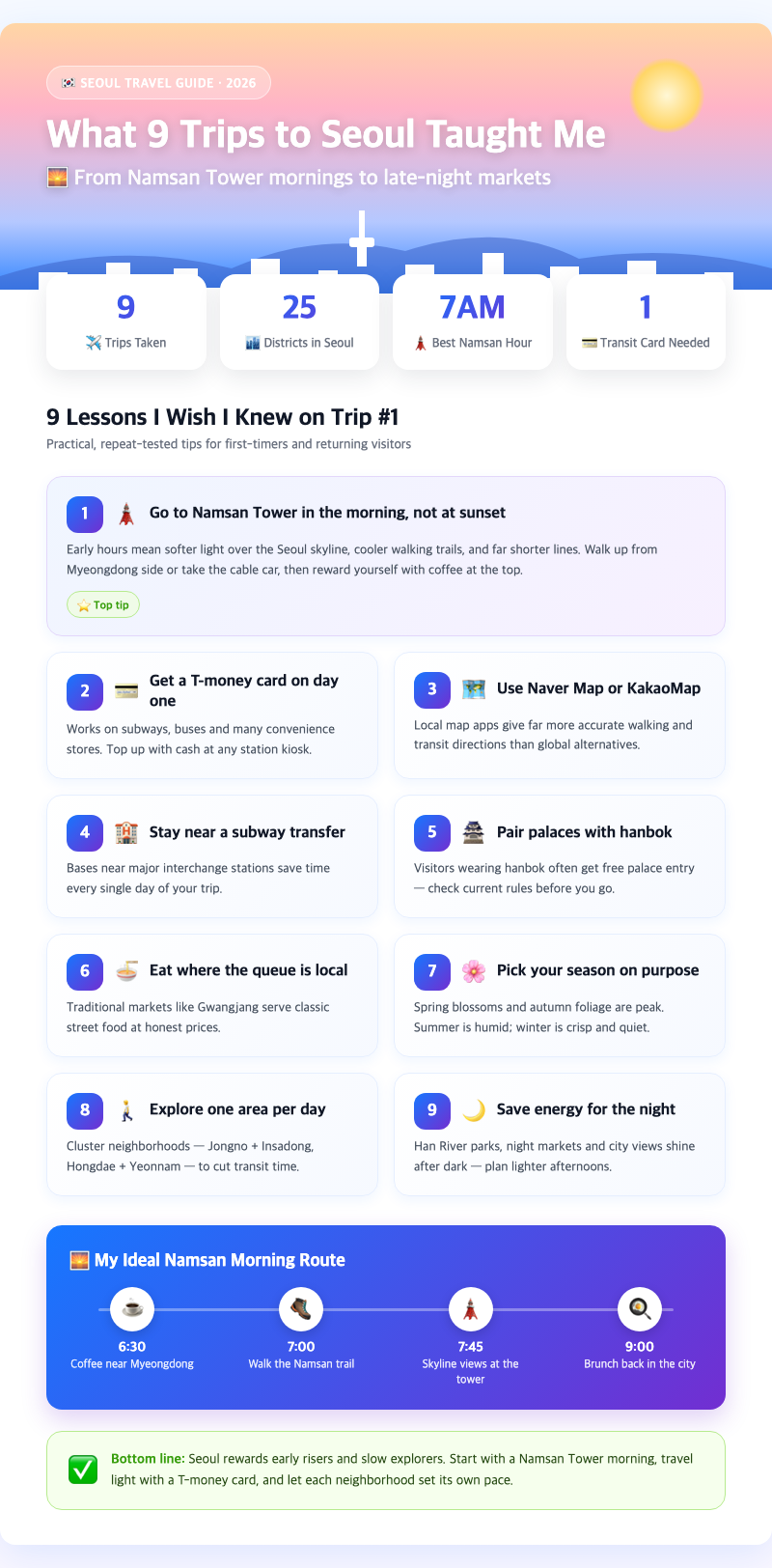
Seoul Travel Guide 2026: The Short Version Before the List
Before the numbered list, some context on why this matters. According to the Korea Tourism Organization, Korea welcomed around 16.4 million international visitors in 2024, and Seoul absorbs the large majority of them. In practice, the famous spots are more crowded than they were five years ago, and the shops on the main tourist drags price accordingly. The good news is that Seoul’s public transport is among the cheapest in any major Asian city, and the neighbourhoods locals actually spend their weekends in are a 15-minute subway ride from the crowds.
I’ve organised everything around three principles from my own trips:
- Pay local prices. If an area’s menus are in four languages and nobody around you is Korean, you’re paying a premium.
- Go at the wrong time. Most viewpoints, palaces and cafes are half-empty before 10am or between 11am and 1pm on weekdays.
- Skip bundles. Passes and packaged tours make sense for families. For solo travellers they rarely do.
If you’re still deciding on dates, I keep a separate breakdown of the find flights on Skyscanner and compare total fares across airlines in one search.
My rule: The cheapest headline fare is often not the cheapest trip. Price in your return baggage before you click buy.
2. Get a T-money Card and Skip the Klook Korea Pass (If You’re Solo)
This is where I disagree with a lot of mainstream travel advice. Plenty of guides push bundled passes as the default. For a solo traveller doing a normal mix of sightseeing, I think the Klook Korea Pass is overpriced. Bundled passes only pay off if you visit enough paid attractions to beat the sticker price, and most solo travellers I talk to spend more time eating, shopping and walking than queueing for paid entries. Buy individual tickets for the two or three things you actually want. Klook is still useful for single discounted tickets, which is a different thing from the bundle.
What you do need is a T-money card. You can buy one at any convenience store at Incheon Airport (GS25, CU, 7-Eleven) for around 3,000-4,000 won depending on the design. Top it up with cash at the same stores or at subway station machines. The machines take cash only, which caught me out once at 11pm in Mapo with nothing but a credit card. A basic subway ride on a card is now around 1,550 won (about SGD 1.50 / USD 1.10) after the 2025 fare increase. Transfers between bus and subway within 30 minutes are discounted. I top up 30,000 won at a time and rarely use more than 8,000-10,000 won a day.
| Option | Upfront Cost | Best For | My Verdict |
|---|---|---|---|
| T-money card + individual tickets | ~3,000-4,000 won card + top-ups | Solo travellers, repeat visitors | My default every trip |
| Klook Korea Pass (bundle) | Varies by tier; check current price | Families hitting 4+ paid attractions | Overpriced for most solo trips |
| Klook single tickets | Per attraction, often discounted | One-off entries like observatories | Worth comparing against the gate price |
| Taxi via Kakao T | Base fare ~4,800 won | Late nights, groups of 3-4 | Fine occasionally, not daily |
Apps matter as much as the card. Google Maps walking directions are still unreliable in Korea, so download Naver Map or KakaoMap before you land. Add Papago for translation and Kakao T for taxis. If you want individual attraction tickets, you can book single attractions through Klook, which sometimes knocks a decent percentage off gate prices. Just compare before you buy.
My rule: Buy the card, not the pass. Then buy tickets one at a time for things you’d actually queue for.
3. Eat at Mangwon Market — Myeongdong Is for First-Timers
Myeongdong is for first-timers. Locals don’t actually go there to eat. The street food stalls along Myeongdong-gil are photogenic, but on my last trip a tornado potato and a skewer of grilled cheese came to over 12,000 won. At Mangwon Market, the equivalent snacks ran me roughly half that. Mangwon is a working neighbourhood market in Mapo-gu, a short walk from Mangwon Station (Line 6, Exit 2). It’s where people from the surrounding apartments buy their side dishes, fried chicken and fruit.
What I order every time, with rough prices from my last visit:
- Dakgangjeong (sweet-spicy fried chicken bites): a cup for around 5,000-7,000 won, enough for lunch.
- Croquettes from the stalls near the main entrance: about 1,000-2,000 won each.
- Hotteok (filled pancakes): around 1,500-2,000 won.
- Kalguksu (knife-cut noodles) at a sit-down stall: roughly 6,000-8,000 won a bowl.
The trade-off is real, though. Mangwon has almost no English signage, cards are accepted at most stalls but not all, and on weekend afternoons the main aisle gets packed with young Koreans doing exactly what you’re doing. I go on weekday late mornings with 20,000 won in cash and leave when I’m full. Pair it with a walk along the Han River at Mangwon Hangang Park, ten minutes away, where people bring takeaway chicken and convenience-store beer at sunset.
If you’re a first-timer who wants to see Myeongdong anyway, fine. Go, look, then skip the street food and eat dinner somewhere else. For more food routes, my compare Hongdae hotels on Booking.com. Filter by distance to the station; anything past a 10-minute walk isn’t worth the saving.
My rule: Always verify bus routes in Naver Map yourself. Forum posts age badly, and Seoul reorganises routes more often than you’d think.
5. Go to N Seoul Tower at 11am — Not at Sunset
Every Seoul travel guide tells you to catch sunset from N Seoul Tower. Don’t waste your time. I’ve tried it twice. Both times, the queue for the observatory lift at golden hour was long enough that I watched most of the sunset through other people’s phones, and the cable car line at the bottom was worse. At 11am on a weekday, I walked straight in, had the windows mostly to myself, and on a clear day could see all the way to the mountains north of the city.
Getting there cheaply matters too. The Namsan cable car costs around 15,000 won return for adults, which is fine but not essential. I usually take the yellow Namsan circulation bus up from Chungmuro or Myeongdong (a normal T-money fare) and walk down through the park. It’s about 30-40 minutes downhill on shaded paths and one of the nicest walks in central Seoul. The observatory itself costs around 21,000 won for adults at the gate. Check Klook against that, because single-ticket discounts do appear.
The trade-off: midday light is flatter, so your photos won’t look like the postcard shots. If photography is the whole point, go on a weekday rather than a weekend, arrive 90 minutes before sunset and accept the wait. For everyone else, the view is the same city, without the crowd.
- Check the air quality forecast (fine dust readings) the morning of. Spring yellow dust days ruin the view entirely.
- Take the circulation bus up and walk down to save the cable car fare.
- The love locks and outdoor terrace are free. You don’t need the observatory ticket to enjoy the top.
My rule: Famous viewpoints at famous hours cost you an hour in a queue. Shift by half a day and you get the same view for free.
6. Start in Anguk: Cafe Onion Anguk and Bukchon Before 10am
Anguk Station (Line 3) is my favourite morning in Seoul. Cafe Onion’s Anguk branch is set inside a renovated hanok, a traditional Korean house, with floor seating around a courtyard. The pandoro, a fluffy bread under a snowfall of powdered sugar, is the one everybody photographs. Drinks and pastries ran me roughly 6,000-8,000 won each on my last visit. It opens fairly early, and by late morning there’s usually a queue out of the gate, so I aim to be there right at opening with a book.
From the cafe, Bukchon Hanok Village is a ten-minute walk uphill. This matters more in 2026 than it used to. Parts of Bukchon are residential, and after years of complaints from residents, Jongno-gu introduced visitor curfews for tourist groups in the core alleys, with evening hours restricted. The rules have been tightened and adjusted, so check the current hours before you go. Either way, morning is when the alleys are quietest, and walking through people’s front yards at 9am feels a lot less intrusive than joining a 4pm tour group.
After Bukchon, walk down to Changdeokgung or Gyeongbokgung palace. Here’s a money tip: in my experience, visitors wearing hanbok enter Gyeongbokgung for free. Rental shops around Anguk charge from about 15,000-20,000 won for a few hours, though, so it only works out if you actually want to wear one. If you’re there for the architecture, the regular entry fee of 3,000 won is cheaper.
- Arrive at Cafe Onion Anguk right at opening on a weekday.
- Walk Bukchon before 10am, quietly, and respect the residents’ signs.
- Finish at a palace before the midday tour groups arrive.
My full Korean skincare routine guide for beginners explains what’s worth buying in Seoul and what you can get just as cheaply back home.
One honest caveat: some products are cheaper on Shopee Singapore during big sales than in Seoul at full price. If it’s a staple you already use, check Shopee before you fly. Buy in Seoul only what’s new, exclusive or on a 1+1.
My rule: Olive Young sets your price ceiling. Anything above it is a tourist tax.
All Seven at a Glance: Cost, Time and Who It’s For
Here’s the whole list in one table, built from my Notion travel database. Costs are per person and approximate, based on my last visit.
| # | Item | Approx. Cost | Best Time | Skip If |
|---|---|---|---|---|
| 1 | Skyscanner flight booking | SGD 350-1,000 return | Tuesday afternoon searches | Your dates are fixed by work |
| 2 | T-money card instead of pass | ~3,000-4,000 won + top-ups | Buy on arrival at Incheon | You’re a family of 4 doing many attractions |
| 3 | Mangwon Market lunch | ~10,000-20,000 won | Weekday late morning | You need English menus |
| 4 | Hongdae base and shopping | Varies; Musinsa basics ~15,000-20,000 won | Afternoon to late night | You want quiet nights |
| 5 | N Seoul Tower at 11am | ~21,000 won observatory | Weekday 11am | High fine-dust days |
| 6 | Anguk morning + Bukchon | ~6,000-8,000 won cafe + 3,000 won palace | Opening time to 10am | You can’t do early starts |
| 7 | Olive Young K-beauty | Masks from ~1,000-3,000 won | Weekday, smaller branches | You can get it cheaper on Shopee |
Practical tip: sort these by neighbourhood, not by number. Items 3 and 4 sit on Line 6 and Line 2 in Mapo. Items 5 and 6 are both central. That gives you a natural west-Seoul day and a central-Seoul day.
How I Picked These
I’m not a tour operator, and nobody paid for a spot on this list. Every item comes from my own Notion database, where I log flights, transport spending, food prices and the mistakes I made. Each one had to meet three tests. I’ve done it on at least two separate trips. It either saves money or saves at least an hour compared with the obvious alternative. And I’d recommend it to a friend from Tampines who’s never been. Things I left off on purpose: tour-bus day trips (I don’t take them), Lotte World (fine, but expensive for what it is) and anything I’ve only done once. Prices change quickly in Seoul, especially after the 2025 transport fare increase, so check current rates before you rely on mine. Where I quote official information, like visitor numbers or fares, it comes from the Korea Tourism Organization and Seoul Metro’s published rates.
Frequently Asked Questions
How many days do I need in Seoul?
For a first trip, I’d say five full days in Seoul itself, plus a travel day on each end. That covers Hongdae and Mapo, central Seoul (palaces, Anguk, Namsan), Gangnam or Seongsu and one slow day. With fewer than four days, you’ll spend too much of the trip on the subway. On repeat trips, I often do three days in Seoul and add Busan or Jeonju by KTX.
Is the Klook Korea Pass worth it?
For solo travellers, usually not, in my experience. Bundled passes only beat individual tickets if you visit enough paid attractions to cover the bundle price, and most solo trips are heavy on food, shopping and free neighbourhoods. Families or groups planning several paid attractions a day may come out ahead. Add up the gate prices of what you’ll actually visit, then compare.
How much should I top up on my T-money card?
I top up 30,000 won at a time, and that lasts me three to four days of heavy subway and bus use. A basic ride is around 1,550 won, with discounted transfers. Top-ups are cash only at most machines and convenience stores, so keep some won on you. You can get the remaining balance refunded at convenience stores before you leave, minus a small fee.
Is Myeongdong worth visiting at all?
Once, briefly, if it’s your first trip. It’s central, lively and easy to navigate. But I wouldn’t shop for cosmetics on the side lanes or eat the street food there, because prices are noticeably higher than in other neighbourhoods. Use it as a walk-through between Namsan and Euljiro, then eat at Mangwon or Gwangjang Market instead.
What’s the cheapest way from Incheon Airport to Hongdae?
The AREX all-stop train goes directly from Incheon Airport to Hongik University Station, and with a T-money card it costs a fraction of a taxi. It takes roughly 50-60 minutes. The express AREX only runs to Seoul Station, so for Hongdae the all-stop train is both cheaper and more convenient. Taxis cost several times more and are only worth it with heavy luggage and a group.
Where should I stay in Seoul as a budget traveller?
Hongdae, Hapjeong and Sangsu are my picks. They have direct airport rail access, cheaper guesthouses than Myeongdong or Gangnam, and plenty of food until late. If you’d rather be central for palaces, Jongno near Anguk or Euljiro works, though evenings are quieter. I’d avoid booking anything more than ten minutes’ walk from a subway station just to save a few dollars.
When is the cheapest time to fly from Singapore to Seoul?
In my logs, the cheapest fares have shown up outside the cherry blossom weeks in early April, the late-October foliage peak and the December school holidays. Late May, June and early September have been my sweet spots. Pair off-peak dates with Tuesday-afternoon searches and a Skyscanner price alert, and always compare totals with a checked bag included.
Before You Book
If you only remember five things from this Seoul travel guide, make it these:
- Compare flight totals with baggage included, and search on Tuesday afternoons.
- Buy a T-money card at Incheon. For solo trips, skip the bundled pass.
- Eat at Mangwon Market. Treat Myeongdong as a walk-through, not a food stop.
- Go to N Seoul Tower at 11am and to Anguk and Bukchon before 10am.
- Use Olive Young as your price ceiling for K-beauty.
If you’re ready to plan, you can check flights from Singapore on Skyscanner, then compare Hongdae hotels on Booking.com. Do it in that order, because flights move faster than rooms. I’ll keep updating this list after trip number ten. Last reviewed: November 2026.