Disclosure: This post contains affiliate links. If you purchase through these links, I may earn a small commission at no extra cost to you.
Korea has more fried chicken shops than McDonald’s has restaurants worldwide. A widely cited KB Financial Group report put the number at roughly 87,000 chicken outlets back in 2019. I think about that every time I type korean fried chicken near me into Google Maps from my flat in Tampines. Half of what comes up is a mall food court doing gochujang wings for S$14. The other half has closed.
Look, here’s the deal. Searching for korean fried chicken near me in Singapore and searching for it in Seoul are two very different jobs. I’ve been to Korea nine times since 2016. I eat chicken on every single trip, and I log every shop in a Notion database, with price, wait time, how crisp it stayed after 20 minutes, and whether I’d go back. That database now has 61 entries. Some are great. Some are the reason I stopped trusting Instagram.
This is a reader Q&A. These are the questions people actually send me through junglemoves.sg and in my DMs. I’ve answered them the way I’d answer a friend at a kopitiam. You’ll find out what separates Korean fried chicken from the American kind, which Seoul chains are worth the queue, where locals really eat, what it costs in won compared with Singapore dollars, how to order delivery without a Korean phone number, and how to spot a legit shop near you before you spend S$40 on soggy wings.
Quick note on who’s answering. I’m Marcus Chen. I’m 36 and spent ten years in banking before I quit in 2022 to write about travel full time. My Korean is survival level: I can order, argue about a bill, and ask for extra pickled radish. I hate tour buses, and I can tell you which Myeongdong shops charge three times the going rate. Nobody sponsors my chicken. I pay for it all.
What does searching korean fried chicken near me actually show you, and how do you filter it?
From my own logs: on my last three trips I compared the top ten Google Maps results with the top ten Naver Map results for the same street. Only three shops showed up on both lists, every time. Google tends to push places with English reviews, which usually means tourist areas. Naver ranks on Korean reviews and on blog posts by actual residents.
Singapore has a different problem. Most results are legit, but many are Korean-inspired rather than Korean-run. That isn’t automatically bad. 4Fingers was founded in Singapore and does a good soy-garlic wing. It’s still a different product from a whole bird double-fried in a neighbourhood shop in Mapo-gu.
Here’s my filter, and it takes about two minutes per listing:
- Check the menu for a whole or half chicken (hanmari / banmari). Shops that only sell wings and drumlets in sets are usually fusion.
- Look for banban, the half-and-half option. Pretty much every Korean shop has it.
- Zoom into customer photos for the small white cubes of pickled radish. If they’re missing, the shop probably isn’t Korean-run.
- Sort reviews by newest. Fried chicken quality falls fast when the kitchen staff change.
- In Korea, check the Naver blog review count. More than 200 on a small shop is a good sign.
For more on reading Korean apps, see my Mangwon Market street food walking route.
My take: Get to the market early. The best chicken in Seoul sells out before dinner.
How much does Korean fried chicken cost in Korea compared with Singapore?
I’m an ex-banker, so of course I tracked this. In my Notion sheet I keep the price per whole bird across my trips and my Singapore meals. Approximate figures, using roughly ₩1,400 to US$1 and S$1 to about US$0.75:
| Where | What | Local price | Approx. USD |
|---|---|---|---|
| Mangwon Market stall, Seoul | Whole fried chicken | ₩10,000–₩15,000 | US$7–11 |
| Neighbourhood hof, Mapo-gu | Whole banban + 500cc beer | ₩26,000–₩30,000 | US$19–21 |
| BBQ franchise, Seoul | Golden Olive whole | ~₩23,000 | ~US$16.50 |
| Myeongdong tourist shop | Half and half | ₩25,000–₩30,000 | US$18–21 |
| Korean chain, Singapore mall | Whole chicken | S$30–S$45 | US$22–34 |
| Wing set, Singapore food court | 6–8 wings + rice | S$10–S$16 | US$7.50–12 |
Singapore runs about 1.5 to 2 times Seoul for a whole bird. The trade-off is that a S$400 flight doesn’t make sense for chicken alone. But if you’re already going to Seoul, eat chicken often there and less at home.
Money-saving tips I use every trip:
- Buy a T-money card at any convenience store (around ₩4,000 for the card) and top up ₩10,000 at a time. Most market stalls take cash or card. T-money works at many convenience stores but not at most stalls.
- Bring ₩20,000 in cash for markets. Some stalls get grumpy about cards on small orders.
- Order a whole bird for two people instead of two half sets. It’s usually cheaper per piece.
My take: Seoul chicken is cheap compared with Singapore. Seoul chicken in Myeongdong isn’t.
What should you order: yangnyeom, ganjang, huraideu or something else?
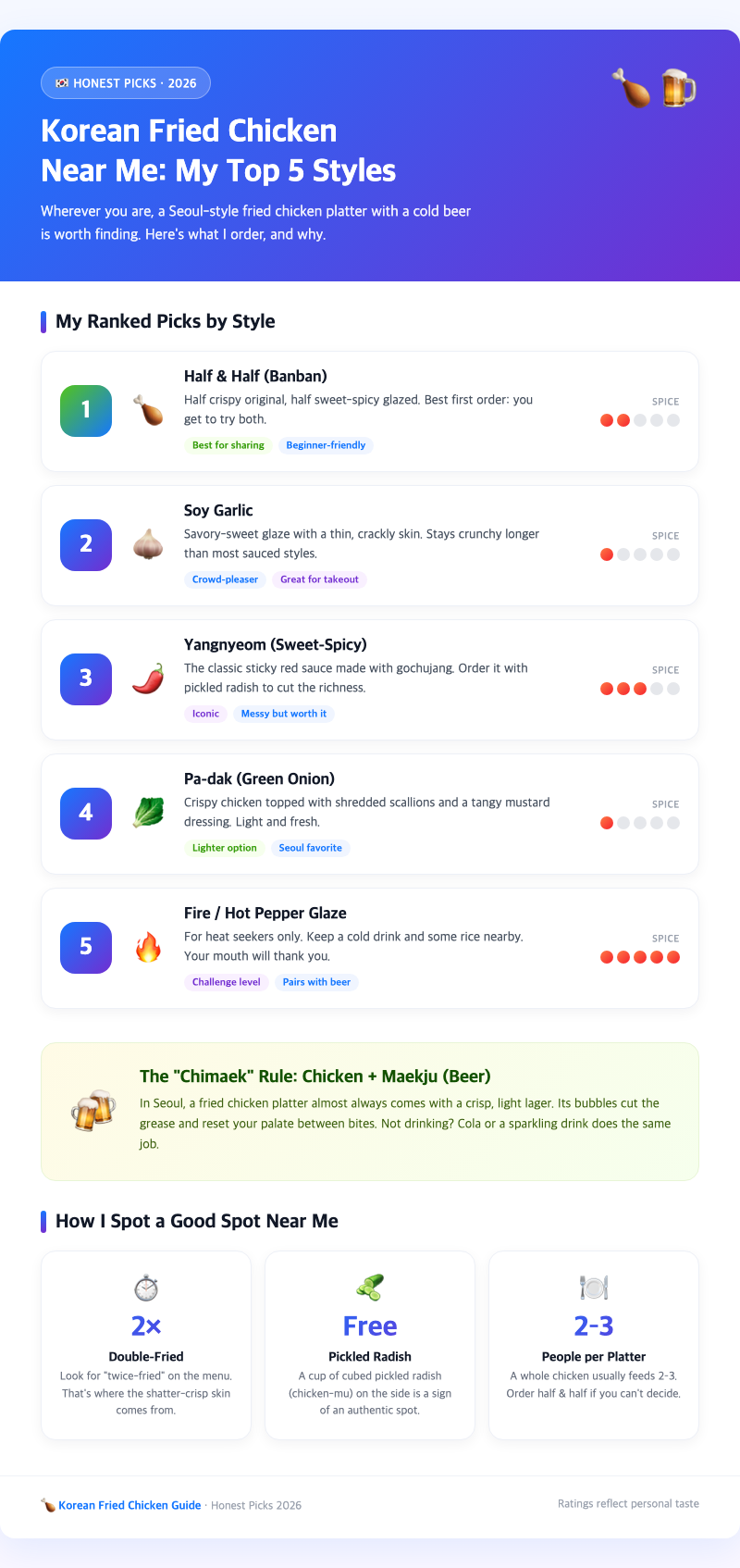
Korean chicken menus look scary until you know about six words. After nine trips I’ve ordered basically everything at least once, including a honey butter chip chicken I’d rather forget. Here’s what each one is, roughly ranked by how often I order it:
- Huraideu (프라이드): plain fried. The honest test of a shop.
- Yangnyeom (양념): sweet, sticky, mildly spicy red glaze. The classic for first-timers.
- Ganjang (간장): soy garlic glaze. Salty and savoury, and it holds its crunch best.
- Banban (반반): half and half. Order this if you can’t decide.
- Padak (파닭): chicken buried in thin-sliced spring onion with a tangy dressing. Great with beer.
- Bburinkle-style powders: cheese or seasoning powder. Fun, but I’d only get it once.
- Maeun (매운) / hot versions: properly spicy. Singapore chilli tolerance helps, but some of these still get me.
Korean food writers, including those behind the Korea Tourism Organization’s Visit Korea food pages, regularly point out that chicken is a social food in Korea. It’s eaten in groups, shared from one box, with beer. That’s why ordering by the piece or in a small set is rare outside tourist areas.
Today’s tip: if you’re ordering at a Korean shop near you and they offer bone-in (ppyeo) or boneless (sunsal), go bone-in. Boneless is usually thigh chunks fried in more batter, and it gets soggy faster. Bone-in tastes better and stays crisp. For more Korean food vocabulary, my 4-day budget Seoul itinerary includes the chicken stops.
My take: Book the famous sights in the morning and keep your evenings for chicken.
Is Korean fried chicken in Singapore worth it, or should you wait for Seoul?
Both, honestly. I eat Korean fried chicken in Singapore about twice a month. Places like Chicken Up on Tanjong Pagar Road, Nene Chicken in the heartland malls and Jinjja Chicken scratch the itch well. They’re just not the same as a Mapo hof, mainly because Singapore shops are built for small sets and quick turnover rather than a whole bird with friends over two hours.
If eating chicken in Seoul is part of why you’re going, here’s how I save money on the trip itself. If you’re flying from Singapore, search Skyscanner on Tuesday afternoons. That’s when I’ve consistently seen the lowest SIN to ICN fares in my alerts. Off-peak returns have come up for around S$350 to S$450 on budget carriers, compared with S$650 to S$900 or more over school holidays and Chuseok. That’s my own tracking, not a guarantee, but the pattern has held across several years.
Here’s how I decide whether a Singapore Korean chicken shop is worth the money:
- Does it sell a whole or half bird, not just wing sets?
- Does the plain fried still crunch after 10 minutes?
- Is there chikin-mu, and is it free?
- Is a whole chicken under about S$35?
If you’re cooking at home, you can buy gochujang, Korean corn syrup (mulyeot) and potato starch at Korean marts in Tanjong Pagar, on Shopee for SG and MY readers, or on Amazon and iHerb for US and UK readers. Home double-frying is messy, but it’s the cheapest Korean fried chicken you’ll eat. My
About the author: Marcus Chen is a Singapore-based travel writer at junglemoves.sg and a former banker who left finance in 2022. He has made nine trips to Korea, speaks survival Korean, avoids tour buses, and keeps every meal, price and transport mistake in a Notion travel database. He pays for his own meals and accepts no sponsored placements from restaurants.
Last reviewed: November 2026. Prices are approximate and change often, so check menus before you go.