Disclosure: This post contains affiliate links. If you purchase through these links, I may earn a small commission at no extra cost to you.
On my first trip to Seoul in 2015, I paid ₩25,000 (about S$23) for a ten-pack of sheet masks on Myeongdong’s main drag. Two streets away, the same box sat on a pharmacy shelf for ₩9,000. That receipt is still in my Notion travel database, under a tag I call ‘tourist tax’. Nine trips later, this seoul travel guide is basically that database cleaned up: what I’d do again, what I’d skip, and where the money actually goes. Most seoul travel guide articles I read before that first trip were copied from tour brochures. This one isn’t.
Look, here’s the deal. Seoul isn’t expensive if you avoid the obvious traps, and it isn’t hard to get around once you’ve got a transit card and a working map app. I quit banking in 2022 and my budget has been tight ever since, so every pick below passed three tests. Did I go more than once? Did I pay for it myself? Would I send my own sister there? Seven things passed. I give prices in Korean won, with rough SGD and USD figures, and I point out where Singapore travellers specifically can save. I also say plainly where I got it wrong.
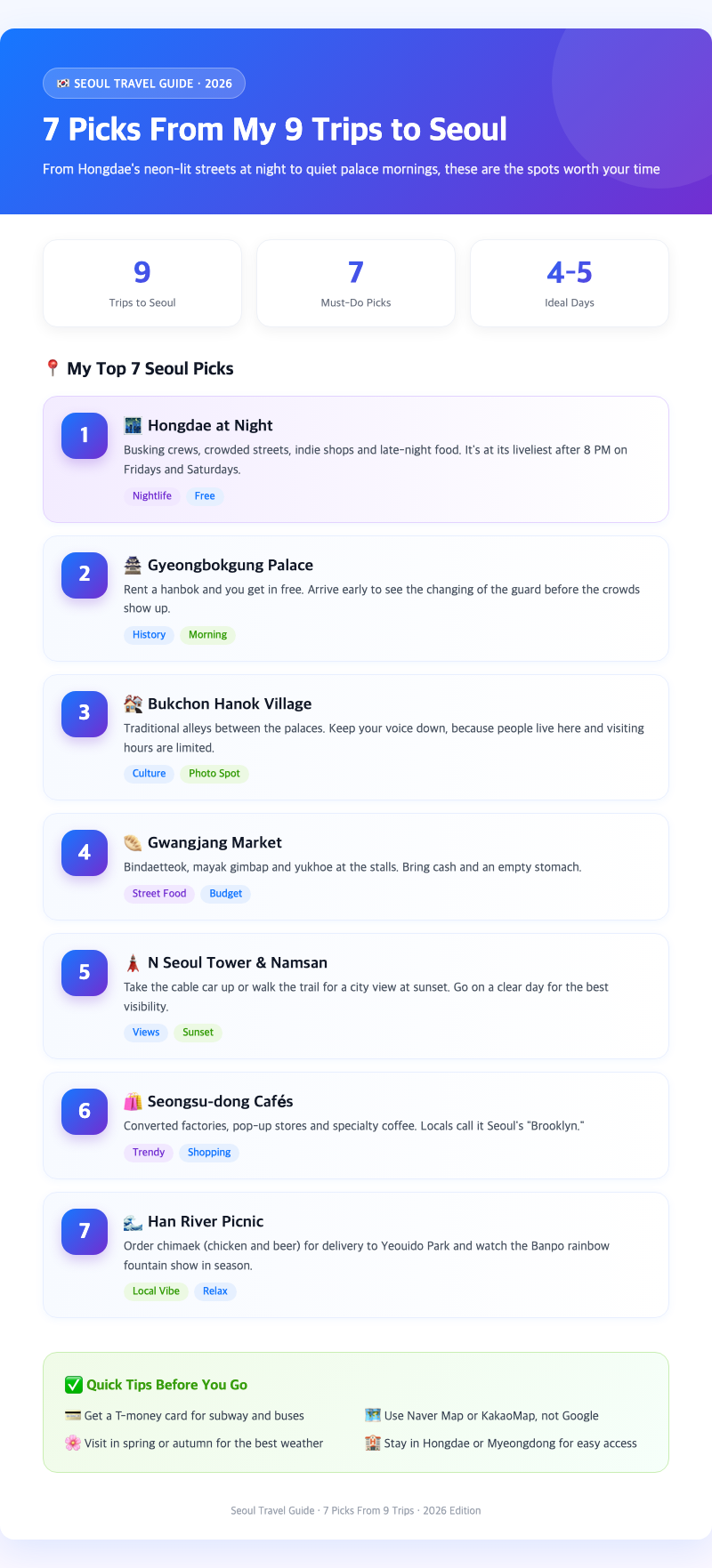
1. Stay in Mapo (Hongdae to Mangwon), Not Myeongdong
I’ve stayed in five different Seoul neighbourhoods over nine trips: Myeongdong twice, Jongno, Gangnam, Itaewon, and Mapo four times. Mapo won every time on value. The Korea Tourism Organization counted roughly 16.4 million foreign arrivals in 2024, and plenty of them seem to book the same few hundred Myeongdong rooms. That’s why prices there jump on weekends and during Chinese holiday periods.
Hongdae sits on the airport line. Hongik University Station is served by AREX, Line 2 and the Gyeongui-Jungang Line, so you can get from Incheon Airport to your hotel without changing trains. When I last took it, the AREX all-stop train cost under ₩5,000. Compare that with the express to Seoul Station (around ₩11,000) plus a taxi with luggage. Over a week, the savings pay for a couple of good dinners.
- Budget: guesthouses near Yeonnam-dong usually run ₩50,000–₩80,000 a night (S$47–75, US$35–57).
- Mid-range: business hotels near Hongik Univ. Station exit 9 often go for ₩110,000–₩160,000 (S$100–150).
- Avoid: rooms directly on Eoulmadang-ro if you’re a light sleeper. The buskers and bars carry on until 2am on Fridays.
The trade-off is real. Hongdae is loud, and on a Saturday night it’s mostly 20-year-olds. If you’re travelling with parents, Mangwon or Hapjeong are only one or two stops away and much calmer, and they still share the transport advantages. You can Seoul market food tour breakdown compares Mangwon with Gwangjang and Tongin if you want to visit more than one.
My take: Mangwon gives you the street-food experience tourists pay double for in Myeongdong, minus the selfie-stick traffic.
3. Get a T-money Card and Skip the Klook Pass
This is where I disagree with most Korea travel tips. Nearly every blog tells you to buy a tourist pass. On trip number four, I bought a multi-attraction pass on Klook for about S$95. I was travelling solo, and I used three of the attractions before the timer ran out. Paid at the gate, those three would have cost me around S$55. I lost forty dollars to save myself the effort of doing maths, and I haven’t bought one since.
The Klook Korea passes make sense for families who want to do six or seven paid attractions back to back. For solo travellers and couples who wander, eat and shop, individual tickets almost always come out cheaper. What you actually need is a T-money card. You can buy one at any GS25, CU or 7-Eleven for around ₩3,000–₩4,000 and top it up with cash at the counter or at subway station machines.
| Option | Upfront cost | Best for | Catch |
|---|---|---|---|
| T-money card + pay as you go | ₩4,000 card + top-ups | Solo travellers, couples, wanderers | Top-ups mostly cash; refunds of leftover balance are fiddly |
| Klook multi-attraction pass | Roughly S$80–S$150 | Families doing many paid sites | Time limits push you to rush |
| Individual tickets (Klook or at the gate) | Per attraction | Anyone visiting 1–4 paid sites | No bundled discount |
| Climate Card (Seoul unlimited transit) | Check current price | Heavy subway and bus users | Seoul only; rules have changed since launch |
For a seven-day trip with normal sightseeing, I usually spend about ₩40,000–₩50,000 (S$37–47) on transport in total. Base subway fares were raised in 2025, so check the Seoul Metro site for current numbers, but they’re still cheap by Singapore taxi standards.
- Buy T-money at the airport convenience store as soon as you land.
- Load ₩20,000 to begin with.
- Always tap out on buses. Transfer discounts only work if you do.
Where Klook does save money is individual tickets, such as the Lotte World or palace hanbok combos, which are often cheaper than gate prices. Book those one by one.
My take: Passes are priced for people who over-plan. A T-money card plus single tickets is cheaper for most solo trips.
4. Go to N Seoul Tower at 11am, Not Sunset
I made this mistake so you don’t have to. On my second trip, I went up Namsan for sunset because every Instagram post said to. The cable car queue took over an hour. The observatory was packed so tightly I couldn’t reach the glass, and by the time I got a spot, the sky was grey haze and the city lights hadn’t come on yet. I left disappointed and down ₩21,000 (around S$20) for the observatory ticket.
Skip sunset and go at 11am on a weekday. I’ve done it that way three times since. There’s almost no queue, the air on clear autumn and spring mornings is noticeably sharper, and on good days you can see the mountains ringing the city. The love locks area on the terrace is free and empty at that hour too, so you get photos without strangers in them.
- Walk up instead of the cable car: the trail from Namsan’s Bukchon-side entrance takes 30–40 minutes, costs nothing, and you skip the queue.
- Check air quality first: the AirKorea app shows fine dust (PM2.5) levels. If they’re ‘bad’ or worse, the view isn’t worth paying for. Go another day.
- Ticket tip: observatory tickets on Klook are sometimes slightly cheaper than at the counter. Compare on the day.
Honestly, the observatory ticket is optional. The free terrace gives you about 80% of the view. I pay for the inside only when I’m showing a first-timer around. If you want night views without crowds, Naksan Park along the old city wall near Hyehwa is free and far less busy after dark.
If you’re putting together a Seoul itinerary, slot Namsan between Myeongdong and Itaewon on the same morning. They’re all close together, and you’ll save a taxi ride.
My take: Sunset at N Seoul Tower costs more time and money for a worse view. Go late morning and use the evening for food.
5. Do Anguk and Bukchon Early, Then Cafe Onion Anguk
Bukchon Hanok Village has a problem. Residents got fed up with noise, and the Jongno district introduced restricted visiting hours and a red zone where tourists aren’t allowed in the evenings. Rules have been tightening since 2024, so check the Jongno-gu notices before you go. In practice, this means early mornings are the polite time to visit, and the best time anyway.
My routine, refined over four visits: take Line 3 to Anguk Station by 8:30am and walk the Bukchon alleys quietly before tour groups arrive around 10. Then walk five minutes to Cafe Onion’s Anguk branch, which is set inside a renovated hanok. It opens at 7am on weekdays. The pandoro there, a fluffy bread buried in powdered sugar, cost me ₩5,500 on my last visit, and an Americano was about ₩5,000. That’s not cheap for coffee, but you’re paying for the space. Get there before 10am and you might get a floor seat by the courtyard, which disappears by noon.
- 8:30am: Bukchon alleys (keep your voice down, as people live here)
- 9:30am: Cafe Onion Anguk for breakfast
- 10:30am: Gyeongbokgung Palace. Entry is free if you wear hanbok, otherwise ₩3,000
- 12:30pm: lunch around Samcheong-dong or Tongin Market
A note on hanbok rentals: shops near Anguk charge ₩15,000–₩30,000 for two to four hours. It’s fun, but you’re mostly paying to skip a ₩3,000 palace ticket and get photos. I’ve never done it solo. With friends, sure.
Compared with Insadong, which mostly sells the same souvenirs Myeongdong does, this corner of Jongno still feels like a neighbourhood. You can find more of these early-morning routes in my Korea trip planning app checklist has the full list I install before every flight.
My take: Set a price alert early, check Tuesdays, and add baggage costs before calling a fare cheap.
All 7 Picks Side by Side, and How I Picked Them
Here’s the whole list in one place, based on my own spending logs. Costs are approximate per person and will shift with exchange rates.
| # | Pick | Typical cost | Best time | Skip if… |
|---|---|---|---|---|
| 1 | Stay in Mapo (Hongdae/Mangwon) | ₩50,000–₩160,000/night | Book 6–8 weeks ahead | You need total quiet at night |
| 2 | Mangwon Market | ₩10,000–₩15,000 for a full graze | Weekday 11:30am | You want a sit-down meal |
| 3 | T-money over Klook pass | ₩40,000–₩50,000 transit/week | Buy on arrival | You’re a family doing 6+ attractions |
| 4 | N Seoul Tower at 11am | Free terrace / ₩21,000 observatory | Weekday, low fine dust | Air quality is poor |
| 5 | Bukchon + Cafe Onion Anguk | ₩10,000–₩15,000 | 8:30–10:30am | You can’t do early mornings |
| 6 | Hongdae beyond the main street | Mostly free | 4pm–8pm | You only want clubs |
| 7 | Smart flight booking | S$320–S$950 return | Alert 3 months out | You’re tied to fixed school-holiday dates |
How I picked: everything here comes from my own nine trips between 2015 and 2026, logged in a Notion database with receipts, dates and what I’d change. A pick only made the list if I’d done it at least twice and paid full price myself. No free stays, no comped meals. I dropped several popular options, including Lotte World Tower’s observation deck, a Han River cruise and most Myeongdong shopping, because they didn’t hold up for value on repeat visits. Prices are from my most recent visits and will move, so treat them as ballpark figures, not quotes.
One more opinion that runs against the usual advice: you don’t need a ‘Seoul in 3 days’ sprint. Five unhurried days in two neighbourhoods beats a checklist across ten. Locals don’t move like that, and you’ll spend half your trip underground on the subway if you try.
Frequently Asked Questions
Is Myeongdong worth visiting in 2026?
For one evening, yes. Go if it’s your first trip and you want the energy, the street food and the big cosmetics stores. Don’t stay there and don’t do your serious shopping there. Prices at street stalls and some tourist-facing shops run well above other districts. I’ve seen the same sheet masks for nearly triple the pharmacy price. Buy skincare at any Olive Young outside Myeongdong, where prices are the same but crowds are thinner.
How much money do I need per day in Seoul?
From my logs, a comfortable budget traveller spends about ₩80,000–₩120,000 a day (S$75–110, US$57–85) excluding the hotel. That covers transit, three meals mixing markets and restaurants, one paid attraction and a café stop. Shopping is the wild card. If you stick to markets like Mangwon and skip taxis, you can go below ₩60,000. Heavy shoppers should budget separately, because Seoul makes it very easy to overspend.
Is the Klook Korea Pass worth it for solo travellers?
In my experience, usually not. I bought one on my fourth trip, used three attractions, and paid about S$40 more than buying those tickets one by one. Passes pay off if you’ll visit many paid sites in a short window, which suits families with a fixed plan. Solo travellers who mix free sights, markets and neighbourhood walks almost always save money with a T-money card plus individual tickets, which Klook often sells below gate price anyway.
What’s the best way to get from Incheon Airport to Hongdae?
Take the AREX all-stop train straight to Hongik University Station. It takes roughly 50–55 minutes, costs under ₩5,000 with a T-money card, and needs no transfers. The express train only goes to Seoul Station, so it’s slower overall for Hongdae. Late at night after the trains stop, airport limousine buses and KakaoT taxis are your options. A taxi to Hongdae usually runs ₩55,000–₩70,000, plus a late-night surcharge.
When is the cheapest time to fly from Singapore to Seoul?
In my Skyscanner records, the cheapest windows were late February to mid-March and November, outside the cherry blossom peak and Singapore school holidays. Chuseok, Korean Lunar New Year and the June and December school breaks push fares up sharply. I set alerts three months out and search on Tuesday afternoons, which has worked for me, though airlines don’t publish any official pattern. Budget carriers have the deepest sales, so watch Scoot and T’way promotions.
Do I need to speak Korean to travel in Seoul?
No. Subway signs, station announcements and most menus in central areas have English. Learning a few phrases still helps a lot, especially in markets and small restaurants: annyeonghaseyo (hello), igeo juseyo (this one please), eolmayeyo (how much) and gamsahamnida (thank you). I speak survival Korean, and it’s earned me friendlier service rather than discounts. Papago works better than Google Translate for Korean, especially with the camera mode for menus.
Is Google Maps usable in Korea?
Only partly. Because of local mapping restrictions, Google Maps walking and driving directions in Korea have been limited for years, though transit directions mostly work. I use Naver Map as my main app. It has accurate walking routes, live bus arrivals and an English interface. KakaoMap is a good backup. Download both before you leave Singapore, along with KakaoT for taxis, and save your hotel address in Korean so you can show it to drivers.
Before You Book
If I had to cut this seoul travel guide down to five lines, these would be them:
- Base yourself in Mapo on the airport rail line. Myeongdong is for one evening.
- Eat at Mangwon Market on a weekday morning and save roughly 40–60% compared with tourist stalls.
- Buy a T-money card and individual tickets. Skip bundled passes unless you’re a family doing a lot of paid attractions.
- Go to N Seoul Tower at 11am, and Bukchon before 9am.
- Set a Skyscanner alert three months out and add baggage before calling any fare cheap.
When you’re ready, find flights on Skyscanner, compare Mapo hotels on Booking.com, and pick up single attraction tickets through Klook where they beat the gate price. Then leave room in the schedule. My best Seoul afternoons were the ones I didn’t plan. Last reviewed: November 2026.