Disclosure: This post contains affiliate links. If you purchase through these links, we may earn a small commission at no extra cost to you.
Last March my skin was in bad shape. It was red around the nose, tight after cleansing, and breaking out along my jaw. That’s embarrassing when Korean skincare has been my job for five years. I spent two years as a merchandiser at Amorepacific and three more as a freelance beauty editor, and I still managed to wreck my own face.
Here’s what happened. I had 14 products on my bathroom shelf in Seongsu, and every one of them came with a story about why I needed it. Some were launch freebies, some were brand gifts, and some were things I’d bought at 1am. My Korean skincare routine had stopped being a routine. It was a pile.
So I gave myself a rule. For four weeks I’d use five products, all bought with my own money, mostly from the Olive Young near Seoul Forest Station exit 3. Each one cost between ₩12,900 and ₩28,000 (roughly $9 to $20). No PR boxes and no ten-step anything.
This is the review of those four weeks. You’ll get the exact lineup and prices. You’ll also get the mistake I made in week one, the product that changed my mind, the sunscreen issue most K-Beauty roundups skip, and the boring step that did more for my skin than any serum. And there’s a short list of things I think are overhyped. Some people won’t like it.
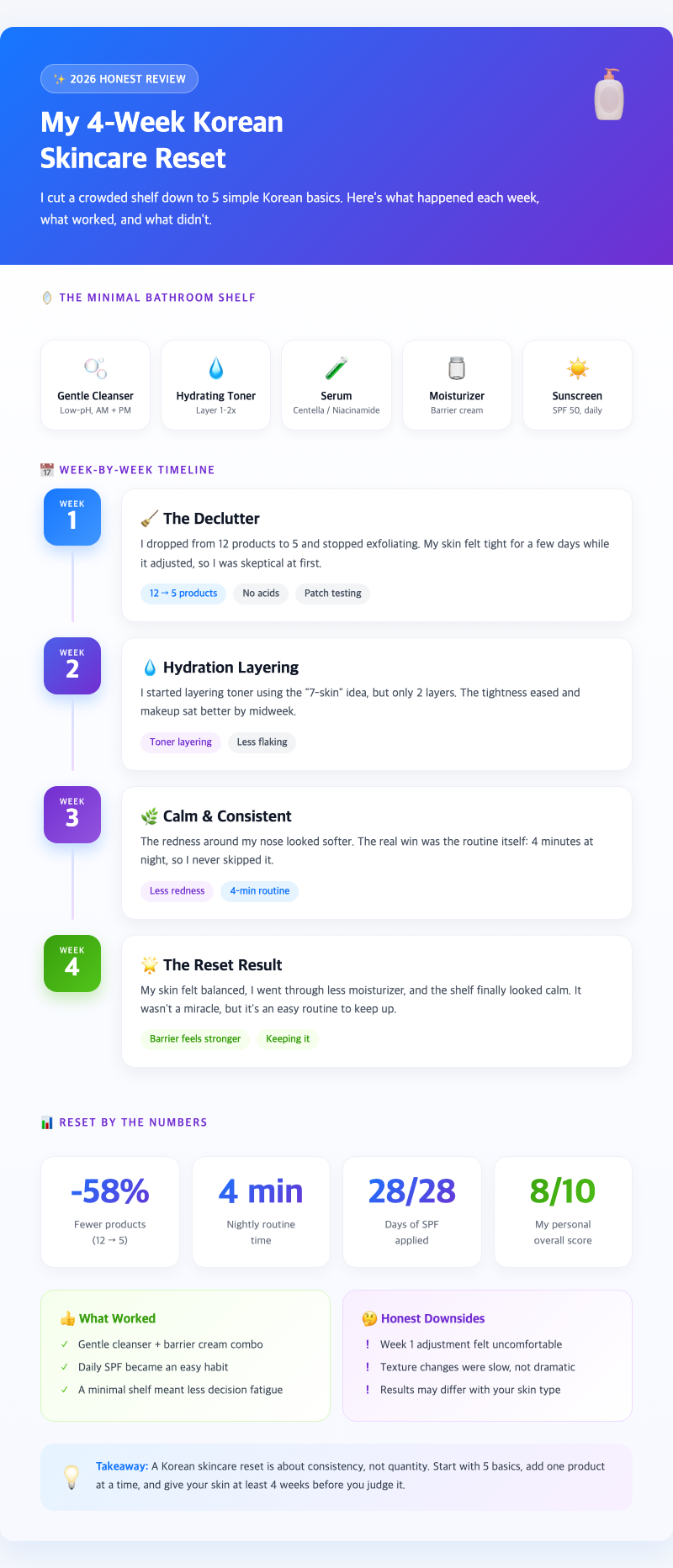
Why I Put My Korean Skincare Routine on a Four-Week Diet
When I worked as an MD, a big part of the job was building a reason to buy. A new launch needed a hook: a new step, a new ingredient, a new texture. I’m not saying those products were bad. Plenty were great. But the sales pitch always said you needed more, and after years of that I’d started believing it about my own skin.
The 10-step routine was mostly a marketing story aimed at overseas buyers. Most Korean women I know, including my mom, my editor friends and the dermatologist I see in Gangnam, use four to six products. Hwahae is the review app nearly everyone in Korea checks before buying, and its top-ranked items each year are mostly basics. Think cleansers, toners and sunscreens, not twelve-step systems.
So the reset had a simple brief. Every product had to do one clear job, and none could overlap with another. Here were my rules:
- Five products maximum, morning and night combined.
- Everything bought at retail with my own money. No samples or gifts.
- Nothing over ₩30,000 (about $21).
- A notes app log every night: redness, breakouts, tightness, and hours slept.
- No new product added in the middle. If something felt off, I took it out.
That last rule matters more than people think. When you add three things at once and break out, you have no idea which one did it. I’ve told readers this for years and ignored it myself for years. If you’re starting from zero, our guide to K-Beauty active ingredients explains which acids are the gentlest if you’re nervous about them.
My honest two cents: Exfoliating toners work. Exfoliating every day plus a cleansing brush is how you end up with stinging, red skin.
Week Two: Anua Heartleaf Changed My Mind
This is where I eat my words. When Anua Heartleaf took off overseas around 2023, I rolled my eyes. A watery toner with a plant extract, going viral on TikTok? I’d seen that cycle a dozen times at work. A brand gets a moment, everyone buys it, then six months later nobody talks about it.
I was wrong about Anua. Honestly, it’s the MVP of my 2025 and 2026 shelf.
Here’s how it feels. The liquid is thin, almost like water, with a faint green, slightly herbal smell that fades in seconds. I patted it on with my hands instead of a cotton pad, because pads felt like too much friction for my angry skin. It sinks in without any tackiness, and you can layer two or three rounds without it pilling.
Heartleaf, or Houttuynia cordata, has been used in East Asian traditional medicine for a long time. Lab research has looked at its anti-inflammatory and antioxidant properties. To be fair, that’s mostly cell and lab work, not big clinical trials on human faces. So I won’t claim it’s medically proven to fix redness. I can only tell you what my log showed.
From my notes app, scoring redness 1 to 5 each evening:
- Day 6 (the stinging day): 4
- Day 9: 3
- Day 12: 2
- Day 14: 2, and no stinging from the serum
Was that all the heartleaf? No. I’d also stopped exfoliating and was sleeping better (spoiler for week four). But I’d tried ‘calming’ toners before during flare-ups, including a centella toner I won’t name, and none of them settled things this quickly.
The trade-off: ₩28,000 (about $20) is at the top of my budget, and at that price the bottle doesn’t feel luxurious. It’s plain, basic packaging. But considering the 250ml lasted me almost seven weeks with patting, the cost per use is fine. On sale it often drops to around ₩19,000 to ₩21,000.
Tip for today: if your skin is irritated, skip the cotton pad and pat toner on with clean hands. Less rubbing makes a real difference.
My honest two cents: Viral doesn’t always mean overhyped. Heartleaf toner earned its spot on my shelf by calming redness faster than anything else I’ve tried.
Week Three: Sunscreen, White Cast, and Some Real Talk
Beauty of Joseon Relief Sun has been one of the most-hyped Korean sunscreens overseas for a few years. For me it holds up. The texture is creamy but light, with a soft, slightly sweet rice smell. It sits nicely under makeup and leaves a dewy finish I like. It never stung, even during my barrier disaster.
In Korea, sunscreens are regulated as ‘functional cosmetics’ by the Ministry of Food and Drug Safety (MFDS). Their UV protection claims go through review before they can be sold. That’s one reason I trust the SPF and PA ratings on Korean sunscreens more than on some random marketplace brands.
Now the part beauty roundups like to skip. Between you and me, a lot of Korean sunscreens still leave a white or grey cast on darker skin. Many, especially the ‘tone-up’ formulas Korean shoppers love, are made to brighten pale-to-medium skin on purpose. A brightening tint is the selling point here. On deeper skin tones it can look ashy.
I’m fair to medium, so I don’t see it on myself. I asked two friends to test, one Malaysian Indian and one Nigerian-British who lives in Itaewon. Here’s how it went:
| Sunscreen | Price (Olive Young) | Approx. USD | Cast on Fair/Medium Skin | Cast on Deeper Skin (friend test) |
|---|---|---|---|---|
| Beauty of Joseon Relief Sun: Rice + Probiotics | ₩18,000 | $13 | None | Very slight, faded in about 10 minutes |
| Round Lab Birch Juice Moisturizing Sun Cream | ₩25,000 | $18 | None | Slight sheen, no real cast |
| A popular tone-up sunscreen (I’m not naming the brand) | ₩22,000 | $16 | Brightening, intentional | Clearly grey and ashy |
My rule: if a Korean sunscreen says ‘tone-up’, ‘brightening’ or has a pink or lavender tint, and you have medium-deep to deep skin, swatch it on your jawline before you buy. Don’t trust photos of it on someone else’s arm.
Week three was also when I brought back the AHA toner, this time at two nights a week (Tuesday and Saturday), and the Clarisonic once that week on a non-acid night. No stinging. My texture was the smoothest it had been all year. For more SPF picks, see our look at Seoul beauty trends this year covers the shift toward slow, minimal routines.
My honest two cents: No toner, serum or sunscreen can make up for five hours of sleep. Fix that first and your products will actually work.
The Overrated List: Where I Disagree With the Hype
Since this review is about cutting things out, here’s what I cut and why. This is just my taste, but I’ve had my hands on all of these, both at work and with my own money.
COSRX. I’ll get angry messages for this one. COSRX built the global K-Beauty boom. The Advanced Snail 96 Mucin Power Essence (around ₩25,000, about $18) is still a good product, and it’s on almost every Western ‘best Korean skincare brands’ list. But I think it’s been hyped well past its peak. Newer indie brands like Torriden, Round Lab and Anua are doing simpler formulas with better textures for the same price or less. When readers ask me where to start, COSRX isn’t my first answer anymore.
Laneige Lip Sleeping Mask. Look, I worked at Amorepacific, which owns Laneige. I know how much effort goes into that little jar. It smells nice and the berry scent is cute. But at around ₩25,000 ($18) for 20g, it does basically what a tub of Vaseline does for about ₩5,000 ($4). It seals moisture into your lips overnight. That’s the job. Petroleum jelly does it perfectly well.
| Product | Price | What It Does Well | My Cheaper or Better Swap |
|---|---|---|---|
| COSRX Advanced Snail 96 Mucin Power Essence | ₩25,000 / $18 | Bouncy hydration, gentle | Torriden Dive-In Serum, ₩22,000 / $16 |
| Laneige Lip Sleeping Mask | ₩25,000 / $18 | Overnight lip moisture, nice scent | Vaseline, about ₩5,000 / $4 |
| 10-step routines and sets | ₩100,000+ / $70+ | Fun to collect | Five basics that each have one job |
To be fair: if you love the Laneige ritual, the scent and the cute jar, that’s a perfectly fine reason to buy it. Pleasure counts for something. Just don’t buy it thinking it does something Vaseline can’t.
And my contrarian take on the mainstream advice that you need a ‘complete’ routine: you don’t. You need a cleanser that doesn’t strip, something hydrating, sunscreen every morning, and maybe one active. Everything else is extra. Some of it is lovely, but it’s still extra.
My honest two cents: The brands that started the K-Beauty boom aren’t always the best buys now. Newer indie brands often do the same job better for less.
Pros, Cons, and Where to Buy Outside Korea
After four weeks, after reading back my own log, and after testing with two friends with very different skin tones, here’s my honest scorecard.
What worked:
- Redness dropped from a 4 to a 2 and stayed there after week two.
- No new jawline breakouts in weeks three and four.
- Texture was smoother with AHA twice a week than when I was using it daily.
- The whole routine took under four minutes at night.
- Total cost under ₩100,000 (about $69).
What didn’t:
- The Some By Mi toner has a noticeable tingle, and it can be too much for very sensitive skin even used weekly.
- The Anua bottle’s wide opening makes it easy to pour too much.
- Tone-up and some mineral Korean sunscreens still aren’t inclusive of darker skin.
- Five products is boring. For someone who loves skincare, I really missed the fun of trying new things.
For readers outside Korea, everything in my lineup is easy to find. In Singapore and Malaysia, Shopee has official brand stores for Anua, Round Lab, Torriden and Beauty of Joseon. Check that it says ‘official store’ before buying, because counterfeit sunscreen really happens. US and UK readers can find all of these on Amazon, YesStyle or iHerb. Prices usually run 20 to 40 percent above Olive Young once shipping is included.
Tip: Olive Young’s global online store ships to many countries now and runs big sales a few times a year. If you’re buying the whole routine, wait for one of those.
Check current prices on YesStyle for the full five-product routine.
My honest two cents: A simple Korean skincare routine has real limits, but most of them are about boredom, not results.
Frequently Asked Questions
Is Korean skincare actually better than Western skincare?
Not automatically. Korean brands are great at gentle, wearable textures, comfortable sunscreens, and fast-moving ingredient trends at low prices. Western brands are often stronger with prescription-style actives like high-strength retinoids. In my experience, the best routines mix both. Korean sunscreen and toner with a retinoid from a pharmacy brand is a perfectly good combination. What matters is the products that suit your skin, not the flag on the bottle.
How many steps does a Korean skincare routine really need?
Three to five for most people. Cleanser, a hydrating layer, and sunscreen in the morning are the basics. At night, add one active if you want one, like an AHA toner two or three times a week. The famous 10-step routine was mostly a marketing story for overseas audiences. Most Korean women I know, including dermatologists, use far fewer steps day to day.
Is Anua Heartleaf toner worth the hype in 2026?
Honestly, yes. That’s from someone who expected to hate it. It’s thin, fragrance-light, layers without pilling, and calmed my redness noticeably within about a week, though I also stopped over-exfoliating at the same time. At around ₩28,000 ($20) full price, it’s not the cheapest, but a 250ml bottle lasted me nearly seven weeks. Buy it on sale if you can.
Do Korean sunscreens leave a white cast?
Some do, especially tone-up formulas and certain mineral (zinc oxide or titanium dioxide) sunscreens. Many are designed to brighten lighter skin on purpose. Chemical-filter options like Beauty of Joseon Relief Sun usually leave little or no cast, but results vary. If you have medium-deep or deep skin, swatch along your jawline in daylight before you commit to a full tube.
Can I use an AHA toner every day?
I tried, and it went badly. Daily acid use plus a cleansing brush damaged my barrier within a week. Most people do better with two or three times a week, on nights without retinoids or physical scrubs. Also, the FDA advises daily sunscreen while using AHAs because they increase sun sensitivity. If a product stings when it normally wouldn’t, stop exfoliating for several days.
Where can I buy authentic Korean skincare in Singapore, Malaysia, or the US?
In Singapore and Malaysia, use official brand stores on Shopee or Lazada, or Olive Young’s global site. In the US and UK, YesStyle, iHerb, and brand storefronts on Amazon are the safest bets. Avoid third-party sellers with prices that look far too low, especially for sunscreen. Fake SPF is a real problem and you can’t tell by looking.
Is glass skin achievable for everyone?
The super-dewy, poreless look in ads involves lighting, makeup and often editing. A healthier, glowing version is realistic, though. In my experience, it depends on three boring things: a calm skin barrier, daily sunscreen, and enough sleep. My skin looked noticeably glassier in week four with the same products, and the only real change was about two more hours of sleep a night.
Would I Buy It Again? My Final Verdict
Four weeks, five products, one embarrassing exfoliation mistake, and a lot more sleep. Here’s where I ended up:
- Fewer products, each with one job, fixed my skin faster than 14 products ever did.
- Anua Heartleaf is the real deal, and I was wrong to write it off.
- AHA toners are great two or three times a week and a bad idea every day.
- Korean sunscreens feel wonderful, but darker skin tones should swatch first.
- Sleep did more for my skin than anything I bought.
My rating: 4.5 out of 5 stars. I took half a star off for the white cast issue on some Korean sunscreens and because a minimal routine gets boring for someone like me.
Would I buy it again? I already have. I picked up my second bottle of Anua at the Seongsu Olive Young last week, I’m on my third Beauty of Joseon tube, and the Clarisonic is back to once a week where it belongs. If you want to copy the routine, start with our check current prices on YesStyle. Last reviewed: November 2026.