Disclosure: This post contains affiliate links. If you buy through them, I may earn a small commission at no extra cost to you.
아침에 일어나서, the first thing I see is the window of my officetel. It faces a brick wall in Hongdae, and the light at 8am is grey and honest. Not golden. That’s where I check my skin, and it’s why I don’t trust most korean skincare videos. I’ve lived here since 2021. I walk about 14,000 steps a day between Hongik Univ station exit 9, the cafes in Yeonnam-dong and the Olive Young near the main Hongdae street. The thing I think about a lot is this: the korean skincare people in Seoul actually do looks nothing like the ten-step ritual you see online.
솔직히, most ‘5am Seoul morning routine’ videos are staged. I know because I’ve filmed a few of them. The ring light goes on, the toner gets poured slowly for the camera, and then everyone goes back to bed. What most people here actually do is shorter and cheaper, and it’s mostly about not wrecking your skin barrier.
So this is a how-to guide, not a product haul. You’ll learn the seven steps I use, the order to do them in, what each one is for, and the mistakes I made so you can skip them. I’ll name the products I actually buy, with the Korean prices I paid and rough USD conversions (I’m using about ₩1,380 to the dollar, and prices change often). If you’re in Singapore or Malaysia, most of these brands are on Shopee. US and UK readers can find them on Amazon, YesStyle or iHerb. I also messed up badly once with acids and retinol, and I’ll tell you about that in Step 7.
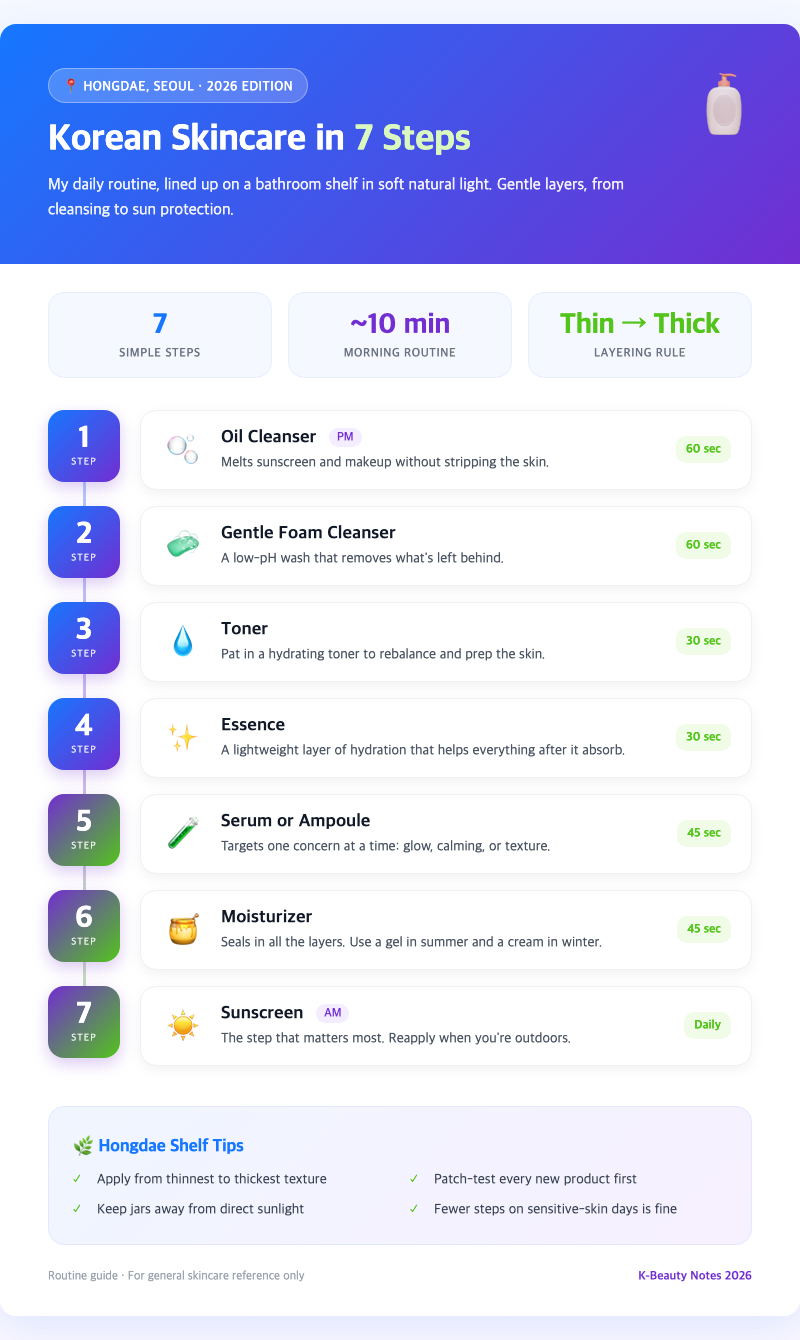
What You Need Before You Start Your Korean Skincare Routine
I’ve been buying skincare in Hongdae and Yeonnam for five years, mostly on a freelancer budget of ₩2-3 million a month. So my first rule is this: you don’t need a drawer full of bottles. You need a few products that fit your skin, and you need to use them for long enough to tell whether they work.
Here’s what to gather before Step 1:
- Time: About 5 minutes in the morning and 8 at night. If a routine takes longer than that, you’ll quit it by week three.
- A gentle cleanser and, if you wear sunscreen daily, an oil or balm cleanser for the evening.
- One hydrating toner with no alcohol high on the ingredient list.
- One serum chosen for a single concern (Step 4 shows how to pick).
- One moisturizer with ceramides or a similar barrier ingredient.
- A sunscreen you’ll actually wear, SPF 50 with a PA rating.
- A notebook or notes app to log what you started and when. It’s a small thing but it’s the step people skip, and it’s how you find out what’s breaking you out.
Here’s what a realistic starter kit costs at an Olive Young in Seoul compared to buying abroad. These are approximate shelf prices I’ve seen this year. Olive Young runs sales almost every month, so you’ll often pay less.
| Step | Product I use | Seoul price (approx.) | Approx. USD | Where to buy abroad |
|---|---|---|---|---|
| Cleanser | Round Lab 1025 Dokdo Cleanser 150ml | ₩12,000 | $9 | YesStyle, Amazon, Shopee |
| Toner | Round Lab 1025 Dokdo Toner 200ml | ₩25,000 | $18 | YesStyle, Amazon, Shopee |
| Serum | COSRX Advanced Snail 96 Mucin Power Essence 100ml | ₩25,000-29,000 | $18-21 | Amazon, iHerb, Shopee |
| Moisturizer | Illiyoon Ceramide Ato Concentrate Cream 200ml | ₩22,000 | $16 | YesStyle, Amazon |
| Sunscreen | Beauty of Joseon Relief Sun SPF50+ PA++++ 50ml | ₩18,000 | $13 | YesStyle, Amazon, Shopee |
That’s roughly ₩100,000, or about $75, for a kit that lasts two to three months. For context, K-lifestyle content rarely shows the rent. An average officetel around here runs ₩600,000-₩900,000 a month ($435-650), and mine is near the top of that range. Skincare comes out of whatever’s left after that. If you want to see how the full regimen fits together first, my guide to K-Beauty active ingredients breaks down the main ones.
The small thing to remember: Use one serum for one concern for at least four weeks. That’s the only way to know whether it works.
Step 5: Seal It In With a Barrier Moisturizer
If I could keep only one step besides sunscreen, it would be this one. Your skin barrier is the outermost layer that holds water in and keeps irritants out. The Korean products that have impressed me most over the past two years aren’t the glowy ones. They’re the boring ceramide creams that dermatology clinics in Seoul hand to patients after laser treatments.
How to do it:
- Take a pea-to-almond-sized amount, depending on how dry you are.
- Warm it between your fingertips and press it over your face, neck included.
- At night, if you’re very dry, add a thin layer of sleeping mask on top. I use Laneige Water Sleeping Mask (around ₩34,000 for 70ml, about $25) two or three nights a week in winter only.
My two moisturizers are Illiyoon Ceramide Ato Concentrate Cream (around ₩22,000 for a big 200ml tub, about $16), which also goes on my elbows, and Aestura Atobarrier 365 Cream (around ₩31,000-38,000 for 80ml, about $22-28) when my face is acting up. The Aestura one feels nicer and absorbs faster. The Illiyoon one is more than twice the volume for less money. I usually have both, and the trade-off is really just texture versus value.
Why it matters: Ceramides are lipids your skin already makes, and they play a large role in holding the barrier together. When the barrier is damaged, water escapes faster. Dermatologists call this transepidermal water loss, and your skin feels tight, stings with products that never bothered it before, and often breaks out more. A moisturizer with ceramides, cholesterol and fatty acids helps repair that.
Common mistake: Oily skin skipping moisturizer altogether. I hear this a lot, and I believed it at 22. Oily skin can still be dehydrated. If you’re oily, choose a gel-cream, but don’t skip the step.
The small thing to remember: Glowy skin starts with a healthy barrier. A plain ceramide cream will do more for most people than an expensive glow serum.
Step 6: Wear Sunscreen Every Morning, Even Under Grey Seoul Skies
This is the step I’d tattoo on people if I could. Korean sunscreens are the reason a lot of my friends abroad got into K-beauty in the first place. They’re light, they don’t leave a white cast on most skin tones, and they don’t smell like a beach. Sunscreen is also what makes every brightening or anti-aging step actually pay off.
How to do it:
- Apply it as the last step of your morning routine, after moisturizer.
- Use enough. The common guidance for the face is about a quarter teaspoon, which is roughly two finger-lengths. Most people use half that.
- Don’t forget your ears, neck and the back of your hands.
- Reapply every two hours if you’re outdoors. On long walking days around Yeonnam I carry a sun stick in my tote.
| Sunscreen | Rating | Seoul price (approx.) | Best for | Downside |
|---|---|---|---|---|
| Beauty of Joseon Relief Sun | SPF50+ PA++++ | ₩18,000 / ~$13 | Normal to dry skin, no-makeup days | Slight dewy finish that can look shiny by afternoon |
| Round Lab Birch Juice Moisturizing Sun Cream | SPF45 PA++++ | ₩20,000 / ~$15 | Dry or dehydrated skin | Not ideal for very oily t-zones in summer |
| Isntree Hyaluronic Acid Watery Sun Gel | SPF50+ PA++++ | ₩19,000 / ~$14 | Combination skin, under makeup | Can sting near the eyes for some people |
Why it matters: The American Academy of Dermatology recommends broad-spectrum sunscreen of at least SPF 30 every day, and Korean formulas also carry a PA rating for UVA protection. The more plus signs, the higher the UVA protection. UVA gets through clouds and windows, and it’s strongly linked to pigmentation and photoaging. In Korea, sunscreens are regulated by the MFDS as functional cosmetics, which is one reason the category is so competitive here.
Common mistake: Skipping it on cloudy days or when you’re ‘just going to the cafe.’ I used to skip it for my 10-minute walk to get coffee. Then I worked out that I do that walk twice a day, every day. That ₩4,500 iced Americano in Seongsu is robbery, by the way, but I still pay it. At least the sunscreen is the cheap part of that habit.
The small thing to remember: If you only change one thing after reading this, start wearing sunscreen every morning.
Step 7: Exfoliate Gently, Then Be Patient for Six Weeks
This is the step where I made my biggest mistake, so I’ll start with that. In spring 2023, I bought an AHA toner, a BHA serum and a retinol cream in the same Olive Young sale and started all three the same week. I wanted glass skin before a brand shoot. By day nine my cheeks were burning when I put on plain moisturizer. I ended up at a dermatology clinic in Hapjeong. The doctor took one look and told me to stop everything except cleanser, ceramide cream and sunscreen for a month. I did. My skin recovered, and the shoot got moved to a week when I didn’t look sunburned.
What to do instead:
- Choose one exfoliant. Gentle PHA or a low-percentage AHA if your skin is dry. BHA (salicylic acid) if it’s oily or acne-prone.
- Use it once a week for two weeks, then go up to twice a week if your skin is fine.
- Use it at night only, and never on the same night as retinol.
- Follow with your barrier moisturizer, and be extra careful with sunscreen the next morning.
COSRX BHA Blackhead Power Liquid (around ₩22,000 for 100ml, about $16) has been my steady pick. It’s gentle enough that I can trust it, and for me it works better than scrubs.
Why it matters: Chemical exfoliants loosen dead skin cells so your skin looks smoother and brighter. Overdoing them damages the barrier you built in Step 5. Skin also renews itself on roughly a monthly cycle in younger adults, and more slowly as you age. That’s why dermatologists usually say to give a new routine four to six weeks, and closer to twelve for pigmentation, before judging it.
Common mistake: Quitting at week two because nothing happened, then buying something new. That restarts the clock. If you want a structured way to see whether things are working, my glass skin myth vs reality post compares unfiltered photos from my own routine.
You Did It! Your Korean Skincare Routine, Simplified
If you’ve read this far, you know more than I did when I walked into my first Olive Young in 2021 and walked out with eleven products I didn’t need. Here’s the short version:
- Check your skin in daylight on a normal day, and again when the season changes.
- Double cleanse at night only, and stop chasing the squeaky-clean feeling.
- Use one or two thin layers of toner and one serum for one concern, for at least four weeks.
- Treat ceramide moisturizer and daily sunscreen as non-negotiable.
- Exfoliate once or twice a week at most, and never start several actives at once.
Next-level tip: After six weeks, take a second daylight photo next to your first one. If something improved, keep that routine for three months before changing anything. Most people’s skin gets better from keeping a routine steady, not from buying something new.
If you’re in Yeonnam-dong, which is calmer than Hongdae, I promise, the Olive Young near the station is the easiest place to test textures in person. If you’re shopping from abroad,