Disclosure: This post contains affiliate links. If you buy through them, I may earn a small commission at no extra cost to you. I paid for every product mentioned here with my own money.
Okay so, confession first. I’m a cat person. Three cats, one condo in PJ, and a monthly vet-and-supplies bill that hovers between RM250 and RM400 (about USD 55-90). So when people in my PJ cat-mom Telegram group started asking me about korean dog care, I almost said “wrong person, lah.” But I kept seeing the same thing. The Korean pet products turning up in our group chats, in the Pet Lovers Centre aisle at 1 Utama, and in my Shopee recommendations weren’t really made for dogs or for cats. They were made for mouths. Korean dog care, and Korean cat care with it, has quietly turned into an oral-care category, and that’s the shift I want to talk about.
The number that got me is an old one. The American Veterinary Medical Association says most dogs and cats show some sign of periodontal disease by the time they’re three. Three! Mochi, my Persian, was four when I adopted her from SPCA Selangor in 2020, and her breath could strip paint. I tried eight toothpastes before I found one she wouldn’t spit at me. I learned this the hard way, and a lot of money went down the sink.
So this isn’t a top-10 list. It’s my attempt to figure out why Korean pet care went from “cute shampoo with a bear on it” to “enzymatic toothpaste with a melon flavour,” who’s pushing it, and where I think it’s going in 2027. There’s also an honest bit about where the hype is ahead of the evidence.
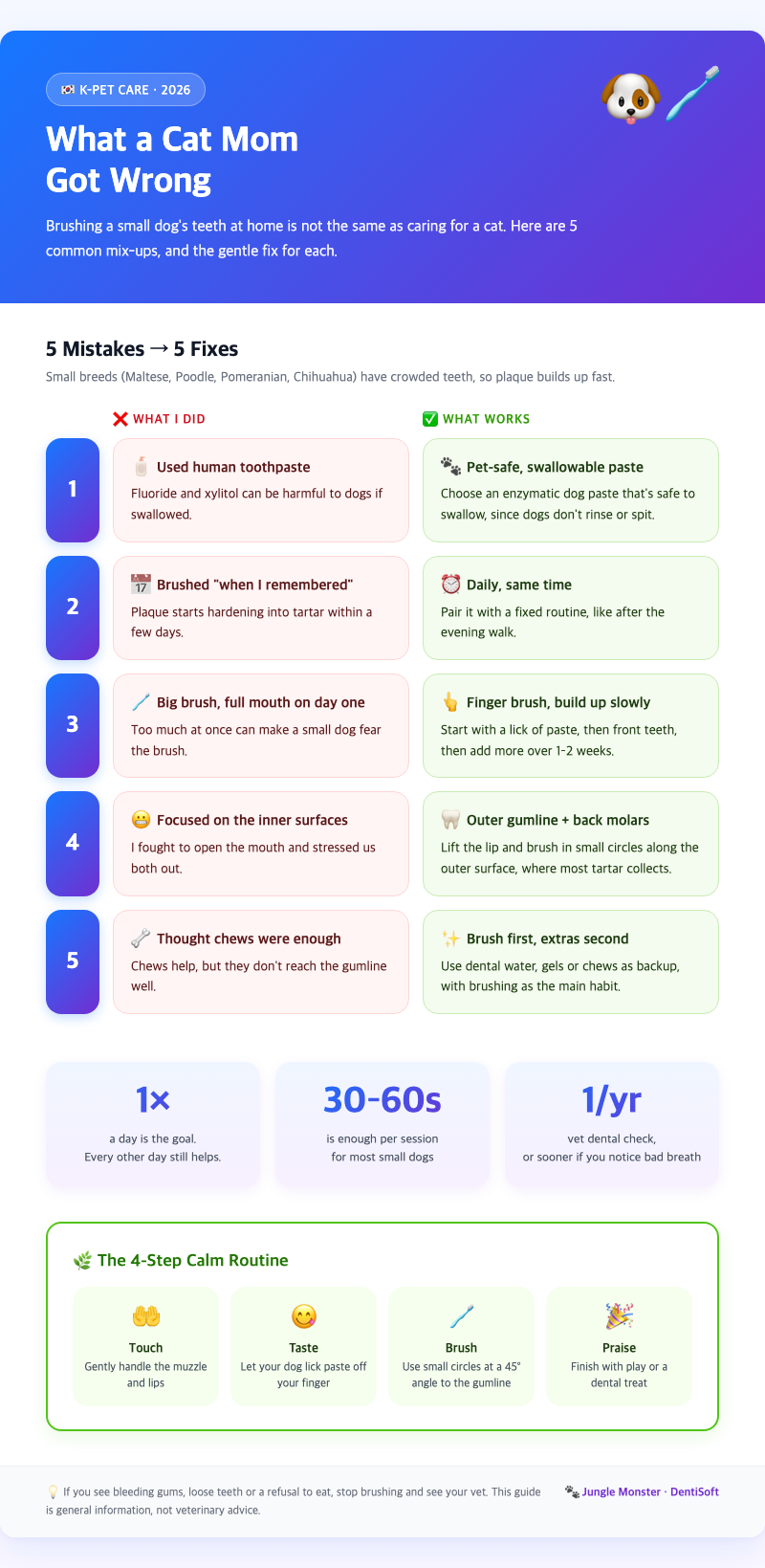
The Signal: Korean Dog Care Is Becoming a Dental Category
Real talk, I didn’t notice the shift because of a report. I noticed it in my cart. Two years ago my Shopee MY history was litter, kibble, and the odd feather toy. This year it’s toothpaste, two kinds of toothbrush, a water additive, and dental wipes I regret. When I scrolled back through our Telegram group’s “what are you buying” thread, most of the Korean brand mentions were oral-care products. That’s one woman’s chat history, not a market study. But the bestseller lists say the same thing.
Look at what Amazon and Chewy put up front in their 2026 dental-care rankings. Chews still lead (Greenies is basically wallpaper at this point), but toothpastes, brushes and water additives now get their own sections. Editorial roundups like the ones from Dogster and Preventive Vet now build their picks around AAHA’s 2019 Dental Care Guidelines and the Veterinary Oral Health Council (VOHC) accepted-products list. Five years ago they mostly ranked by “dogs love the taste.” Pet owners have started asking whether a product works, not just whether the dog eats it.
Korean brands are well placed for that question, because the Korean market got there first. Walk into a pet shop in Seoul (I did, on a work trip in 2024, and dragged a very patient colleague with me) and the dental shelf is longer than the treat shelf. There are toothbrushes with heads the size of a fingernail, toothpastes in four flavours from the same line, and gel versions for pets who won’t tolerate a brush at all. When I came home I started noticing the same brands turning up on Shopee MY with Korean packaging and sticker translations.
If you want the basics before the trend talk, I wrote up a piece on how Korean pet care borrows from K-Beauty.
Here’s how my own spending changed over the same period. It’s a rough mirror of the market:
| Year | What I bought most (3 cats) | Approx. monthly spend | Oral-care share |
|---|---|---|---|
| 2020 | Food, litter, shelter-recommended shampoo | RM180 (USD 40) | Almost zero |
| 2022 | Food, litter, Greenies Feline treats | RM240 (USD 53) | Treats only (~RM35) |
| 2024 | Food, litter, Virbac C.E.T. paste, finger brush | RM310 (USD 69) | ~RM60-70 |
| 2026 | Food, litter, Korean enzymatic paste, micro-bristle brush, water additive | RM350-400 (USD 78-89) | ~RM80-89 |
Notice the 2024 row. That finger brush is a story for later, and it involves blood. Mine.
What I’d tell a friend: if you’ve got a small-breed dog or a flat-faced cat, start dental care earlier than you think you need to.
Who’s Driving It: Small Brands, Picky Pets, and Group Chats
It’s easy to give the credit to big multinationals. They do own the shelf space at Pet Lovers Centre and they own most of the VOHC seals. But the energy in Korean dog care comes from much smaller players, and from people like me.
First, the small Korean brands. Many started as one-product companies fixing a specific complaint, like “my dog won’t let a brush in” or “my cat hates mint.” Junglemonster is a good example of the type. Its 냥치멍치 (Nyang-chi Meong-chi, a cute play on “cat teeth, dog teeth”) line comes in chicken, sweet potato, melon and blueberry. That sounds gimmicky until you’ve owned a Persian who rejects everything. Multiple flavours is a practical feature, not just a marketing one.
Second, Korean vet clinics. The Korean Veterinary Medical Association and many Seoul clinics have pushed home brushing hard, partly because scaling under general anaesthesia is expensive and owners of elderly small dogs are nervous about it. When the vet says “brush daily or we’ll be doing this again under anaesthesia,” people go home and buy a toothbrush.
Third, and I don’t think this gets enough credit, it’s us. The group chats. My PJ cat-mom Telegram group has a couple hundred members, and the most shared message type isn’t cute photos. It’s “has anyone tried X, did your cat spit it out?” Korean products spread through that kind of peer testing. One person orders during a Shopee sale, three people copy, and a month later half the group is using the same paste. There’s a dog-owner group in Damansara Utama that does the same thing, and the overlap is real. Several of us have dogs and cats.
I’ll be honest about the limits here. Group-chat word of mouth is great for “will my pet tolerate it” and terrible for “does it actually reduce plaque.” Nobody in my chat is running a controlled trial. That’s what the VOHC exists for, and most small Korean brands don’t carry its seal yet. Keep that in mind.
What I’d tell a friend: use other owners’ reviews to judge tolerance, and use vets and VOHC to judge whether something works. Keep the two questions apart.
What It Means for the Industry: The Dental Treat Is Getting Called Out
Here’s my unpopular opinion, and my vet would kill me but I’ll say it anyway. Most pet “dental treats” are just biscuits with marketing. I fed Bao, my domestic shorthair, Greenies Feline (around RM35, about USD 8, for a pouch) for over a year, believing they were doing the job. His next check-up showed tartar building along his back molars anyway.
To be fair, some chews do carry VOHC acceptance, and the VOHC seal means the product met set standards for reducing plaque or tartar in trials. That’s real. But a lot of shelf products say “dental” with no seal, no trial, and a crunchy texture that mostly cleans the tips of the teeth. Gum disease starts at the gum line, which crunching doesn’t reach. AAHA’s 2019 guidelines are blunt that daily brushing is the most effective home-care method, and that everything else is a supplement.
The Korean brands have, intentionally or not, built their whole pitch around that gum-line problem. Brush heads keep getting smaller and bristles keep getting finer so they can slip into the gingival margin. This is how the industry is getting pulled. Western bestseller lists are adding more brushes and enzyme pastes because buyers who have tried both are asking for them.
Here’s how I’d sort the categories after six years of buying all of them:
| Category | Typical MY price | Reaches gum line? | My honest take |
|---|---|---|---|
| Dental treats / chews | RM35-60 (USD 8-13) | Rarely | Fine as a reward. Only trust VOHC-sealed ones for any dental claim. |
| Water additives | RM45-75 (USD 10-17) | No (chemical action only) | Helpful for breath, a lazy-day backup. Not a replacement. |
| Enzymatic toothpaste | RM35-60 (USD 8-13) | Yes, with a brush | The core of the routine. Flavour decides if it’s used. |
| Micro-bristle toothbrush | RM25-50 (USD 6-11) | Yes | Biggest upgrade I’ve made. |
| Dental wipes | RM30-45 (USD 7-10) | Partly | Okay for nervous pets. Mochi ate one. Don’t ask. |
What I’d tell a friend: look for the VOHC seal before you believe the word “dental” on a treat bag.
What It Means for Consumers: Flavour Is the Real Feature
This is where I’ve earned my opinions the hard way. Eight toothpastes for one cat. Let me save you some money.
The best toothpaste is the one your pet lets you use every day. A clinically perfect paste that ends up on your wall does nothing. I started with Virbac C.E.T. poultry (around RM45, about USD 10). It’s a respected, vet-recommended product, and Bao and Tofu, my Munchkin, were fine with it. Mochi treated it like poison. Then came a beef one, a malt one, an unflavoured gel and a mint one. I don’t know who thought mint was a good idea for a cat.
Junglemonster’s DentiSoft 냥치멍치 in melon was the first one Mochi didn’t spit out. I can’t fully explain why. My guess is the sweeter, less meaty smell suits a cat who’s fussy about strong odours. It’s one of the few pastes in my drawer that’s used daily rather than “sometimes.” It uses an enzymatic formula, so even a quick, imperfect brush is doing something. The trade-off: it doesn’t carry a VOHC seal the way some Western brands do, so I’m relying on the enzyme mechanism and my vet’s check-ups rather than a published trial. At roughly RM35-50 depending on the sale, I’m okay with that bargain, but you should know it’s a bargain.
Now the finger brush. If you’ve got a Persian, you know. Don’t buy a finger brush if you’ve got a Persian unless you want stitches. That flat face means your finger is millimetres from her teeth, and she knows it. My 2024 finger-brush era ended with a trip to a clinic on Jalan SS2/24 and a tetanus shot. A long-handled micro-bristle brush keeps your hand out of range and reaches the back molars better anyway.
If you’re building a routine from scratch, this is the order that finally worked in my house:
- Let your pet lick the paste off your finger for 3-4 days. No brush yet.
- Rub paste along the gums with a soft brush for 10 seconds, then reward.
- Work up to 30 seconds per side over two weeks.
- Add a water additive only as a backup for days you miss.
What I’d tell a friend: buy a small tube in two flavours first and let your pet choose. It’s cheaper than buying eight like I did.
The Gum-Line Brush: Where Korean Design Earns Its Hype
Of everything in the Korean dog care wave, brushes are the part I’m least cynical about. Most pet toothbrushes sold here for years were basically human toothbrushes with an angled handle. Their bristles were too thick and their heads too big for a Shih Tzu, never mind a cat.
Korean designs went the other way. Junglemonster’s Dentisoft brush uses 0.01mm ultra-fine bristles, and the brand says it removes 73% more plaque at the gum line than standard brushes. I’ll be careful here. That’s the manufacturer’s figure, I haven’t seen the underlying test, and you should treat any brand stat with the same suspicion you’d give a “dental” biscuit. What I can tell you from experience is that the bristles bend into the gum margin instead of scraping across it, and none of my cats has bled on it. The old medium brush made Bao’s gums bleed, and my vet said that was the brush, not just gingivitis.
Here’s how it compared with the two brushes I used before:
| Brush | Approx. price (MY) | Pros | Cons |
|---|---|---|---|
| Junglemonster Dentisoft (0.01mm bristles) | RM25-40 (USD 6-9) | Very soft, small head, gentle on gums, works for cats and toy dogs | Wears out faster. I replace it about every 6-8 weeks. Brand plaque claim not independently verified. |
| Virbac C.E.T. dual-ended brush | RM20-30 (USD 4-7) | Widely available, vet-trusted, cheap | Bigger head is awkward for a Persian jaw; firmer bristles |
| Generic silicone finger brush | RM10-15 (USD 2-3) | Cheap, easy for dogs who are calm | Puts your finger in the danger zone, barely reaches the gum line, and I have the scar |
If you’re in Singapore or Malaysia, Junglemonster is available on Shopee Malaysia (and on Shopee SG for my Singapore friends). US and UK readers will find more VOHC-sealed options on Amazon and Chewy, which is a fair reason to look there too. For a broader side-by-side, I keep a running guide to reading VOHC seals and pet dental labels is where I’ll keep updates.
What I’d tell a friend: buy Korean for the design and the flavours, and keep asking brands for evidence.
Frequently Asked Questions
What is Korean dog care, and why is it trending in 2026?
Korean dog care means the pet-care products and habits coming out of South Korea’s pet market, which has a lot of apartment-living small breeds and owners who see pets as family. In 2026 it’s trending mostly because of oral care: enzymatic toothpastes in several flavours, ultra-soft micro-bristle brushes and water additives. They fit the AAHA’s recommendation of daily brushing and make it easier for fussy pets to put up with.
Are dental treats enough to clean my dog’s or cat’s teeth?
In my experience, no. Most dental treats clean the tips of the teeth, while gum disease starts at the gum line. Some chews carry the Veterinary Oral Health Council seal, which means they passed plaque or tartar trials, and those are worth buying. Even then, AAHA’s 2019 guidelines treat daily brushing as the gold standard. Think of treats as a supplement, and give a treat without a seal no more credit than a biscuit.
Is Korean pet toothpaste safe for cats?
Pet-specific enzymatic toothpastes, Korean or otherwise, are made to be swallowed, which matters because cats can’t rinse. Never use human toothpaste: xylitol and some fluoride levels are dangerous for pets. Check the ingredient list, start with a small amount, and watch for drooling or vomiting. If your cat has existing gum disease, see your vet before you start brushing, because sore gums need treatment first.
How often should I brush my dog’s teeth?
Daily is the target recommended by the AVMA and AAHA, because plaque starts hardening into tartar within days. Real talk though: three or four times a week is far better than zero, and most of my progress came from consistency, not perfection. Start with 10-second sessions, reward heavily, and build up over two weeks. A missed day isn’t a disaster. Skipped months are.
When is the best time to buy Korean pet products in Malaysia?
Shopee MY’s 11.11 sale is usually the best time, followed by 12.12. Korean pet brands often join the bigger vouchers then, and stacking free shipping and shop coupons can bring toothpaste and brushes down to the lower end of the RM35-RM89 range I usually pay. Stock up on consumables like toothpaste. Don’t overbuy brushes, since they wear out every couple of months.
Is a finger brush good for a Persian or flat-faced cat?
I’d say no, and I have the scar to prove it. A Persian’s flat face puts your finger right next to her teeth, and finger brushes are bulky and don’t reach the back molars well. A long-handled, small-headed, ultra-soft brush keeps your hand out of range and fits the jaw better. If your cat won’t take any brush yet, start with paste on your finger for licking only, with no scrubbing.
Do water additives actually work for pet dental hygiene?
They help, mostly with breath and as a backup on days you can’t brush. Some carry VOHC acceptance for tartar control, so check the label. But they act chemically and can’t remove plaque that has already stuck to the teeth. I use one as a supplement for all three cats, and some pets refuse water with additives, so introduce it slowly and keep a plain bowl available.
Is Korean dog care worth the extra cost over Western brands?
It depends what you need. Korean brands usually win on design (softer brushes, more flavours) and on tolerance for fussy pets. Western brands like Virbac and Greenies more often have VOHC seals and published trials. I use both: a Korean brush and paste because my Persian accepts them, and VOHC-sealed treats as occasional rewards. If your pet already accepts a Western paste, there’s no reason to switch.
My Prediction for the Next 12 Months
Okay so, here’s where I’ve landed after six years, three cats and one tetanus shot. Korean dog care has stopped being a grooming trend and become a daily oral-care habit, and the habit is the useful part.
- Daily brushing still beats every chew, wipe and additive on the market.
- Flavour and brush softness decide whether you’ll actually keep it up, and that’s where Korean brands are strongest.
- Most “dental” treats are just biscuits with marketing unless they carry a VOHC seal.
- Shopee MY’s 11.11 sale is the cheapest time to stock up on Korean pet consumables.
- Brand plaque statistics are claims, not proof. Keep asking for evidence.
My falsifiable prediction: by November 2027, at least one Korean pet oral-care brand will have a product on the VOHC accepted list, and oral care (toothpaste, brushes and additives) will be the top-selling Korean pet category on Shopee MY during 11.11, ahead of shampoo and grooming. If I’m wrong, I’ll come back and say so in this post. Until then, if you’re starting out, try a small tube in two flavours and a soft brush, and see what your pet accepts. Check Junglemonster on Shopee SG/MY, or browse VOHC-sealed options on Amazon if you’re in the US or UK. Last reviewed: November 2026.