Disclosure: This post is published by Junglemonster, a Korean pet care brand. Some of the products mentioned below are made by us, and some links are affiliate or store links. We have tried to be clear about where our products fit and where they don’t.
Veterinary dental organisations commonly estimate that most dogs show signs of periodontal disease by about age three. That’s not senior dogs. It’s three-year-olds. This is a big reason korean dog care puts so much weight on the mouth. In Seoul apartments, where Maltese, Poodles and Pomeranians outnumber big breeds, nightly tooth brushing (양치, yangchi) is as normal for a dog as it is for a child. If you’ve wondered why Korean pet shelves are full of soft brushes, flavoured gels and water additives, that’s the reason. Korean dog care treats prevention as an everyday habit, not a one-off yearly fix.
The problem for owners in Singapore and Malaysia is the cost. A professional dental scale and polish under anaesthesia often costs several hundred ringgit or dollars, and much more if extractions are needed. The search results this month are full of ‘low-cost dog dental near me’ guides, which tells us plenty of owners are facing that bill right now.
Below are seven Korean dog care habits worth copying, roughly in order of impact. Here is how we picked them: (1) each one is backed by published veterinary guidance, mainly the WSAVA Global Dental Guidelines and the position statements of the American Veterinary Dental College (AVDC); (2) a busy owner can do it at home in under five minutes a day; and (3) it works in a hot, humid Southeast Asian climate. We make some of the products in this space, so we also point out where our products are not the answer.
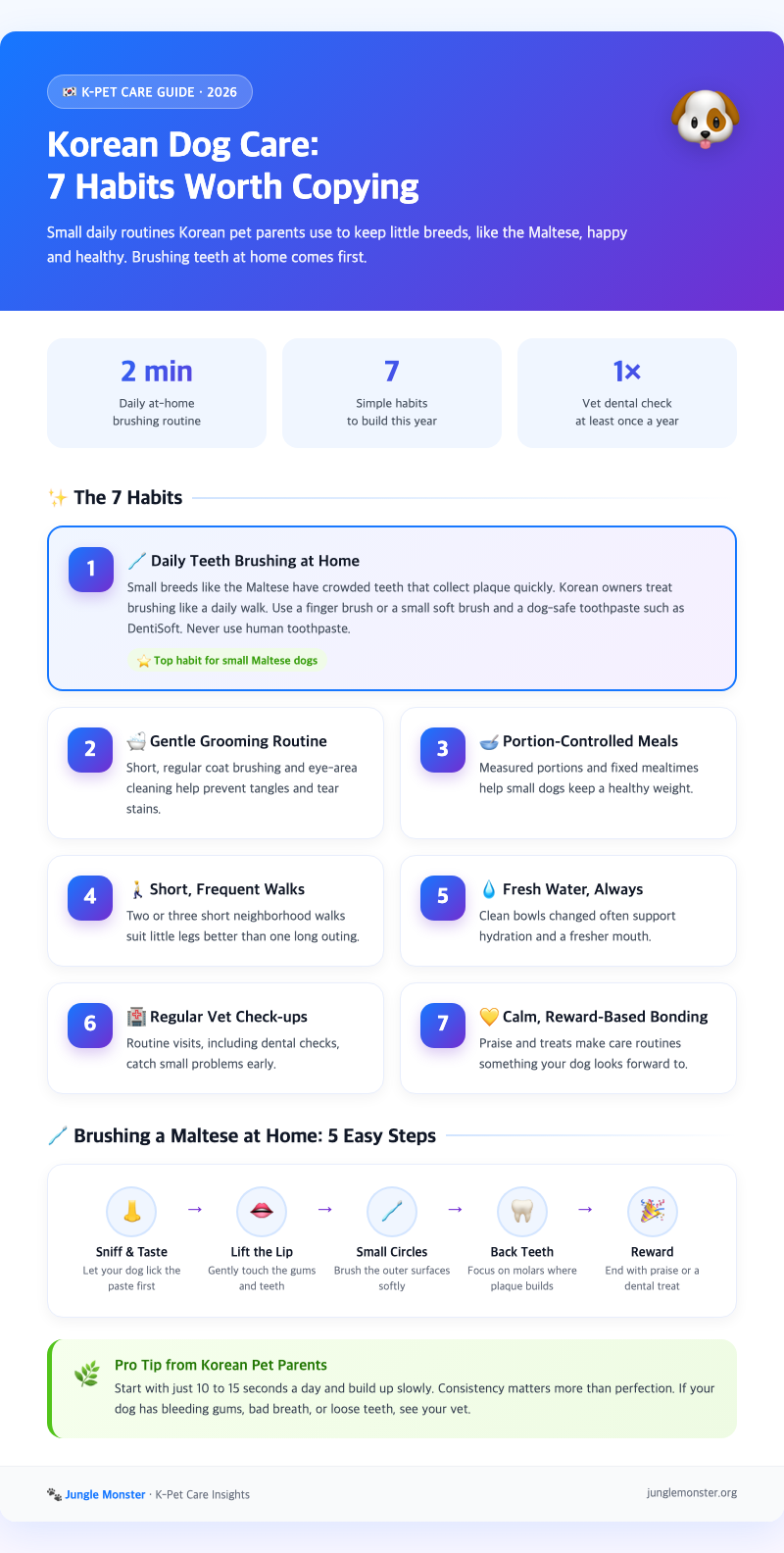
1. Brush Daily With an Ultra-Soft Brush (The Korean Yangchi Habit)
Every serious dental guideline gives the same answer to ‘what actually works?’ The WSAVA Global Dental Guidelines call daily tooth brushing the gold standard of home oral care. The reason is mechanical. Plaque is a soft bacterial film that starts to mineralise into hard tartar within days. A brush can remove plaque. It can’t remove tartar. Once tartar forms, only a vet’s scaler can get it off.
Korean owners have built this into a routine more than a technique. Brushing happens at the same time every night, usually after the last meal, and it’s short. Thirty seconds of brushing done every day beats a thorough five minutes done every other Sunday. Korean brushes for small dogs also tend to have very fine, soft bristles, because a Maltese’s gums are small and easily irritated. A dog that has been hurt by a stiff brush learns to clamp its mouth shut.
- Start with the outside surfaces of the upper back teeth (the carnassials and molars). That is where tartar builds up first, and you don’t need to open the dog’s mouth to reach them.
- Angle the bristles about 45° toward the gum line. Periodontal disease starts there, not on the tip of the tooth.
- Keep the first week to 10 seconds. Stop before your dog wants to stop, and finish with praise or a meal.
- Skip the inside surfaces at first. The tongue cleans them reasonably well, and most dogs won’t allow it early on anyway.
If your dog has never been brushed, our guide to reading dog treat labels.
Without a VOHC seal, a ‘dental’ chew is just a treat, so budget for it like one.
6. Book Proper Anaesthetic Cleanings and Skip ‘Anaesthesia-Free’ Scaling
Even with perfect home care, most dogs eventually need a professional cleaning. This is where the ‘low-cost dental near me’ searches come from. Saving money here is sensible, but there’s one shortcut to avoid.
‘Anaesthesia-free dental cleaning’ is offered by some groomers and is often cheaper. The AVDC has a formal position against it. Scraping visible tartar off an awake dog makes the teeth look clean but leaves the disease under the gum line untouched. It also gives no chance for dental X-rays or a full probe of each tooth. The owner thinks the problem is solved while it carries on below the gums. A proper cleaning under general anaesthesia, ideally with dental radiographs, is the standard of care.
| Option | What you get | Typical cost level | Our view |
|---|---|---|---|
| Anaesthesia-free scaling (groomer) | Cosmetic tartar removal above the gum line | Low | Not recommended; hides disease below the gums |
| Private clinic cleaning under anaesthesia | Full scale and polish, often with X-rays | Moderate to high | Standard of care; ask for an itemised quote |
| University teaching hospital (e.g. UPM University Veterinary Hospital, Serdang) | Supervised care, sometimes at lower cost | Often lower | Worth calling; waiting times can be longer |
| Welfare-group clinics (e.g. SPCA Selangor, Ampang) | Varies by programme | Lower | Call ahead; services and eligibility change |
How to cut the bill without cutting corners: ask for an itemised estimate, ask whether pre-anaesthetic blood work is included, and book earlier rather than later. A cleaning at age three with no extractions costs far less than one at age eight with five extractions. If you’re in the Klang Valley, compare a couple of clinics around Petaling Jaya and Damansara before booking. Prices for the same procedure can differ a lot.
A cheap cleaning that skips anaesthesia isn’t really a cleaning, and booking early is the best way to save money on dental care.
7. Build Grooming Into the Same Five Minutes (and Buy on Sale Days)
The last Korean habit is about routine more than any single product. Korean owners rarely treat dental care, eye cleaning and paw care as separate chores. They group them into one short evening routine. Brush the teeth, wipe tear stains with a gentle pad, check the paws for redness, and finish with a treat. Five minutes, every night, at the same time. Habits tied to a fixed time slot are much easier to keep than tasks you remember ‘whenever’.
This matters in humid climates. Yeast and bacterial infections between the toes, and tear staining on white breeds, are common complaints in Singapore and Malaysia. A daily paw and eye check catches problems while they’re still cheap to treat. Quiet clippers and trimmers also help with nervous dogs. Korean grooming tools are often designed to be low-noise for apartment living, and that quieter sound makes a real difference for sound-sensitive breeds.
- Order matters: do the least-liked task (usually teeth) first, while your dog is calm, and the most-liked last.
- Stock up during big sales. Shopee’s 11.11 and 12.12 campaigns usually have the deepest discounts on imported Korean pet products. 11.11 is under two weeks away as we publish this, so it’s a good time to buy a full set of brush, toothpaste and pads instead of buying them one at a time.
- Replace the toothbrush every 2–3 months, or sooner if the bristles splay. A worn brush misses the gum line.
For a full grooming checklist, see our cat oral health guide covers the differences.
One fixed five-minute routine covering teeth, eyes and paws is easier to keep up than three separate tasks.
All 7 Korean Dog Care Habits Compared
| # | Habit | Time per day | Cost level | Impact on dental health |
|---|---|---|---|---|
| 1 | Daily brushing at the gum line | 30–60 sec | Low | Highest |
| 2 | Swallow-safe enzymatic toothpaste | Included in #1 | Low | High (mostly by making brushing easier) |
| 3 | Brush matched to mouth size | Included in #1 | Low | High for small breeds |
| 4 | Water additive on missed days | None | Low–moderate | Modest |
| 5 | Only VOHC-sealed dental chews | None | Moderate | Modest |
| 6 | Anaesthetic professional cleaning | Yearly check | High | Essential once tartar forms |
| 7 | Combined nightly grooming routine | About 5 min | Low | Indirect (keeps habits consistent) |
How we picked: We started from the WSAVA Global Dental Guidelines and the AVDC position statements, then kept only the habits a typical apartment owner in Singapore or Malaysia can realistically keep up. We left out anything without veterinary support, including coconut-oil ‘pulling’ and bones sold as natural toothbrushes. Where our own products appear, we’ve said so and compared them with established alternatives.
If you’d like to browse the Korean products mentioned here, you can check Junglemonster on Shopee Malaysia or check Junglemonster on Shopee Singapore.
Frequently Asked Questions
How often should I brush my dog’s teeth?
Every day if possible. The WSAVA Global Dental Guidelines name daily brushing as the gold standard because plaque begins to harden into tartar within days. Brushing every other day still helps, but the benefit drops noticeably when brushing is less frequent than that. If you can only manage a few times a week, use a water additive or a VOHC-accepted chew on the other days. Book a yearly vet dental check either way.
Can I use human toothpaste on my dog?
No. Many human toothpastes contain xylitol, which is toxic to dogs even in small amounts. Fluoride and foaming agents are also not meant to be swallowed, and dogs can’t spit. Use a toothpaste made for pets. These are designed to be swallowed and come in flavours dogs accept, such as chicken or sweet potato. If you’ve already used human toothpaste and the product contains xylitol, call your vet promptly.
Is anaesthesia-free dog teeth cleaning safe?
The American Veterinary Dental College advises against it. Cleaning an awake dog only removes visible tartar above the gum line, while periodontal disease develops below it. It also rules out dental X-rays and a proper examination of each tooth. The teeth may look clean while infection continues. A cleaning under general anaesthesia, with pre-anaesthetic checks, is the recommended standard for dogs of any age.
Are dog dental chews worth it?
Some are. Look for the Veterinary Oral Health Council (VOHC) Seal of Acceptance, which means the manufacturer has submitted trial data showing reduced plaque or tartar. Many products labelled ‘dental’ have no such evidence and are really just treats. Even good chews support brushing rather than replace it. Count their calories too, especially for small breeds.
What are the signs my dog needs a dental vet visit?
See a vet if you notice persistent bad breath, red or bleeding gums, brown tartar along the gum line, loose or broken teeth, chewing on one side, dropping food, pawing at the mouth, or swelling under the eye or along the jaw. Sudden refusal to eat, heavy drooling or facial swelling can mean an active infection and should be seen urgently. Don’t wait for the next routine check.
How can I find low-cost dog dental care in Malaysia or Singapore?
Start by asking several clinics for itemised quotes, since prices for the same procedure can vary a lot. In Malaysia, university teaching hospitals such as UPM’s University Veterinary Hospital in Serdang, and welfare groups such as SPCA Selangor, may offer lower-cost options. Call ahead, because programmes and schedules change. The cheapest long-term option is prevention: daily brushing at home reduces how often professional cleanings are needed.
Why are Korean pet dental products so popular?
Korea’s pet population leans heavily toward small breeds living in apartments. Breed surveys such as KB Financial’s Korea Pet Report regularly list Maltese, Poodles and Pomeranians near the top, and these are breeds at higher risk of dental disease. That demand has pushed Korean brands to focus on soft brushes, flavoured enzymatic toothpastes and water additives designed for small, sensitive mouths.
So what now
The core of Korean dog care is simple: do a little dental care every day instead of a lot once a year.
- Daily brushing at the gum line is the single most effective habit. Every other product supports it.
- Choose a swallow-safe toothpaste your dog enjoys and a brush sized for its mouth.
- Treat water additives and dental chews as backup, and only trust chews with a VOHC seal.
- Avoid anaesthesia-free scaling, and book proper cleanings early to keep costs down.
- Combine teeth, eyes and paws into one five-minute nightly routine so it sticks.
If you’re setting up a routine before the 11.11 sales, start with a brush and toothpaste, then add the rest gradually. You can find Junglemonster’s Korean dental range on Shopee Malaysia, or compare with the alternatives in the table above. Whatever you buy, the habit matters more than the brand. Last reviewed: October 2026.