Disclosure: This post contains affiliate links, and junglemonster.org is operated by the team behind the Junglemonster brand. We include competitor products in every comparison, and we tell you when the evidence for a category is weak — including our own.
Something is shifting in korean dog care, and you can see it in the search data before you see it on the shelves. For most of the past decade, the story of korean dog care exported to the world was visual: precision grooming, teddy-bear cuts, strollers, apparel sized for Maltese and Poodles. In 2026, the fastest-growing segment is something you cannot photograph well at all — canine oral health. Toothbrushes, enzymatic pastes, water additives, and dental wipes from Korean brands are climbing Shopee category rankings across Singapore, Malaysia, and Thailand, and the dental aisle is where Korean pet brands are now choosing to compete.
This is not a listicle. This is an attempt to explain a trend: why a market famous for aesthetics is pivoting to prevention, who is driving it, what the veterinary evidence actually supports, and what it means for you if you own a dog in Singapore, Kuala Lumpur, or anywhere Korean pet products are a few taps away. Along the way we will connect several data points — Korea’s small-breed demographics, the economics of anesthetic dental scaling, a 2015 brushing-frequency study that the industry still hasn’t fully absorbed — into one story arc, and close with predictions you can check against reality in twelve months.
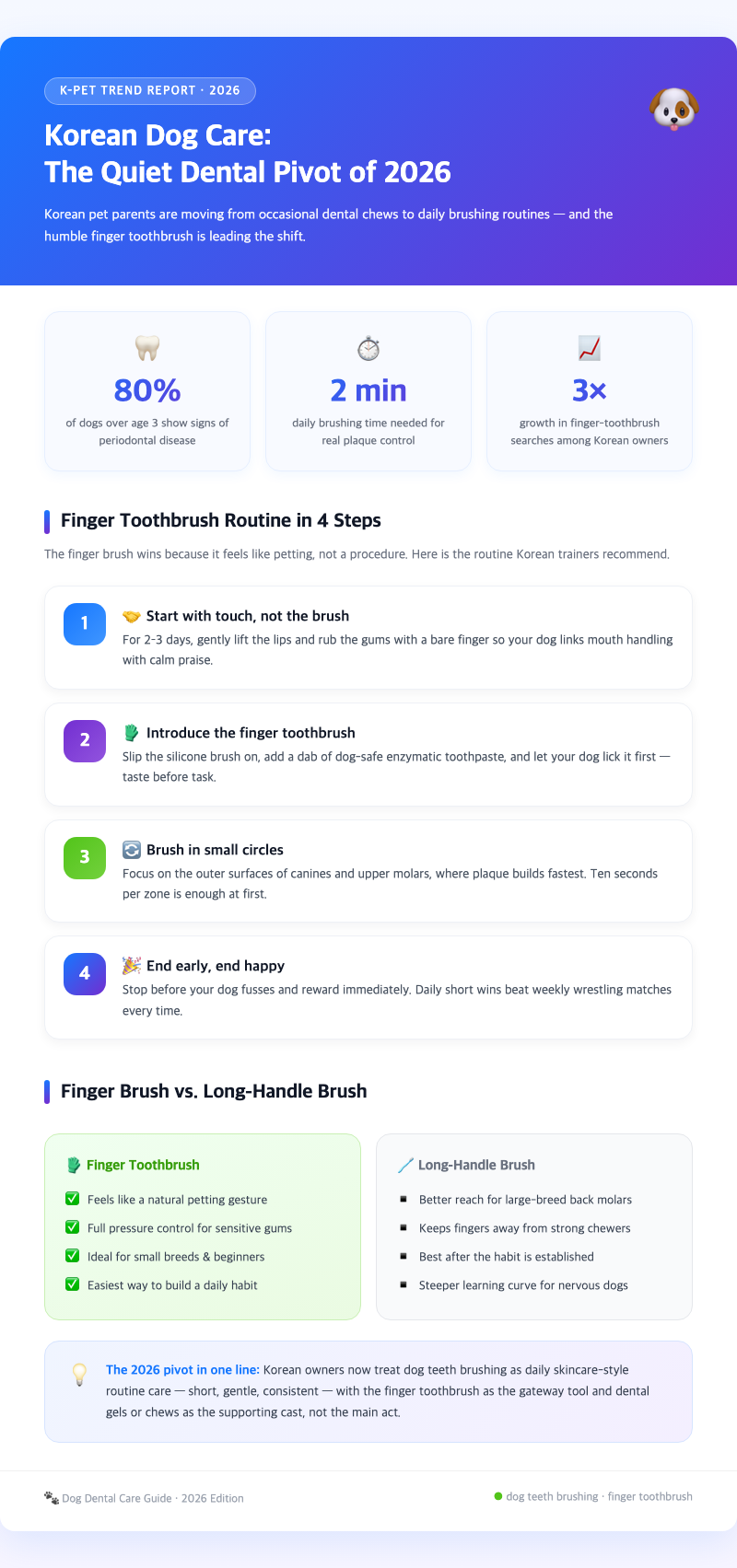
The Signal: Korean Dog Care Is Turning Toward Teeth
Start with the least glamorous statistic in veterinary medicine. The American Veterinary Dental College has long noted that most dogs show signs of periodontal disease by age three — a figure commonly cited in the range of 80 percent and higher, and worse in small breeds. Periodontal disease is the most common clinical condition in adult dogs, and it is almost entirely preventable with mechanical plaque removal. That gap — between how common the disease is and how simple the prevention is — is the market opening that Korean brands have spotted.
The signal shows up in three places at once. Global marketplaces like Amazon now maintain dedicated best-seller charts for dog dental care, a category granularity that did not exist a decade ago. The Veterinary Oral Health Council (VOHC), which reviews plaque and tartar claims, has seen its accepted-products list grow steadily across diets, chews, water additives, and brushes — a sign that manufacturers now consider third-party dental validation commercially worthwhile. And on Shopee Singapore and Malaysia, Korean pet dental sub-categories are expanding faster than the grooming categories that built K-pet’s reputation. When distribution, validation infrastructure, and consumer search all move together, that is a trend rather than a fad.
How We Got Here: Small Dogs, Long Lives, Expensive Anesthesia
Korea’s dog population is unusually skewed toward small breeds — Maltese, Poodles, and Pomeranians dominate registrations, a pattern documented in the KB Financial Group Korea Pet Report, which estimates that roughly one in four Korean households now lives with a companion animal. This matters for teeth more than almost any other health category. Small and toy breeds have crowded dentition and are dramatically overrepresented in periodontal disease and tooth-loss statistics; a Maltese is far more likely to need extractions by age eight than a Labrador.
Layer on longevity. As veterinary care improves, Korean dogs — like dogs in Singapore and Japan — are living well into their mid-teens. A dog that lives sixteen years with unmanaged plaque will accumulate multiple rounds of anesthetic scaling, and each round carries cost and anesthetic risk that owners of senior small dogs feel acutely. In Singapore, an initial dental consult at a private clinic commonly runs in the S$45–S$120 range, while a full anesthetic scale-and-polish typically costs several hundred dollars, and more if extractions are needed — check your own clinic, as prices vary widely. Multiply that over a small dog’s lifespan and the economics of a S$10 toothbrush become obvious.
Korean brands, having saturated the grooming and apparel categories at home, followed the money and the demographics. The result is a wave of dental-first product lines designed around the specific problem of brushing a 3 kg dog with a small mouth and low tolerance — ultra-fine bristles, finger-brush formats, and pastes flavored to be treated as food rather than medicine. For background on the broader ecosystem, see our step-by-step home dog dental care guide covers technique for reluctant dogs.
What It Means for the Industry
For the pet industry, the dental pivot changes what competition looks like. Grooming products compete on results you can see in a mirror; dental products compete on claims you have to trust. That pushes the category toward third-party validation, and here is the uncomfortable truth for Korean brands, our own included: the VOHC accepted-products list is still dominated by Western manufacturers. Most Korean dental products — again, including Junglemonster’s — are not yet VOHC-listed. We expect that to change, because the K-beauty industry already demonstrated Korean manufacturers’ willingness to pursue foreign regulatory and validation regimes once export revenue justifies the cost.
The likely industry consequences over the next two to three years: consolidation of me-too products (dozens of near-identical finger brushes will thin out), a race toward clinical substantiation as marketing claims face scrutiny, and bundling — brush, paste, and additive sold as a routine, K-beauty style, rather than as single SKUs. Here is how the main home-care approaches compare on the dimensions that matter:
| Approach | Evidence strength | Effort required | Typical monthly cost (SGD/USD) |
|---|---|---|---|
| Toothbrushing, daily or every other day | Strong (Harvey et al. 2015) | High — 2–3 min/day, training period needed | S$3–8 / US$2–6 (paste amortized) |
| VOHC-accepted dental chews or diet | Moderate | Low | S$15–40 / US$11–30 |
| Water additive | Modest, product-dependent | Very low | S$8–15 / US$6–11 |
| Professional scaling (as needed) | Strong, but treatment not prevention | Clinic visit, anesthesia | Several hundred dollars per procedure |
What It Means for Dog Owners in Singapore and Malaysia
For owners, the practical takeaway is that the interesting question is no longer ‘which product is best’ but ‘which product will you actually use four times a week.’ Compliance beats formulation. That is the honest lens through which to evaluate the Korean products now filling Shopee search results — and it is where some of them genuinely earn their place.
Among the Korean tools in this wave, Junglemonster’s Dentisoft toothbrush is built around 0.01mm ultra-fine bristles intended to reach under the gum line, where plaque actually initiates periodontal disease; the company’s internal testing claims up to 73% more plaque removal at the gum line versus standard bristles — a manufacturer claim, not independent VOHC data, and we say so plainly. Its companion enzymatic paste, Nyang-chi Meong-chi, competes mainly on flavor (chicken, sweet potato, melon, blueberry), which is precisely the variable that determines whether a routine survives past week two. Both typically retail in the S$10–S$25 range. For fairness, here is how they sit against established alternatives:
| Product | Type | Approx. price | Honest pros | Honest cons |
|---|---|---|---|---|
| Junglemonster Dentisoft | Ultra-fine bristle brush | ~S$12–18 / US$9–14 | Gum-line-focused bristles; suits small breeds | Not VOHC-listed; plaque claim is manufacturer data |
| Virbac C.E.T. Enzymatic kit | Brush + enzymatic paste | ~S$18–28 / US$13–21 | Long clinical track record; widely vet-recommended | Fewer flavor options; bulkier brush for toy breeds |
| Oxyfresh Pet Dental water additive | Water additive | ~S$25–35 / US$19–26 | VOHC-accepted; zero effort | Adjunct only — does not replace brushing |
Prices are approximate 2026 marketplace ranges; check current listings. SG and MY readers can check Junglemonster on Shopee Singapore or Shopee Malaysia; US and UK readers will find Virbac and Oxyfresh readily on Amazon. Whichever brush you buy, the regimen is the product: aim for daily, accept every other day, and treat anything less as maintenance theatre. Cat households face a different compliance problem entirely — our Shopee Singapore. Last reviewed: 2026.