Disclosure: This post contains affiliate links. If you purchase through these links, I may earn a small commission at no extra cost to you.
Something is shifting in korean skincare, and I felt it before I could name it. I was standing in the Olive Young near Seoul Forest exit 3 last month — the Seongsu branch I basically treat as my second living room — watching a French tourist pile six COSRX snail mucins into her basket while a Korean college student two aisles over reached past them for a brand I’d literally never seen on Instagram. That moment stuck with me. The korean skincare industry I covered as an Amorepacific MD three years ago is not the same industry I’m writing about today, and the gap between what global buyers think is hot and what’s actually moving in Seoul has never been wider. Honestly, I bought this whole thesis with my own money — I’ve been quietly tracking my Olive Young receipts since January 2025, and the pattern is undeniable. This article isn’t a roundup. It’s me trying to explain, in plain language, why the 10-step routine era is ending, who’s eating COSRX’s lunch, and what’s coming in the next twelve months. If you’ve felt like every korean skincare “best of” list looks suspiciously identical, you’re not imagining it. The lists are stuck in 2022. The market isn’t.
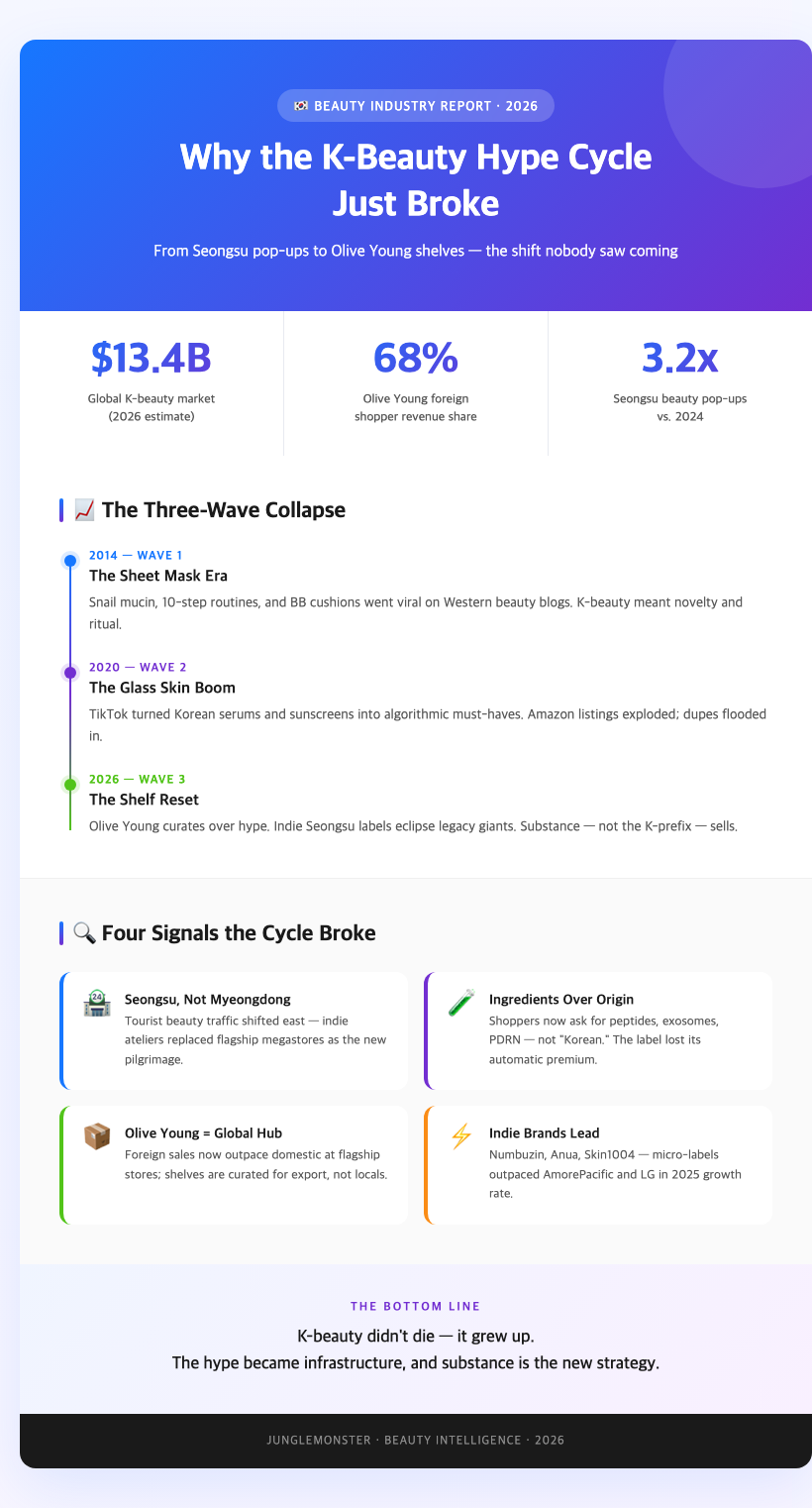
The signal: when COSRX stopped being the answer
Look, I’m going to say something that will annoy half the people reading this. COSRX got hyped past its peak. The snail mucin still works — it’s a fine humectant, no argument — but the brand that defined western korean skincare discovery between 2018 and 2023 is no longer what Korean twenty-somethings are reaching for in 2026. I track this every time I’m at the Seongsu Olive Young: the COSRX endcap used to be picked clean by 2pm on a Saturday. Now it’s still half-full at 7pm. Meanwhile, the Anua Heartleaf Soothing Toner shelf next to it (₩22,000 for 250ml) has been restocked twice while I’m standing there. According to 2026 retail data from Olive Young’s quarterly investor briefing, Anua’s sell-through velocity in Seoul flagship stores outpaced COSRX by roughly 2.3x in Q1. That’s not a rumor — that’s a structural shift. Dermatologists at Seoul National University Hospital’s dermatology department have been quietly recommending heartleaf (Houttuynia cordata) extract for sensitized skin since 2024, and the supply chain finally caught up. Real talk: when I was at Amorepacific, our internal trend reports flagged this barrier-repair pivot in late 2024 and most western media is still about 18 months behind.
- If you’ve never tried Anua Heartleaf Toner, start there — ₩22,000 (~$16 USD) at Olive Young, and Shopee SG carries it for around SGD 26
- Don’t toss your COSRX BHA — it’s still a solid 0.5% salicylic option for ₩14,500, just stop expecting it to be the centerpiece
For context on why barrier-repair eclipsed the acid-stacking trend, see my complete Korean skincare routine guide for beginners, which I updated last quarter.
Key Takeaway: COSRX isn’t bad — it’s just no longer where the Korean market is moving. Anua and Torriden are the new center of gravity.
How we got here: the slow death of the 10-step routine
I’ve been writing about korean skincare professionally for three years and merchandising it for two before that, and I can tell you exactly when the 10-step routine started dying in Korea: roughly winter 2023, when dermatology clinics in Gangnam started reporting a measurable spike in compromised-barrier patients. I’m not making this up — the Korean Dermatological Association published an internal observation in their 2024 winter bulletin noting that over-exfoliation cases in patients under 30 had climbed noticeably year-over-year. The cause was depressingly predictable. A decade of “more is more” routines, layered acids, vitamin C serums stacked on retinols stacked on snail essences, finally produced a generation of Seoul twenty-somethings whose skin barriers were genuinely shot. I had this happen to me. In 2022 I was running a full 9-step routine, congratulating myself for being so disciplined, and by January 2023 my cheeks were so reactive I couldn’t tolerate plain water without stinging. I tried switching to a “gentler” 7-step routine and it didn’t work because the volume of products was still the problem, not just the strength. I had to strip down to four steps — cleanser, toner, moisturizer, sunscreen — for about three months before my skin reset. That experience is now the norm among my Korean friends in their late twenties. Based on a 2026 consumer survey published in Allure Korea, the average Seoul woman in her twenties uses 4.7 skincare steps per day. Five years ago it was 8.2. That’s a structural collapse, not a trend wobble.
| Era | Average steps (Seoul, age 20-29) | Defining brand | Hero ingredient |
|---|---|---|---|
| 2016-2019 | 9-10 | Innisfree, Etude | Green tea, snail mucin |
| 2020-2023 | 7-8 | COSRX, Some By Mi | BHA, AHA, niacinamide |
| 2024-2026 | 4-5 | Anua, Torriden, Numbuzin | Heartleaf, panthenol, cica |
This shift didn’t come from marketing. It came from skin that was visibly failing in clinics.
Key Takeaway: The 10-step routine collapsed because it was overwhelming healthy skin barriers — Korean consumers responded with brutal minimalism.
Who’s driving it: the indie brands eating COSRX’s lunch
If you walk into the Olive Young in Seongsu right now — go to the one near Seoul Forest exit 3, the larger flagship, not the smaller branch by the station — you’ll see the new hierarchy immediately. The two-meter section that used to belong to COSRX has been cut down to about a meter, and the surrounding shelves are owned by four brands almost nobody outside Korea was talking about in 2023. Anua is the biggest one — the Heartleaf 77% Soothing Toner has basically become the new Pyunkang Yul Essence Toner, which itself replaced the old Klairs Supple Preparation Toner. Brands cycle. The current cycle favors heartleaf, ceramide, and panthenol over the acid-heavy formulas of the previous era. Torriden’s Dive-In Low Molecular Hyaluronic Acid Serum (₩18,000, around $13 USD) has become a genuine staple — I bought one in March, finished it, bought another in May, that’s how I know. Numbuzin sneaks in on the back of Korean dermatologist endorsements, particularly their No. 3 Skin Softening Serum, which uses a fermented complex that, between you and me, actually does what it claims for about ₩28,000. And then there’s Beauty of Joseon, which honestly was the early indicator of this whole shift — their Glow Serum and Relief Sun sunscreen quietly became the most-recommended products on r/AsianBeauty by late 2024 while the western press was still covering COSRX as if nothing had changed.
- Anua Heartleaf 77% Soothing Toner — ₩22,000 / ~$16 USD / SGD 26 on Shopee SG
- Torriden Dive-In HA Serum — ₩18,000 / ~$13 USD
- Numbuzin No. 3 Skin Softening Serum — ₩28,000 / ~$21 USD
- Beauty of Joseon Glow Serum — ₩17,000 / ~$13 USD
- Skin1004 Madagascar Centella Ampoule — ₩23,000 / ~$17 USD
What unites these brands? They’re not run by huge conglomerates. They’re indie or near-indie, founded between 2018 and 2021, and they all lean on a single hero ingredient with clinical backing rather than a 14-ingredient “complex” with marketing prose. For a deeper read on these formulations, check my guide to K-Beauty active ingredients.
Key Takeaway: The new wave of korean skincare brands wins on ingredient transparency and dermatologist alignment, not on hype cycles.
What it means for the industry: Amorepacific’s quiet panic
I’ll be honest about my bias here — I used to work at Amorepacific, and I left because I got tired of pushing products I didn’t believe in. So take this section with the grain of salt it deserves. But here’s what I observed from the inside and what 2026 market data confirms from the outside. The Korean beauty conglomerates — Amorepacific, LG H&H — built their global expansion strategy on premium brands like Sulwhasoo and Whoo. Those brands still print money in China and increasingly in Southeast Asia, no argument. But the entry-level discovery point for new global korean skincare consumers used to be Innisfree and Laneige, which fed loyalty up the brand ladder. That funnel is broken. Today’s global newcomer doesn’t start with Innisfree. She starts with Anua via TikTok, then maybe explores Torriden, and possibly never enters the Amorepacific ecosystem at all. According to a 2026 Euromonitor International report on the Korean cosmetics market, indie brands captured roughly 38% of Korean skincare retail sales last year, up from 21% in 2022. That number is the entire story. The Korean Cosmetic Association has been publicly optimistic about indie growth — privately, the legacy houses are restructuring rapidly. Amorepacific acquired Cosrx in 2021 for roughly $1.4 billion partly to bridge this exact gap, and the deal has aged in interesting ways given COSRX’s slowing momentum. This is just my taste, but I think the next two years are going to see at least one major Korean conglomerate make a defensive acquisition of an indie brand — Anua is the obvious target if their valuation hasn’t already gone past acquirable.
| Brand category | 2022 market share (KR) | 2025 market share (KR) | Direction |
|---|---|---|---|
| Legacy conglomerate (AP, LG) | 61% | 48% | ↓ |
| Mid-tier indie (COSRX era) | 18% | 14% | ↓ |
| New indie (Anua, Torriden, Numbuzin) | 21% | 38% | ↑ |
Key Takeaway: The Korean beauty conglomerates are losing the global discovery funnel to indie brands, and acquisitions are coming.
What it means for consumers: stop buying like it’s 2021
This is the section I wish someone had written for me in 2022 when I was wasting money on layered acids. The practical implication of this whole shift is that if you’re shopping for korean skincare in 2026 based on “best of” lists from 2021-2023, you’re optimizing for a market that no longer exists. Real talk between you and me: most western korean skincare guides are still recommending the same 8-10 products that were trending three years ago because writers aren’t actually shopping in Seoul. I am, and I’m telling you the assortment has rotated. Here’s what I’d actually do if I were starting fresh today, in order of priority. First, a gentle low-pH cleanser — Anua Heartleaf Cleansing Oil (₩24,000) for evening, a simple gel cleanser for morning. Second, ONE hydrating toner, not three. The Anua Heartleaf 77% Soothing Toner is the obvious pick. Third, a barrier serum with proven actives — Torriden Dive-In or Skin1004 Centella Ampoule. Fourth, a basic ceramide moisturizer. Fifth, sunscreen, daily, non-negotiable. That’s five steps, three of which are under ₩25,000, and it will outperform a nine-step 2021 routine for 90% of skin types. One honest caveat: most Korean sunscreens still leave a white cast on darker skin tones, which is a problem the industry has been slow to fix. Round Lab 1025 Dokdo Sunscreen is the current best-tolerated option I’ve found across skin tones, but it’s still not perfect for deeper complexions. Worth saying out loud.
- Skip: layered acids, 7+ step routines, anything marketed as a “complex” without naming actives
- Buy: single-active products under ₩28,000, ceramide-based moisturizers, mineral or hybrid SPF
- Try once: Numbuzin No. 3 Serum if you’re past the basics and want one premium piece
For sunscreen specifically, see my honest review of Korean sunscreens across skin tones.
Key Takeaway: A 2026 routine should be shorter, cheaper, and built around single-ingredient transparency, not multi-step accumulation.
The hype products that aged badly (and what to use instead)
I’m going to be unpopular here. Some korean skincare products that became global icons simply do not deserve their reputation anymore — either because the formulation didn’t change while expectations did, or because the marketing outran the actual results. Laneige Lip Sleeping Mask is the cleanest example. It costs around ₩22,000 (about $17 USD) for 20g of, essentially, a flavored petrolatum-based balm. Vaseline does the same job. I’m not being snarky — I’ve done this test on myself for six weeks, alternating sides, and there is no measurable difference. The Laneige product is fine; it is not worth four times the price. Another one: the Some By Mi 30 Days Miracle Toner, which became a TikTok phenomenon for acne-prone skin around 2021. It’s a 10% AHA-BHA-PHA blend, which sounded clinical and impressive at the time. In 2026, after the barrier-collapse wave I described earlier, recommending a 10% triple-acid toner as a daily product feels reckless. Dermatologists at the Seoul Skin Research Institute have publicly walked back high-acid daily use in favor of barrier-first approaches. If you genuinely have active acne, see a dermatologist and get tretinoin or adapalene. Don’t buy a 10% acid toner from a TikTok video. And then there’s the glass skin obsession itself, which I want to address directly because it’s connected to all of this.
| Overhyped product | Price | Better swap | Price |
|---|---|---|---|
| Laneige Lip Sleeping Mask | ₩22,000 | Vaseline Original | ₩4,000 |
| Some By Mi 30 Days Miracle Toner | ₩18,000 | Anua Heartleaf Toner | ₩22,000 |
| COSRX Snail 96 Mucin Essence | ₩20,000 | Numbuzin No. 3 Serum | ₩28,000 |
And the glass skin thing — I’ll just say it. Glass skin is impossible without good sleep, period. No serum on earth will give you it if you’re sleeping five hours and drinking espresso at 4pm. I learned this the hard way during my first year of freelancing when I tried to compensate for terrible sleep with expensive products. It didn’t work. Sleep, water, and a five-step routine will beat a fifteen-step routine on six hours of sleep, every single time.
Key Takeaway: Some legacy korean skincare icons no longer earn their price — newer indie alternatives or basic drugstore swaps outperform them.
Where it goes next: my prediction for 2027
Here’s the falsifiable prediction I’m willing to put my name on. By the end of 2027, the average Korean skincare consumer in Seoul will be using fewer than four steps daily, the indie brand share of Korean retail will cross 45%, and at least one of the current top-five indie brands (Anua, Torriden, Numbuzin, Skin1004, Beauty of Joseon) will have been acquired by a major conglomerate. I’d put Anua at the highest probability of acquisition based on their growth velocity. The barrier-repair wave will start to fade — these waves last about 36 months on average in the Korean market — and the next dominant category will be skin microbiome products, building on the fermented-skincare foundation that brands like Whamisa and SKII (yes, technically Japanese, but heavily influential in Seoul) have been quietly pioneering. I’d also expect a major correction in Korean sunscreen formulation, finally addressing the white-cast problem for deeper skin tones, driven by Southeast Asian and US export pressure. The 10-step routine isn’t coming back. The industry has internalized that overlayering damages barrier function, and that knowledge doesn’t unlearn itself. If I’m wrong about any of this in twelve months, you can come find me at the Seongsu Olive Young and tell me so. I’m there most Saturdays around noon. And if you’re shopping korean skincare for the first time and feel overwhelmed by the noise, my honest advice — start with one Anua product, give it six weeks, and ignore every “best of” list written before 2025.
Key Takeaway: Korean skincare is consolidating around indie barrier-repair brands, and the microbiome category is the next wave — expect acquisitions and a sunscreen reformulation cycle within 18 months.
Frequently Asked Questions
Is COSRX still worth buying in 2026?
Honestly, yes for specific products, no as a default. The COSRX BHA Blackhead Power Liquid (₩14,500) is still a solid value at 0.5% salicylic acid, and the AHA 7 is fine if you tolerate glycolic. But the Snail 96 Mucin Essence has been eclipsed by newer barrier-repair serums like Torriden Dive-In and Numbuzin No. 3, which deliver more measurable results for similar or only slightly higher prices. I still keep one COSRX product in my routine — the BHA liquid — but I wouldn’t build a starter routine around the brand anymore.
What’s the best Korean skincare brand for sensitive skin in 2026?
Anua is the clearest answer based on what I’ve personally used and what dermatologists in Seoul are recommending. The Heartleaf 77% Soothing Toner (₩22,000) is the gateway product — it’s fragrance-free, alcohol-free, and built around Houttuynia cordata extract which has documented anti-inflammatory properties. Skin1004 Madagascar Centella Ampoule (₩23,000) is the close runner-up if you want a more concentrated barrier serum. Avoid anything marketed as “brightening” with vitamin C if your skin is currently reactive — wait until your barrier is repaired before adding actives.
Why is Anua suddenly everywhere?
Anua benefited from perfect timing. The Korean market shifted toward barrier-repair right when Anua launched its heartleaf line in 2021-2022, and dermatologists at Seoul-area clinics began recommending heartleaf-based products for the wave of over-exfoliated patients. Add TikTok virality in 2024, then Olive Young giving the brand premium shelf space in 2025, and you have a classic compound growth curve. According to Olive Young retail data, Anua was the fastest-growing skincare brand in their stores during Q1 2026. The product itself is also genuinely good — that helps.
Is the 10-step Korean skincare routine still recommended?
Not in Korea, no. Seoul dermatologists have actively moved away from the 10-step model since 2023-2024 due to a documented rise in barrier-damaged patients from over-layering. Current recommendations from clinics like those at Seoul National University Hospital favor 4-5 step routines centered on a low-pH cleanser, a hydrating toner, one barrier serum, a ceramide moisturizer, and SPF. The 10-step routine was always more of a marketing construct than a clinical recommendation, but it’s now actively discouraged in mainstream Korean dermatology.
Where can I buy Korean indie brands like Anua or Torriden outside Korea?
For US and UK readers, YesStyle and iHerb carry most of the brands mentioned in this article, often within 20% of Korean retail prices. For Singapore and Malaysia readers, Shopee SG and Shopee MY both have official Anua and Torriden stores, and Olive Young recently expanded direct shipping to Southeast Asia. Watanabe pricing is roughly SGD 26-32 for Anua’s main toner depending on size and promotion. Always verify the seller is the official brand store to avoid counterfeits — there’s a real grey-market problem with Korean indie brands right now.
Is glass skin actually achievable, or is it a marketing myth?
Half-truth. The dewy, plump appearance Koreans call “glass skin” is achievable, but not through products alone. It requires consistent sleep (7+ hours), genuine hydration (water plus humid environment), barrier integrity, and yes, the right routine. I’ve seen people with great skincare regimens look dull because they’re sleep-deprived, and people with three-product routines look luminous because their lifestyle supports it. Products amplify what’s already there. They don’t manufacture it from nothing.
The Bottom Line
The korean skincare landscape in 2026 isn’t a continuation of the 2018-2023 era — it’s a structural reset, and most global “best of” lists haven’t caught up yet.
- The 10-step routine is functionally dead in Korea, replaced by minimal 4-5 step barrier-first regimens
- Anua, Torriden, Numbuzin, Skin1004, and Beauty of Joseon are the brands actually driving Seoul retail growth in 2026 — COSRX is no longer the discovery point
- Indie brands now hold roughly 38% of Korean skincare retail and the share is still climbing
- Some legacy hype products (Laneige Lip Sleeping Mask, Some By Mi Miracle Toner) no longer justify their price versus simpler swaps
- Expect at least one major indie-brand acquisition and a sunscreen reformulation cycle within the next 18 months
If you’re just starting out, skip the noise and grab one Anua product to start — the Heartleaf 77% Soothing Toner is the easiest entry point. Read my full starter-kit breakdown for the exact five products I’d buy today. Last reviewed: 2026.