Disclosure: This post contains affiliate links. If you purchase through these links, we may earn a small commission at no extra cost to you.
Does this sound familiar? You saved forty photos of korean fashion men on Pinterest. They had wide trousers, a boxy knit and clean white sneakers, and the whole look seemed effortless, like they’d just walked out of a Seongsu café with an iced americano. So you bought the same pieces. You put them on and looked in the mirror, and somehow you looked like you were wearing your older brother’s clothes. Or like a guy going to a job interview at a startup that doesn’t exist.
Look, I’ve seen this happen a lot. Before I went freelance as a beauty editor I spent two years as a merchandiser at Amorepacific, and I sat in a lot of meetings about how Korean men want to look versus how they actually end up looking. These days I live a ten-minute walk from Seoul Forest, and I spend a slightly embarrassing number of hours in Seongsu cafés watching people. Honestly, the gap between the Pinterest version of korean fashion men and what works on a real body almost never comes down to which brand you bought. It’s proportion, fabric, and (yes, I’m a beauty editor, so of course I’m saying this) your face and hair. In this piece I’ll walk you through why the look falls apart, what that costs you, and the fix I’d give a friend: silhouette first, fabric second, grooming third, brand logos last. I’ll give real prices in won and dollars, name the shops I actually go to, and own up to the mistakes I made styling my boyfriend.
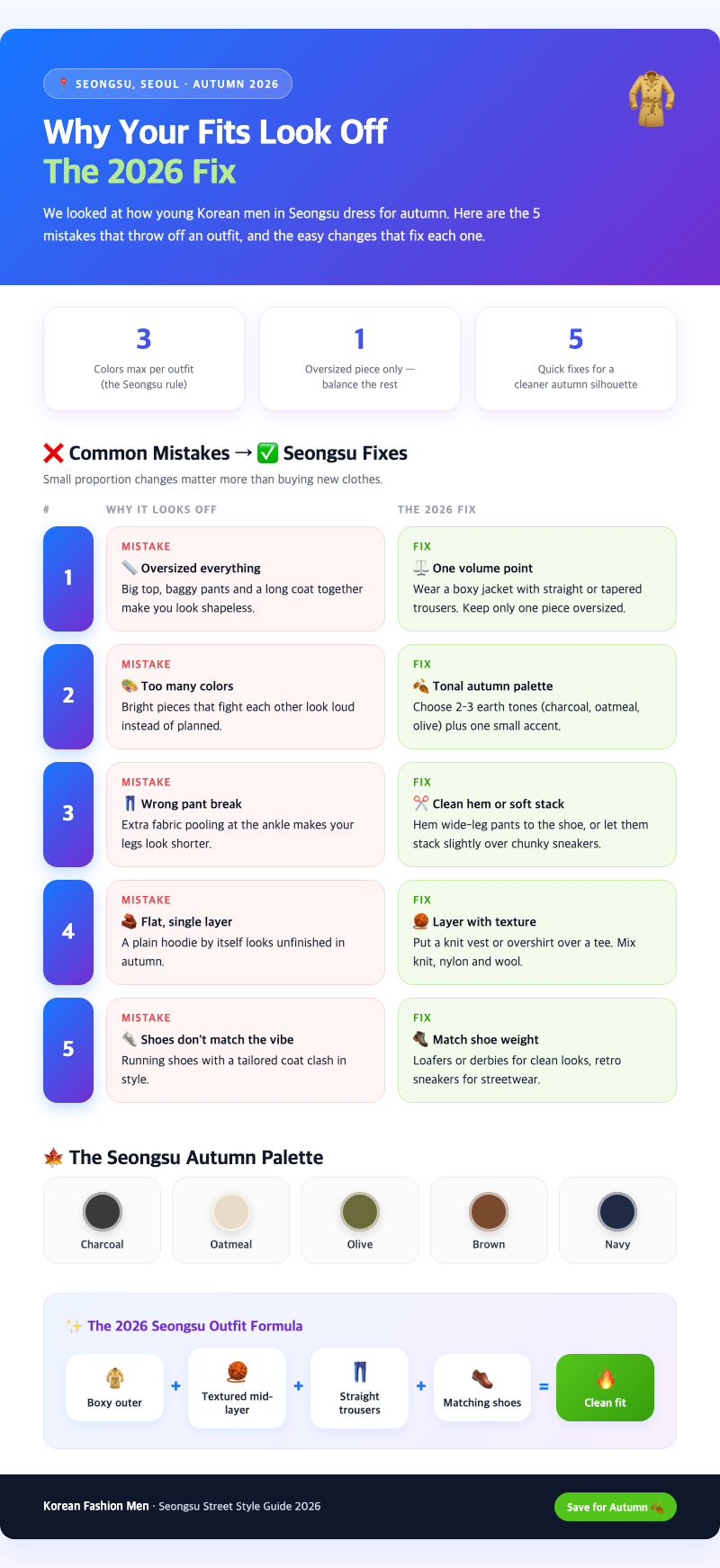
Why Korean Fashion Men Looks Never Translate Off the Screen
I’ve been watching this trend since about 2023, when wide slacks went from niche to basically a uniform in Seongsu and Hannam-dong. On a random Saturday this October I sat by the window of a café on Yeonmujang-gil and counted for an hour. Of the roughly forty guys in their twenties who walked past, I’d say about thirty were in some kind of wide or straight trouser, not skinny jeans. That’s not a study, it’s just me with a latte, but it matches what every stylist I know says.
So why does the copy look wrong? There are four root causes, and you probably have at least two of them.
First, the photos lie about proportion. Most of the korean fashion men content you’re saving is shot on guys who are styled by professionals, sometimes pinned at the back, and photographed from a low angle that makes their legs look endless. The trousers sit at the true waist, not the hips. When you wear the same wide trousers at hip level, you lose about ten centimeters of visual leg length immediately.
Second, fabric. A wide trouser in stiff, shiny polyester looks like a costume. The ones in the photos are usually a drapey wool blend or brushed cotton that falls straight down. Same cut, completely different result.
Third, color. Seoul street style tends to stick to a narrow palette: oatmeal, charcoal, navy, olive, off-white. People abroad often grab one Korean piece and throw it on with a loud graphic tee from home, and then it reads as a mash-up instead of a look.
Fourth, and this is the one nobody in fashion media wants to say out loud: the grooming is doing a lot of the work. Clear-ish skin, eyebrows that have been tidied a bit, hair with a little texture. Take that away and the same outfit looks unfinished.
- Check where your trousers actually sit. If the waistband is below your belly button, that’s your first problem.
- Feel the fabric before you buy. If it squeaks or shines under shop lights, skip it.
- Lay your outfit on the bed and count colors. More than three, and you should take one out.
If you want the broader context of how this fits into daily life here, my Korean lifestyle trends for 2026 across fashion, home and wellness.
If you do one thing: build one base outfit you can wear on autopilot, then add to it slowly.
Step One: Fix the Proportions (Rise, Length, Shoulder)
I tried something last winter that taught me a lot. I took my boyfriend to the Musinsa Standard shop near Hongdae and had him try the same wide slacks in three sizes. The only difference between them was where they sat on his body. The size he “normally” wears sat on his hips and pooled at the ankle. One size down sat at his natural waist, fell straight, and stopped right at the top of his sneaker. He looked like he’d grown. Same trousers, same price.
Proportion is about three spots on your body, and you can check all of them in a fitting room in under five minutes.
| Area | The Seoul Way | The Common Mistake | Quick Fix |
|---|---|---|---|
| Trouser rise | Sits at or just below the navel | Sits low on the hips | Size down at the waist or choose “high-rise” or “one-tuck” cuts |
| Trouser length | Slight break or no break at the shoe | Fabric pooling at the ankle | Hem 2-3cm shorter; most Seoul shops hem for under ₩10,000 |
| Shoulder seam | Slightly dropped, relaxed | Huge oversized or tight | Drop of 3-5cm past your natural shoulder, no more |
| Top length | Hits at the hip or is half-tucked | Covers the whole crotch area | Front-tuck knits, or pick cropped-boxy cuts |
| Shoes | Low-profile sneakers, loafers, derbies | Chunky running shoes with everything | One clean white pair, one dark leather pair |
The hemming point is underrated. Most clothing shops and neighborhood tailors (수선집) in Seoul will shorten trousers cheaply and fast, often the same day. If you’re overseas, a local alterations shop does the same job. People skip this step and then blame the trousers.
One honest trade-off, though: high-rise wide trousers are less forgiving if you’re very short and wear very chunky shoes. If you’re under about 170cm, go straight-leg instead of super-wide and keep your shoes slim. Wide still works, but straight is easier.
If you do one thing: get your trousers hemmed so they barely touch your shoe. It’s the cheapest upgrade in menswear.
Step Two: Fabric, Color and the Seongsu Palette
After visiting what felt like every select shop between Seoul Forest and Ttukseom, I’ve come to think fabric is what really separates a good Korean outfit from a cheap-looking one. Two knits can be identical in the photo. One’s lambswool blend, one’s acrylic. In person you can tell from across the street.
The palette you see on korean fashion men in Seongsu right now is pretty narrow, and that’s the point. Think oatmeal, ecru, charcoal, washed black, navy, olive and a muddy brown. The accent, if there is one, is usually a burgundy beanie or a faded blue shirt peeking out under a knit.
Here’s a price-level comparison of brands I’ve actually bought from or styled. Prices are what I saw in-store or on Musinsa this autumn, so they’ll move around a bit with sales.
| Brand | What to Buy | Typical Price | Honest Pro | Honest Con | Where to Buy |
|---|---|---|---|---|---|
| Musinsa Standard | Wide slacks, basic knits | ₩39,900 (~$29) | Great fit for the money | Fabric thinner than premium labels | Musinsa app, Seongsu & Hongdae stores |
| Covernat | Cable knits, outerwear | ₩79,000 (~$58) | Solid wool-blend knits | Logo-heavy lines can look dated | Musinsa, department stores |
| LMC | Heavy tees, sweatshirts | ₩45,000 (~$33) | Thick cotton that holds shape | Graphics are hit or miss | Musinsa, select shops |
| Thisisneverthat | Hoodies, nylon jackets | ₩89,000 (~$65) | Well-cut streetwear | Easy to look like a 2019 throwback | Flagship stores, Musinsa, YesStyle |
For readers in Singapore and Malaysia, several of these labels pop up through Shopee resellers. Check the seller ratings, because fakes of the bigger streetwear names do exist. US and UK readers will find some on Amazon and more reliably on YesStyle or the brands’ own global sites.
- Rub the fabric between your fingers. Matte and slightly textured is good. Slippery and shiny is not.
- Look for at least 30% wool in knits if your budget allows it.
- Pick your two neutrals this season and stick to them for every purchase.
If you do one thing: shrink your palette to two neutrals and one accent, and your mismatched pieces will suddenly start working together.
Step Three: Grooming Is Half the Outfit (A Beauty Editor’s Honest Take)
Okay, this is my lane. When I worked as an MD, the men’s line data we looked at kept showing the same pattern: Korean men in their twenties and thirties were buying basic skincare as a normal part of getting dressed, not as a luxury. Euromonitor and other market trackers have repeatedly listed South Korea among the biggest per-capita spenders on men’s skincare in the world. You see the result on the street. It’s not “glass skin” on every guy. It’s skin that looks rested and even, and that’s what makes a plain knit look expensive.
So here’s the minimum routine I’d give any guy trying to pull off the look, with real prices from the Olive Young in Seongsu, the one near Seoul Forest Station exit 3, where I’ve honestly tried almost every bestseller on the shelf. Most of what’s worth buying lands somewhere between ₩12,900 and ₩28,000.
- Toner: Anua Heartleaf 77% Soothing Toner, around ₩28,000 (~$20) at full price and often discounted. I’ll say it plainly: this is the real MVP of 2025-2026 for guys with redness or shaving irritation.
- Serum (optional): Torriden Dive-in Low Molecular Hyaluronic Acid Serum, around ₩22,000 (~$16). Lightweight, not sticky.
- Sunscreen: Round Lab Birch Juice Moisturizing Sun Cream, around ₩25,000 (~$18). One caveat below.
- Lips: plain Vaseline, around ₩5,000 (~$4).
Now for my unpopular opinions. COSRX got hyped past its peak. The Advanced Snail 96 Mucin Essence (around ₩25,000, ~$18) is fine, but newer indie brands like Torriden and Anua are doing the same job with nicer textures, so I wouldn’t treat it as a must-buy anymore. And the Laneige Lip Sleeping Mask at around ₩24,000 is overrated. I bought it with my own money, more than once, and Vaseline does the same job overnight for a fraction of the price.
The sunscreen caveat is a big one. Most Korean sunscreens, even in 2026, still leave a white or greyish cast on darker skin tones. If you’re a deeper skin tone, test on your jawline in daylight before committing, or look for tinted or “no white cast” chemical formulas. Mainstream K-Beauty coverage glosses over this a lot, and I think that’s unfair to readers in Malaysia, Singapore and beyond.
One more thing, and I’m firm on it: glass skin is impossible without good sleep, period. You can buy every product in that Olive Young and still look grey after four hours of sleep. I still use a Clarisonic I bought in 2018, once a week, and it helps with texture, but it does nothing for a bad week of sleep. If you want the full routine, my Korean daily wellness habits that actually stick goes into sleep and routine in more depth.
If you do one thing: take a dated mirror photo today, so in a month you’ll actually be able to see what changed.
Common Mistakes (Including the Ones I Made)
Let me start with my own failure. When I first started styling my boyfriend, I went all-in on oversized everything. Oversized coat, oversized knit, wide trousers, chunky sneakers. I thought I was recreating the Seongsu look. He looked like a sleeping bag with feet. The problem was that I made every part of the outfit big instead of balancing it. One relaxed piece needs one cleaner piece next to it. Big top, straighter bottom, or wide bottom with a more fitted knit.
Here are the other mistakes I see constantly, both in Seoul and in DMs from readers abroad:
- Buying the brand, not the fit. A ₩89,000 hoodie in the wrong size still looks wrong.
- Skinny ankles with wide everything else. Socks and shoes matter. Tiny no-show socks with wide trousers make your feet look odd.
- Copying idol stage outfits for daily life. Stage clothes are built for lights and cameras, not the subway.
- Overdoing the skincare. Ten steps is a marketing story. Three steps done consistently wins.
- Ignoring hair. A little texture paste (most drugstore ones run ₩12,900-₩18,000) changes how the whole outfit reads.
- Forgetting the climate. If you’re in Singapore or Kuala Lumpur, swap heavy wool for linen-blend and cotton trousers in the same cut. The silhouette matters more than the exact fabric.
There’s a trade-off I should own here too. The Seoul look leans clean and muted, and some guys find it a bit boring. That’s fair. If you love color or graphics, keep your silhouette and palette disciplined and let one piece be loud. You get personality without the outfit turning chaotic.
And please don’t throw out everything you own. Most of your closet can be rescued with hemming, tucking and a palette edit. Considering what clothes cost now, that’s the smartest move.
If you do one thing: balance every outfit with one relaxed piece and one cleaner piece, and never go oversized from head to toe.
Frequently Asked Questions
What is the Korean fashion style for men in 2026?
In 2026, korean fashion men style leans clean and relaxed. You see high-rise wide or straight trousers, boxy knits, muted colors like oatmeal, charcoal and olive, and low-profile sneakers or loafers. From what I see every week in Seongsu and Hannam-dong, logo-heavy streetwear has cooled down. Guys care more about good basics, fabric quality and grooming. Think less “idol on stage” and more “quietly put-together guy at a café.”
Where can I buy Korean men’s clothing outside Korea?
Musinsa has a global site that ships to many countries. YesStyle carries a lot of Korean labels for US, UK and Southeast Asian readers. In Singapore and Malaysia, Shopee has resellers for Thisisneverthat, Covernat and others, but check seller ratings carefully because fakes exist. Amazon has some Korean brands, though selection is patchier. Honestly, a well-fitted local basic often beats an imported piece in the wrong size.
Why do Korean men’s outfits look better on Instagram than in real life?
Partly professional styling, partly camera angles. Many photos are taken from low angles that make legs look longer, and clothes are sometimes pinned or clipped for the shot. Lighting and editing smooth out skin, too. The good news is you can get most of the way there in real life by fixing trouser rise and length, sticking to matte fabrics, and taking skincare and sleep seriously.
Is Korean fashion good for short men?
Yes, with adjustments. If you’re under roughly 170cm, go for straight-leg trousers rather than very wide ones, keep the rise high, and make sure there’s little or no break at the shoe. Matching your trouser and shoe color also adds visual length. Avoid long oversized coats that hit mid-calf. A hip-length jacket or a front-tucked knit works much better on shorter frames, in my experience.
Do Korean men really use skincare every day?
A lot of them do, especially in their twenties and thirties. That’s what I saw in the sales data back in my merchandising days, and it’s what I see at Olive Young every weekend. It’s usually simple, though: cleanser, toner or moisturizer, and sunscreen. Products like Anua Heartleaf toner and Round Lab sun cream are common picks. The ten-step routine is mostly a marketing story, not daily reality for most guys.
Is it worth buying expensive Korean designer brands?
This is just my taste, but not until your basics are sorted. Spend first on trousers that fit, a good knit and hemming. After that, a premium piece from a Korean designer label can be worth it for fabric and construction. Buying an expensive hoodie to fix an outfit that’s failing on proportion is the most common waste of money I see.
What hairstyle goes with Korean men’s fashion?
Soft, textured cuts work best. Think a natural two-block, a comma-style fringe, or a slightly longer textured crop. The key is movement, not stiffness, so skip heavy gel. A small amount of matte texture paste, usually ₩12,900-₩18,000 at Olive Young, goes a long way. If you’re unsure, bring a photo to your barber and ask for something that still looks good unstyled.
So, Where Does This Leave You
If your Korean-inspired outfits keep looking off, nothing is wrong with you, and you haven’t wasted your money for good. You were just fixing things in the wrong order.
- Proportion comes before brand: high rise, a clean hem and a relaxed but not huge top.
- Matte, drapey fabric and a three-color palette make cheap pieces look considered.
- Grooming carries half the look. Sleep, sunscreen and a simple toner like Anua Heartleaf do more than any logo.
- Balance every outfit: one relaxed piece, one cleaner piece.
- Give clothing fixes a week and skin fixes a month before you judge them.
Start with one base outfit this week and get the trousers hemmed. If you want to shop the pieces I mentioned, you can , musinsa standard, Seongsu fashion, seoul street style 2026