Disclosure: This post contains affiliate links. If you purchase through these links, we may earn a small commission at no extra cost to you.
Last Tuesday I pulled four teeth from a nine-year-old Shih Tzu called Mochi. Her owner asked me something I hear about once a week: ‘But doctor, she gets a dental stick every day. How did this happen?’ I’ve been a small animal vet for fourteen years, the last nine at a clinic off Bukit Timah Road. I’ve extracted enough teeth to have strong views on the gap between what owners think protects a dog’s mouth and what actually does.
People ask me about korean dog care because I trained at Seoul National University and still buy a fair number of Korean pet products. The Korean approach has also become fashionable across Southeast Asia. Honestly, the science says the useful part of korean dog care isn’t the packaging or the cute flavours. It’s the habit underneath. Many Korean owners treat oral care the way they treat their own skincare: a short routine done several times a week, not a yearly event at the vet. Most Singapore owners I meet brush their pet’s teeth maybe twice a year. The bar is low, which is actually good news, because small changes clear it.
Below are the seven habits I recommend, in the order I would introduce them. I picked them on three criteria. First, they reduce what I see on the dental table. Second, a normal working owner can keep them up. Third, they’re reasonably priced in Singapore dollars. Products only show up later, and only where they solve a specific problem. Where I think a popular idea is overrated, I’ll say so plainly.
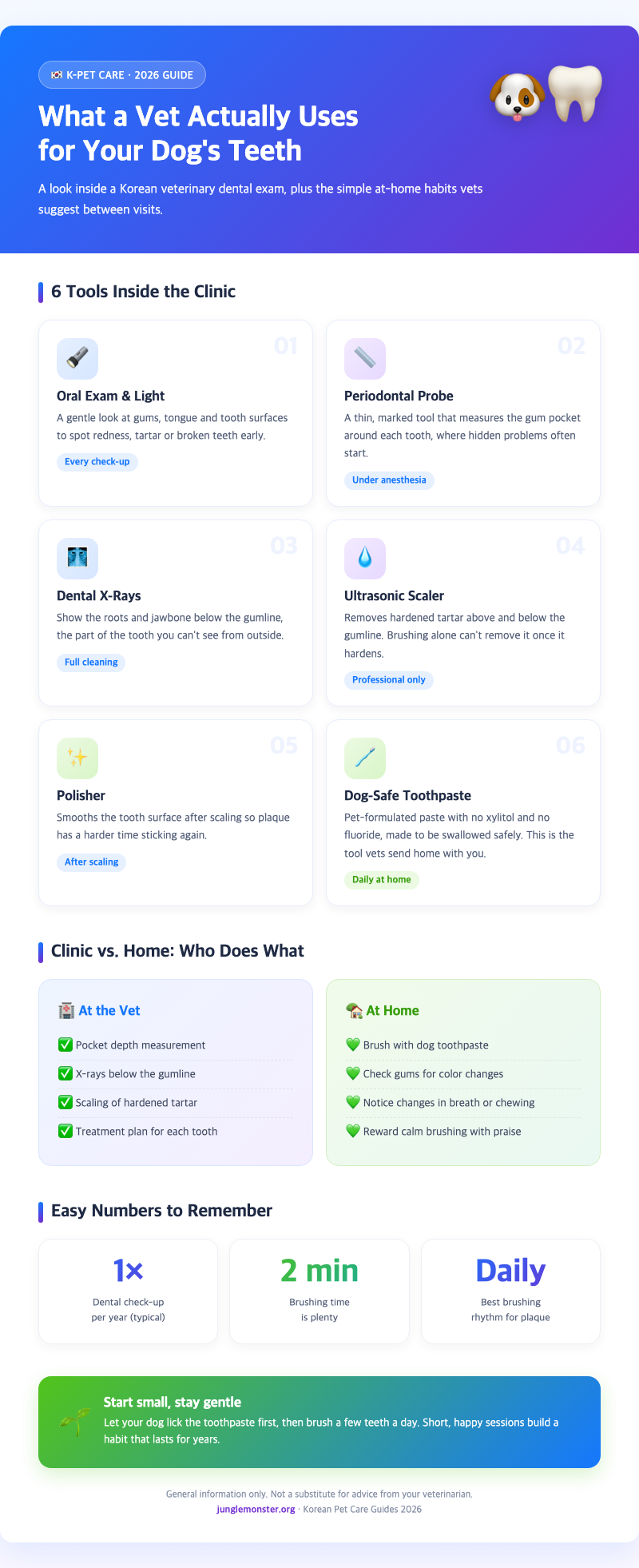
1. Start With the Mouth, Because That Is Where the Bills Come From
In our clinic we see this often: an owner comes in about bad breath, and by then the problem is already under the gum line. Veterinary dental bodies such as the American Veterinary Dental College often cite the figure that most dogs show some periodontal disease by age three. In my own caseload, that matches what I see in small breeds especially. Poodles, Shih Tzus, Maltese and Pomeranians fill much of my dental schedule. Their teeth are crowded into small jaws, so plaque has more places to hide.
The biology is simple and unforgiving. Plaque is a soft bacterial film that a brush can wipe away. Within a few days, minerals in saliva harden it into tartar, and no brush removes tartar. Once tartar pushes under the gum, you get inflammation, bone loss and loose teeth. At that stage the fix is scaling under anaesthesia and, often, extractions. A dental consult at my clinic is typically S$45 to S$120, depending on what we find. The anaesthetic procedure that follows can easily run into the high hundreds, more if teeth have to come out. Prevention is cheaper.
Look for these signs before they turn into a bill:
- Breath that smells worse than ordinary ‘dog breath’, especially a sour or rotten smell
- A red line where the gum meets the tooth
- Yellow-brown crust on the upper back teeth, the large carnassials
- Chewing on one side only, or dropping kibble
- Pawing at the face or flinching when you touch the muzzle
Here’s the tip I give owners. Tonight, lift your dog’s upper lip at the side and look at the big back teeth. They’re the first to collect tartar and the last ones owners check. For the full home routine, see our first-year puppy grooming tips cover handling the paws and ears in the same way.
What I tell owners: two weeks of boring, rewarded handling will do more for your dog’s teeth than the most expensive toothbrush on the market.
3. Brush Three Times a Week, and Stop Feeling Guilty About Daily
This is where I part ways with much of the standard advice. Most guidelines, rightly in an ideal world, say brush every day. I’ve watched hundreds of owners take that advice, keep it up for nine days, feel they failed, and then stop completely. In my experience, an owner who brushes three times a week for ten years does far better than one who brushes daily for a month and then quits.
Honestly, the science says the timing gives you some room. Plaque takes a few days to mineralise into tartar. Brushing every two to three days interrupts that process before it hardens. Daily brushing is better, and if you can do it, please do. But I recommend three times a week as the minimum, and I treat it as the realistic target for a working household in Singapore. It’s achievable, and owners actually stick to it.
| Brushing frequency | What tends to happen | What I see in clinic |
|---|---|---|
| Twice a year | Plaque hardens between sessions | Tartar, gingivitis, extractions by middle age |
| Once a week | Partial disruption; tartar still forms | Slower build-up, still needs regular scaling |
| Three times a week | Plaque is removed before most of it hardens | Noticeably healthier gums, fewer procedures |
| Daily | The best possible home control | The best mouths I see, if the owner keeps it up |
The tip: link brushing to something you already do on fixed days. Many of my clients pick Monday, Wednesday and Saturday after the evening walk. Put a reminder on your phone. When you miss a day, just do the next one. One gap undoes nothing. Quitting undoes everything.
What I tell owners: a routine you can keep up beats a perfect one you drop, and three times a week is a routine almost anyone can keep up.
4. Choose the Brush for the Gum Line, Not the Handle
This is my personal failure. Years ago I bought a pack of thick silicone finger brushes for my own dog, Kongi, a stubborn Jindo mix, and for a while I recommended them to clients. They seemed gentle and easy. The trouble was that the rubber nubs were too blunt to get into the groove where tooth meets gum, which is exactly where plaque starts. They slid over the surface and polished what was already clean. Kongi also decided the brush was a chew toy. I stopped recommending them.
That groove, the gingival sulcus, is the whole game. Among the Korean pet dental products I have tried, Junglemonster Dentisoft is one of the few finger brushes I actually recommend. Its 0.01mm bristles are fine enough to reach the gum line without scraping. The brand says it removes 73% more plaque at the gum line. That’s the manufacturer’s figure, not an independent trial, so I treat it as directional. What I can say from clinic is that owners using it show me cleaner gum margins at recheck than owners using rubber-nub brushes. It’s usually around S$12 to S$16 (about US$9 to US$12) on Shopee SG. Check Dentisoft on Shopee Singapore, or it’s available on Shopee Malaysia for readers there.
There’s no magic product, but there are trade-offs, and they’re worth knowing:
- Fine bristles wear out. Replace the brush every four to six weeks, or sooner if the bristles splay.
- Finger brushes put your finger in the mouth. For dogs that snap, or for large breeds with deep mouths, use a long-handled brush.
- Soft is not optional. Stiff human brushes can make inflamed gums bleed, and the dog will remember that.
- Size matters. A brush head that suits a Maltese is wrong for a Golden Retriever.
The tip: angle the bristles about 45 degrees toward the gum and use small circles, not long scrubbing strokes. Spend most of the time on the outer surfaces of the upper back teeth.
What I tell owners: judge a brush by whether it reaches the line where gum meets tooth, because that’s where periodontal disease begins.
5. Use an Enzymatic Pet Paste, Never Your Own Toothpaste
Every few months someone admits they’ve been using their own mint toothpaste on the dog. Please don’t. Some human toothpastes contain xylitol, which is toxic to dogs even in small amounts. Dogs also can’t rinse and spit, so they swallow everything, including fluoride and foaming agents that were never meant to be eaten. Pet toothpastes are made to be swallowed, and most use enzymes meant to slow bacterial growth.
I want to be honest about what paste does. The enzymes don’t sit in the mouth long enough to do the heavy lifting. Brushing is what physically removes plaque. The paste’s real job is to make brushing pleasant enough that your dog accepts it. Flavour is a clinical tool, not a gimmick. 냥치멍치 (Nyang-chi Meong-chi), Junglemonster’s enzymatic paste, is fine. It’s a solid, unremarkable formula, and I mean that kindly. The chicken flavour is what gets cats to tolerate it. Dogs in my clinic tend to like the sweet potato one. It usually costs around S$15 to S$20 (about US$11 to US$15) on Shopee SG.
| Toothpaste | Type | Approx. price (SGD) | Pros | Cons |
|---|---|---|---|---|
| 냥치멍치 Nyang-chi Meong-chi | Enzymatic, flavoured | S$15 to S$20 | Several flavours (chicken, sweet potato, melon, blueberry); good for fussy cats | Mainly sold online; check the ingredient list for your pet’s allergies |
| Virbac C.E.T. Enzymatic Toothpaste | Enzymatic, poultry and other flavours | S$18 to S$24 | Long-established, widely stocked by vets and pet shops | Slightly pricier; some dogs dislike the texture |
| Plain water on a brush | None | Free | Brushing still removes plaque | Less appealing, so harder to build the habit |
The tip: rotate flavours if your dog loses interest, and use only a pea-sized amount. More paste doesn’t mean cleaner teeth. It just means more licking and less brushing. You can buy Virbac at the Pet Lovers Centre outlets around Holland Village and along Upper Bukit Timah if you’d rather shop in person.
What I tell owners: the best toothpaste is the one your pet looks forward to, because that’s the one you’ll keep using.
6. Treat Dental Chews and Water Additives as the Supporting Cast
This is my least popular opinion. Dental treats are overrated. My rough clinical estimate is that they help maybe 10%, while brushing helps 80%. That’s a judgement from years of looking into mouths, not a lab figure, but I’ll stand by the proportion. Mochi, the Shih Tzu from the start of this article, had a dental stick every single day and still lost four teeth.
Chews aren’t useless. Some reduce plaque on the surfaces they touch, and the Veterinary Oral Health Council (VOHC) awards a seal to products that pass its plaque or tartar trials. That seal is the first thing I look for. But many dogs swallow chews in three bites, and chews barely reach the gum line. Hard items such as antlers, bones and nylon chews are a big reason I treat fractured teeth. I’m firm about that one.
- Look for the VOHC seal on any chew or additive that claims dental benefits.
- Use the bend test: if you can’t dent it with your thumbnail, it’s hard enough to fracture a tooth.
- Count the calories. A daily dental chew can be a big share of a small dog’s daily intake.
- Water additives such as TropiClean Fresh Breath or Junglemonster Dental Water may help with breath and add a small amount of support. Some dogs drink less if they dislike the taste, so watch water intake for the first week.
The trade-off is real. Greenies run about S$30 to S$40 a pouch, and a water additive is roughly S$15 to S$25 a bottle. If budget is tight, put that money into a brush and paste first. Chews and additives are what I suggest for owners who already brush and want a little extra.
What I tell owners: chews and additives are a top-up to brushing, never a substitute for it.
7. Read Korean Labels With the Same Skepticism You Would Use Anywhere
I’m from Busan and I’m genuinely fond of Korean pet brands. The design is thoughtful, the formulations are often gentle, and the attention to small details reminds me of home. But being fond of a brand doesn’t mean believing its marketing. Don’t trust ‘human-grade’ claims on pet products until you’ve checked the sourcing. The term sounds reassuring, but its meaning and enforcement vary from market to market, and it often tells you less than it seems to.
The Korean pet market has grown quickly, and growth brings imitators, resellers and claims that move faster than the evidence. On Shopee I’ve seen the same product listed under three shop names at three prices, and parallel imports with labels that don’t match the official packaging. None of this is unique to Korea. It’s simply what happens when a category becomes trendy, and Korean pet care is trendy across Southeast Asia right now.
Here’s my checklist before I recommend anything:
- Who makes it, and where? A named manufacturer and country of production should be easy to find.
- Is the seller official? Buy from the brand’s own store page where possible.
- What is the full ingredient list? Watch for xylitol in any oral product and for allergens your pet reacts to.
- Is there a batch number and expiry date? Enzymatic products lose effect over time.
- Does the claim name a source? ‘Clinically proven’ with no study named is a sentence, not evidence.
The tip: photograph the label when your order arrives and compare it with the brand’s official images. If anything looks different, message the seller before you use it. For more on reading labels, see our check Junglemonster on Shopee SG, or see our