Disclosure: This post contains affiliate links. If you subscribe through some of these links, I may earn a small commission at no extra cost to you.
I’ll be honest: the first time I watched When Life Gives You Tangerines, I was on deadline, so I watched it mostly as source text. I had a spreadsheet open and a cold oolong going flat beside my laptop in my apartment off Heping East Road in Daan, and I was marking every line of Jeju dialect I didn’t know how to render in Traditional Chinese. By episode four I had 61 flagged lines. By episode eight I had closed the spreadsheet and was crying into a 7-Eleven napkin. This When Life Gives You Tangerines Netflix review comes from someone who has subtitled more than 30 Korean series since 2019, and who has now rewatched this show twice, in Korean, with English subs, and with Chinese subs, because I wanted to know why my friends abroad called it ‘slow’ while everyone I know in Seoul called it the drama of the decade.
Something is shifting in K-drama, and this show is the clearest signal of it. The decades-spanning family saga, the kind of story that follows one marriage from the 1950s to the present, has come back, and it brought a bigger budget, a global platform and a translation problem nobody fixed. The odd thing is that you can see the same pull outside Korea too. Japan’s Kingdom 4: Return of the Great General, the 2024 Shinsuke Sato film, pulled the focus away from its young hero and onto an aging general’s past, and MyDramaList reviewers said that was what made it the best entry in the series. Audiences want legacy now. They want the long view.
In this piece I’ll walk through what the original Korean is actually saying, why Western reviews missed some of it, how this fits the tvN vs JTBC vs Netflix contest in 2026, what it costs to watch properly here in Taipei, and where I think the trend goes in the next twelve months.
The Signal: Why When Life Gives You Tangerines Still Matters in 2026
I’ve been tracking long-form ‘life’ dramas since Reply 1988 aired on tvN in 2015. Its finale hit about 18.8% in Nielsen Korea cable ratings, which was a record for cable at the time. The data tells a consistent story. Whenever Korean TV goes through a run of high-concept genre shows (zombies, revenge plots, chaebol fantasies), a slow, warm, generational story comes along and outperforms everyone’s expectations. Tangerines is that story for the streaming era. Netflix released it in four weekly batches of four episodes in March 2025, and it sat on Netflix’s public global Top 10 for non-English TV for weeks. A year and a half later it still drives search traffic and rewatch threads. That’s the part that interests me as someone who recaps for a living.
The premise sounds modest. Oh Ae-sun is a sharp, poetry-writing girl from a Jeju haenyeo (female diver) family, played young by IU and later by Moon So-ri. Yang Gwan-sik is the quiet boy who loves her his whole life, played by Park Bo-gum and later by Park Hae-joon. The show follows them through poverty, children, loss and the slow modernisation of Korea, told in four ‘seasons’ that work like chapters of a life. There’s no villain in the usual sense. The antagonists are time, money and the expectations placed on Korean women of Ae-sun’s generation.
What makes it a signal rather than a one-off is the reaction it got. Korean viewers argued about it the way they argued about My Mister, which Kim Won-seok also directed. Daughters watched it with their mothers. Over the past year, I’ve watched Taiwanese fans on PTT’s KoreaDrama board treat it as a reference point for a whole kind of drama, not just as one more hit. When a show becomes a yardstick, the industry starts copying it.
Something you can act on today: if you’ve only seen clips on social media, start from episode one and not from a highlight reel. The first four episodes are deliberately cramped and harsh, and the payoff in episodes 12 to 16 depends on you having sat through that.
My read: Tangerines is the clearest sign that the generational saga is back, and this time it has a global audience behind it.
How K-Drama Got Here: From Reply 1988 to a Jeju Haenyeo Saga
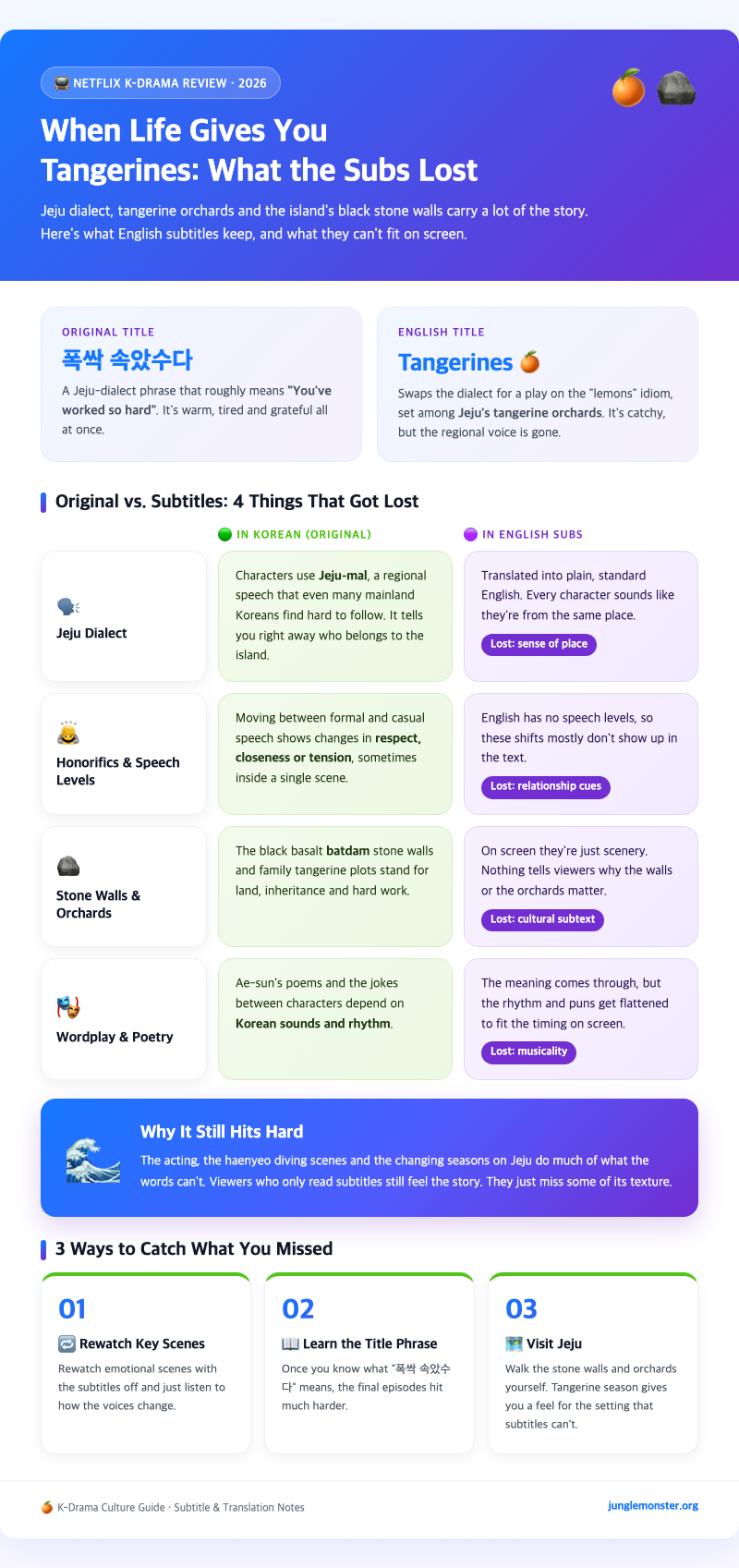
From the translation side, the history of this genre is mostly a history of dialect. Reply 1994 used Gyeongsang and Jeolla dialects as comic shorthand. Reply 1988 leaned on neighbourhood slang from Ssangmun-dong in Seoul. When the Camellia Blooms (KBS, 2019), Lim Sang-choon’s previous big hit, set its story in a fictional port town and wrote its dialogue full of regional rhythm. Tangerines goes further than any of them. Jeju-eo is different enough from standard Korean that UNESCO lists it as critically endangered, and Netflix Korea actually shows Korean subtitles for some Jeju lines, for Korean viewers.
So there’s a timeline. Each wave of this genre has pushed further into regional and historical specificity. Each time, Korean audiences have rewarded it, and each time, foreign subtitles have had a harder job. My count of the Jeju-dialect lines in episode one alone came to over 40. Some of them are background noise from the market women. Others are jokes the plot hangs on.
Then there’s money. The reported production budget for Tangerines was around 60 billion won, roughly US$43 million, which is huge for a non-genre Korean drama. Ten years ago a story like this would have gone to a terrestrial broadcaster or tvN, been shot quickly, and aired twice a week. Netflix’s money meant season-by-season art direction: actual period fishing boats, a reconstructed 1960s Jeju village, and costume changes that age the characters. It shows. It also changed the incentives. A saga used to be a safe, cheap ratings play. Now it can be a prestige global release.
I made a mistake here that I want to own. When Netflix first announced the show in 2024, I told my editor it would underperform outside Korea because ‘nobody abroad will sit through 16 hours of a Jeju marriage.’ I was thinking of how Reply 1988 stayed a cult favourite outside Asia and never became a mainstream hit. I was wrong. I underestimated how much the batch release would help. Four episodes a week gave viewers enough to get hooked and still left a week to talk about it.
If you want the background, it’s worth watching K-drama streaming services comparison for Asia breaks down which platform has which broadcaster’s catalogue.
My read: Pay for 1080p if you can, rotate your other subscriptions, and don’t let a paid ‘must-see’ list decide what you watch.
The Rewatch Test: What Holds Up and What Doesn’t
Recapping teaches you one harsh rule: a drama’s real quality shows on the rewatch, when you already know the twists. In my experience, the rewatch is where the writing either holds or falls apart. So here’s my test, applied to Tangerines and two shows people always ask me about.
Crash Landing on You holds up. I rewatched it last winter for a recap series, and the North Korean village scenes are even better the second time, because you notice how carefully Park Ji-eun built each of the village women. The romance has formula, but the ensemble writing carries it. Vincenzo doesn’t hold up, and I know that’s an unpopular view because I love Song Joong-ki. On first watch, the tonal swings between slapstick and violence feel daring. On rewatch, they feel like a show that couldn’t decide what it was, and the middle stretch of episodes 10 to 14 drags once the surprise is gone. Its finale got around 14.6% in Nielsen Korea ratings, a strong number, but popularity on first broadcast tells you little about how a show ages.
Tangerines holds up better on rewatch than on first watch. That’s rare. On my second viewing, the early episodes I’d found harsh became the best part, because I knew where every character would end up. A line Ae-sun’s mother says on the beach in episode one, a simple warning about the sea, becomes almost unbearable once you know the rest of the story. That’s Lim Sang-choon planting lines a full season ahead. The weakest part, for me, is the modern-day section with the grown daughter Geum-myeong, also played by IU. Some of her Seoul subplots feel thinner than the Jeju ones, and a romance in the final season resolves too neatly.
Here’s my contrarian take: the mainstream advice is that the young IU and Park Bo-gum romance is the heart of the show. I disagree. The heart is Moon So-ri and Park Hae-joon in the middle-aged years, two tired people who stay kind to each other when nobody’s watching. That’s where Kim Won-seok’s patient camera does its best work, and it’s the part I’d show anyone who doubts that Korean dramas can be adult.
If you want more rewatch analysis, my my Korean drama trends tracker, where I update the numbers every quarter.
My read: The ‘old general’ turn is real across East Asian screen stories, and subtitle quality will decide how far it travels.
Frequently Asked Questions
Is When Life Gives You Tangerines worth watching in 2026?
Yes, especially if you like slow, character-driven stories. It’s a 16-episode Netflix drama from 2025 by writer Lim Sang-choon and director Kim Won-seok, the director of My Mister. I’ve rewatched it twice, and it improves the second time because early lines pay off later. Watch with Korean audio. If the first four episodes feel harsh, stick with them. That harshness is the foundation for the emotional final season.
What does the Korean title 폭싹 속았수다 mean?
In Jeju dialect, 폭싹 속았수다 means roughly ‘you’ve worked so hard’ or ‘thank you for your trouble.’ It’s a phrase of gratitude. Many standard Korean speakers mishear it as ‘completely fooled,’ which is a running joke among Korean viewers. The English title, When Life Gives You Tangerines, is a pun on ‘when life gives you lemons.’ It’s catchy but loses the gratitude that sits at the centre of the story.
Are the Netflix English subtitles for When Life Gives You Tangerines good?
They’re readable and mostly accurate on plot, but they flatten the Jeju dialect, the speech-level shifts and the wordplay in Ae-sun’s poems. As a professional subtitler, I’d say they’re better than Squid Game’s English subs but still lose much of the texture. If you read Traditional Chinese or another language with a careful track, compare a few scenes. The differences show where the original is doing something clever.
How many episodes does When Life Gives You Tangerines have and how long does it take to watch?
There are 16 episodes, released by Netflix in four weekly batches of four in March 2025. Each episode runs roughly an hour, so plan for about 16 to 17 hours. I recommend watching it in four sittings, one per ‘season’ of the characters’ lives, with a break between. That matches the release structure and gives the time jumps room to land emotionally.
Who plays the leads in When Life Gives You Tangerines?
IU plays young Oh Ae-sun and also her adult daughter Geum-myeong. Park Bo-gum plays young Yang Gwan-sik. Moon So-ri and Park Hae-joon play the couple in their middle and later years. In my view, the Moon So-ri and Park Hae-joon years are the strongest part of the drama. The younger romance gets the attention, but the older couple’s quiet kindness carries the show’s real weight.
Is When Life Gives You Tangerines related to the Kingdom series?
No. When Life Gives You Tangerines is a Korean Netflix family drama. Kingdom is a separate Korean Netflix zombie period series, and Kingdom: Return of the Great General is a 2024 Japanese film by Shinsuke Sato based on a manga. They come up together in searches partly because of name confusion. They also share a theme: stories that move the focus from youthful ambition to the legacy of an older generation.
Is tvN or Netflix better for Korean drama quality in 2026?
In my experience subtitling for both, tvN still has the most consistent writing bench, with hits like Crash Landing on You and Queen of Tears behind it. Netflix has bigger budgets and global reach, and Tangerines shows it can match tvN’s craft. JTBC makes bold shows but stumbles on endings more often. For quality, follow writers and directors rather than platforms. A proven writer’s next project is usually the safest bet.
Should I trust ‘best K-drama of the year’ lists?
Be careful with them. Many year-end K-drama lists are paid promotions or affiliate-driven, and I’ve personally been offered payment to include shows. A good sign of a real list is specific scene-level detail that couldn’t come from a press release. A better approach is to check Nielsen Korea ratings, the Baeksang Arts Awards nominations, and the writer’s previous work, then decide for yourself.
Where I Land on When Life Gives You Tangerines
說真的, I didn’t expect a Netflix family saga to make me rethink how I subtitle, but this one did. Here’s what I’d tell a friend over coffee in Daan:
- When Life Gives You Tangerines is the clearest sign that decades-spanning family sagas are back, and that they now get global budgets.
- The Jeju dialect and the title phrase carry meaning the English subs flatten. Watch in Korean audio and compare subtitle tracks if you can.
- The heart of the show is the middle-aged couple, not the young romance, and it gets better on rewatch.
- tvN still leads on writing consistency, but Netflix has shown it can buy that craft.
- Pay for 1080p (Netflix Standard is TWD 330 in Taiwan) if you watch on a TV, and ignore paid ‘essential’ lists.
If you want to watch it properly, start with a Netflix plan that fits your screen, and see my