Disclosure: This post contains affiliate links. If you buy through them, I may earn a small commission at no extra cost to you. I bought every product mentioned here with my own money.
77%. That’s how much heartleaf extract is in the toner that calmed my face down after I wrecked it in spring 2025. I spent two years as a merchandiser at Amorepacific, deciding which korean skincare products got the end-cap at the front of the store. So believe me when I say I don’t get excited about toners. I know how the sausage is made. Most korean skincare launches are a new bottle color and a bigger promise.
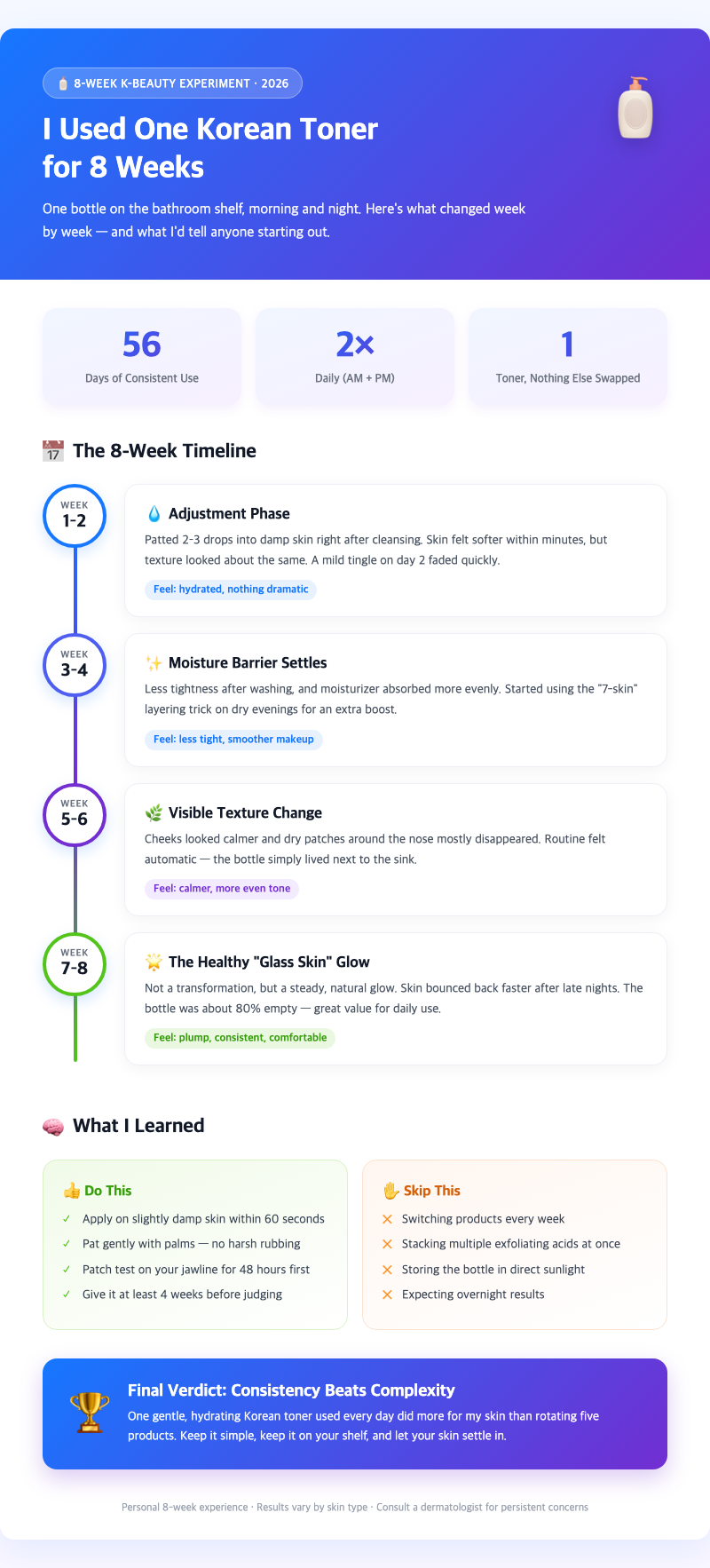
This one stuck, though. I used Anua Heartleaf 77% Soothing Toner every morning and every night for eight weeks straight, and I’m still on it months later. I bought it at the Olive Young in Seongsu, the one near Seoul Forest Station exit 3 where I basically live on weekends. Shelf price was about ₩28,000 (roughly US$20).
Here’s the problem I think a lot of you have. You’ve read the Vogue list, the Byrdie list, the Glamour list. They all name the same nine brands. You end up with a seven-step routine, a ₩200,000 haul, and skin that’s angrier than before you started. That was me.
So this isn’t a top-10 list. It’s one product: what it did, what it didn’t do, who shouldn’t bother, and the two or three things I pair it with. I’ll tell you what I paid and where to buy it outside Korea (Shopee for Singapore and Malaysia, Amazon for the US and UK, YesStyle for most places). I’ll also tell you about the mistakes I made, so you can skip them.
Check current prices on YesStyle →
korean skincare in 2026: The One Toner I Keep Rebuying
Look, I’ll say the unpopular part first. Anua Heartleaf is the real MVP of 2025 and 2026, and that isn’t because it’s exciting. It’s because it’s boring in exactly the right way: watery texture, no fragrance I can detect, no tingle, no glitter-in-a-bottle promise. When I was an MD I sat through a lot of launch meetings where the first question was always ‘what’s the hook?’ This toner doesn’t really have one, and that’s why I trust it.
Here’s the math that sold me. A 250ml bottle cost me ₩28,000 at shelf price. I used it twice a day and pressed it in with my hands. One bottle lasted me roughly ten weeks, which works out to about ₩400 a day. That’s less than an extra shot in a Seongsu latte. The ₩45,000 serums I used to buy lasted me five weeks.
It’s not some niche pick that only I like, either. On Hwahae, the Korean review app that has collected more than 10 million reviews, heartleaf toners have been fixtures in the toner rankings for a couple of years. Anua’s toner has also spent long stretches near the top of Amazon’s US toner charts. Popularity isn’t proof, and I spent two years manufacturing popularity for a living. Still, when Seoul office workers and American Amazon shoppers settle on the same boring bottle, I pay attention.
What it’s good for:
- Calming redness after cleansing, exfoliating, or a bad night’s sleep
- Giving dehydrated-but-oily skin a light layer of hydration that doesn’t feel heavy
- Being the safe first layer when your barrier is upset and you’re nervous about putting anything on
What it isn’t: an acne treatment, a brightener, or a wrinkle fix. If a blog tells you otherwise, they’re selling something. (Yes, I see the irony, since there’s an affiliate link up top.)
One tip you can use today: patch test behind your ear or along your jawline for three nights before you put it on your whole face. Heartleaf is gentle for most people, but ‘most’ isn’t ‘all’. If you’re starting from zero, my Check Anua Heartleaf on Shopee SG/MY →
My take: The best product in a routine is usually the one that’s too boring to go viral, and this toner is exactly that.
The Problem: My ₩210,000 Korean Skincare Mistake
Between you and me, I wrecked my skin in spring 2025, and I did it with products I actually like. I’m an AHA toner believer, and I still am. But I got greedy. I was using an AHA toner every night and my old Clarisonic from 2018 every morning (it’s supposed to be a once-a-week thing). On top of that I’d just added a retinol serum because a brand sent me one to review. That’s three exfoliating steps stacked on each other. It was a classic former-MD move: assume more product means more results.
Within about ten days my cheeks felt tight, looked red, and stung when I put on plain moisturizer. I ended up at a dermatology clinic near Seongsu Station, ₩45,000 (about US$32) lighter. The doctor told me, politely, that I’d over-exfoliated and needed to stop nearly everything.
| ❌ Before (my 7-step mess) | ✅ After (3 steps, 8 weeks) |
|---|---|
| About ₩210,000 (~US$150) on seven products in one Olive Young haul | ₩28,000 toner + ₩18,000 sunscreen + a moisturizer I already owned |
| 12–15 minutes every night | Under 2 minutes |
| Stinging, redness on both cheeks, flaking around my nose | No stinging by week 2, redness mostly gone by week 3 |
| AHA every night, daily Clarisonic, new retinol | AHA toner twice a week, Clarisonic once a week (yes, still the 2018 one) |
Here’s the part that disagrees with a lot of mainstream K-Beauty content. The 10-step routine was always more of a marketing story than a skincare method. I know because I helped sell it. More steps means more SKUs, and more SKUs means a bigger basket at checkout. Your skin doesn’t care how many bottles are on your shelf. What matters is whether the few you use work together without irritating you.
Labels are part of the confusion too. Korea’s Ministry of Food and Drug Safety (MFDS) recognizes a short list of ‘functional cosmetic’ categories, things like brightening, wrinkle improvement, and UV protection, and products need approval to make those claims. ‘Soothing’ isn’t on that list, so any brand can print it on a bottle. That doesn’t make soothing toners useless. It means you’re trusting the formula and the reviews, not a government stamp.
Actionable tip: tonight, line up everything you put on your face and count the exfoliants. That includes AHA, BHA, PHA, retinoids, vitamin C at low pH, scrubs, and cleansing brushes. If you get more than two that you use daily, that’s probably your problem, and no new product will fix it.
My take: Most ‘my Korean skincare stopped working’ stories are really ‘I stacked too many actives’ stories.
How It Works: 3 Steps, Under 60 Seconds
After the clinic visit I rebuilt everything around three steps. Honestly, I was skeptical it would be enough. I’ve tested more K-Beauty routines than I can count, and my instinct is always to add something. Here’s the whole thing:
- 1️⃣ Cleanse gently, then press in 3–4 pours of the toner with your palms. Benefit: you calm redness right away and stop wasting product on cotton pads.
- 2️⃣ Wait about 30 seconds, then apply one simple moisturizer. Benefit: the moisturizer holds in the hydration so your skin doesn’t feel tight by lunch.
- 3️⃣ Morning: sunscreen. Night: go to bed. Benefit: you protect what you’ve calmed down, and you let your skin repair itself overnight.
A few notes from my own testing. First, the cotton pad thing. When I used pads, a bottle lasted about seven weeks. With my hands it lasted about ten. Pads soak up product, and the extra friction is the last thing a cranky barrier needs. If you love the swiping feeling, save it for your AHA days.
Second, I tried the ‘seven skin’ method, where you layer the same toner seven times. It didn’t do anything that three pours didn’t, and I went through a bottle in under a month. Skip it unless you’re very dry and very patient.
Third, sunscreen. Real talk: most Korean sunscreens still leave a white cast on darker skin. Mineral formulas are the worst offenders. My friends with deeper skin tones have given up on half the options at Olive Young. If that’s you, look at chemical or hybrid filters and test the shade on your jawline in daylight, not under store lighting. I go into it more in my See today’s price on YesStyle → · Amazon US/UK →
My take: The most honest proof for any product is a repurchase you didn’t have to think about.
Who Should Skip It (and What I’d Buy Instead)
Honestly, this toner isn’t for everyone, and pretending otherwise is how I’d lose your trust. After eight weeks of testing it, plus trying alternatives over the past two years, here’s who I’d steer elsewhere:
- Very dry skin: it’s watery. On its own it won’t be enough in a Seoul January. You’ll need a richer cream on top, or a thicker toner.
- People who need active ingredients: if you have clogged pores or texture, you need an exfoliating toner, and a soothing one won’t do that job.
- Budget shoppers: ₩28,000 isn’t cheap for what is mostly a calming water. Some cheaper options come close.
Here’s how it stacks up against what I’ve used. These are shelf prices I’ve seen in Seongsu, rounded. Sale prices often run 20–40% lower.
| Toner | Price (KRW / approx. USD) | Best for | Honest downside |
|---|---|---|---|
| Anua Heartleaf 77% Soothing Toner (250ml) | ₩28,000 / ~$20 | Redness, sensitive or upset skin | Too light for very dry skin |
| Round Lab 1025 Dokdo Toner (200ml) | ~₩19,000 / ~$14 | Gentle daily hydration | Slightly less calming for me |
| COSRX AHA/BHA Clarifying Treatment Toner (150ml) | ~₩14,000 / ~$10 | Mild exfoliation, clogged pores | Not for an irritated barrier |
| Some By Mi AHA BHA PHA 30 Days Miracle Toner (150ml) | ~₩12,900 / ~$9 | Budget exfoliation | Tea tree smell. It stung me during my bad phase |
This is just my taste, but COSRX got hyped past its peak. Five years ago it was the brand I’d recommend to everyone. Now newer indie brands are doing gentler formulas with better textures for about the same money. COSRX isn’t bad. It’s just not the automatic answer anymore, and the snail essence is mostly riding nostalgia at this point.
Round Lab is the honest trade-off pick. If ₩28,000 feels steep, the Dokdo toner gets you maybe 80% of the experience for about two-thirds of the price. Considering that, I wouldn’t blame anyone for choosing it. I just found Anua calmer on my worst days. If you want to understand why some formulas sting and others don’t, my Check price →
One more thing: my 2018 Clarisonic is still in the rotation, once a week, on a soft brush head. I’m not telling you to buy one, since the line has been discontinued anyway. I’m telling you that the tools you already own are fine if you use them less often. Overusing it was half my problem, and the device itself was never the issue.
The combined cost of the toner, sunscreen, and cream is around ₩66,000 (roughly US$47). That’s a third of my old seven-product haul, and the results were better.
My take: A good routine is a short list of products you’d buy again, plus one cheap thing you already have.
Where to Buy Korean Skincare Outside Korea (and What It Costs)
I get asked this constantly, mostly by friends in Singapore and KL who visited me in Seongsu and then ran out three months later. The prices below are rough ranges for the Anua toner based on my own checks. They change every week with vouchers and sales, so treat them as a sense check, not a quote.
| Where | Rough price (250ml) | Notes |
|---|---|---|
| Olive Young Seongsu (near Seoul Forest exit 3) | ₩28,000 shelf, often ~₩20,000 on sale | Smaller crowds than Myeongdong, good stock |
| Olive Young Myeongdong flagship | Same shelf price | Tourist tax refund available, but always packed |
| YesStyle | Roughly US$18–25 | Ships to most of the 7 markets; free shipping above a threshold |
| Amazon US/UK | Roughly US$18–30 / £15–25 | Buy from Anua’s official store listing only |
| Shopee SG / MY | Roughly S$20–32 / RM60–95 | Look for the official mall badge, and stack vouchers |
Three practical tips:
- Time it to the Olive Young Sale. Olive Young runs its big sale roughly every quarter, around March, June, September, and December. If you’re visiting Seoul, plan around one. On a ₩28,000 toner, the discount can pay for your coffee all week.
- Avoid sketchy third-party sellers. Popular K-Beauty products get faked, and Anua’s toner is popular enough to be a target. If a Shopee price is half of everywhere else, there’s a reason.
- Check the batch date. Unopened toners hold up fine, but I prefer stock made within the past year. The date is printed on the bottom of the bottle.
If you’re planning a beauty-shopping trip, my Check current prices on YesStyle → · Shopee SG/MY → · Amazon US/UK →
Last reviewed: November 2026. Prices are approximate and change often. Check the store page before you buy.