Disclosure: This post contains affiliate links. If you buy through these links, I may earn a small commission at no extra cost to you. My clinical opinions are my own and I don’t change them for commissions.
Last Tuesday I pulled four teeth from a seven-year-old Maltese named Mochi. It was my third extraction case that week, and when I asked her owner how often she brushed, she laughed and said, “Twice a year? At New Year and when I remember.” She was being honest, and that’s about average. In my experience most Singapore owners brush their pet’s teeth roughly twice a year, so the bar is low. I bring this up because people keep asking me about korean dog care. I trained at Seoul National University, I grew up in Busan, and I’ve practised in Singapore since 2017. Clients assume Korean owners have some secret routine. Korean dog care does have a few habits worth copying, but there’s no secret. It’s mostly about making brushing easy and putting up with a slightly annoyed dog for ninety seconds a few times a week.
This is a case study of one dog and one owner over twelve months: what went wrong, what I got wrong myself, what we changed, and what the numbers looked like at the end. Mochi’s name and some details are changed for privacy, but the clinical course is real and typical of what I see. You’ll learn why owners give up on brushing, which tools actually reach the gum line, where dental treats belong in the routine (lower down than the packaging suggests), and what a realistic home routine costs in Singapore dollars. I’ll also tell you where I think Korean pet brands earn their reputation and where the marketing gets ahead of the evidence.
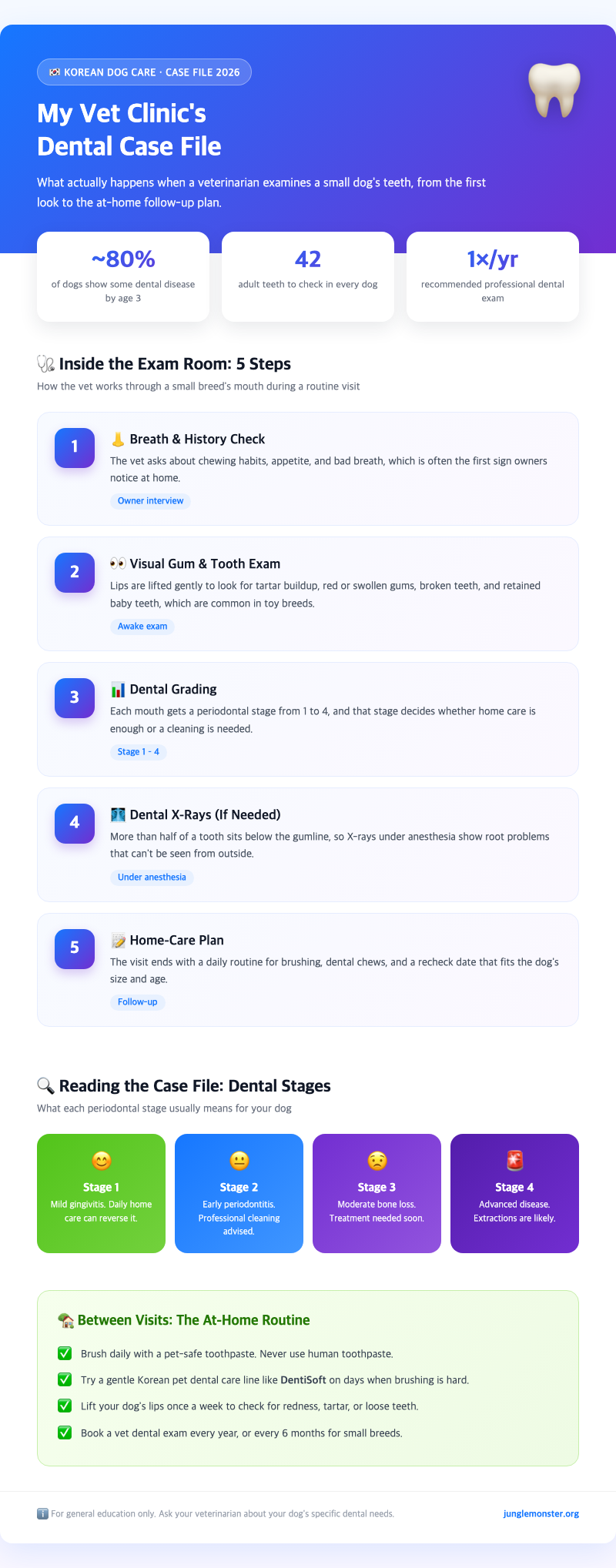
Korean Dog Care Through a Dental Chair in Bukit Timah
In our clinic we see this often: a dog comes in for vaccinations, I lift the lip, and the back premolars are brown with calculus right up to the gum. The owner is usually surprised. Small breeds, which make up most of the dogs in Singapore’s HDB flats and condos, hide dental disease well. They keep eating. They just eat a bit more slowly and chew on one side.
The data here is not new or controversial. The American Veterinary Dental College has long stated that most dogs show some form of periodontal disease by around age three. Banfield Pet Hospital’s State of Pet Health reports have put dental tartar near the top of the most common diagnoses in dogs for years. Small and toy breeds are hit hardest because their teeth are crowded into small jaws. A Maltese, Pomeranian, Shih Tzu or toy poodle is effectively a dental patient waiting to happen. That’s also why these breeds are so popular in both Seoul and Singapore.
Honestly, the science says the thing that matters most is mechanical disruption of plaque at the gum line, where the tooth meets the gingiva. Plaque starts mineralising into calculus within a few days. That’s why brushing frequency matters more than which toothpaste you pick. A frequently cited study by Harvey and colleagues in the Journal of Veterinary Dentistry (2015) compared brushing frequencies in dogs. It found that daily brushing kept gingival health clearly better than brushing every other day. Every-other-day brushing still beat nothing by a wide margin.
- Lift your dog’s upper lip tonight and look at the upper fourth premolar, the big tooth above the back of the mouth. Yellow-brown buildup there is your baseline.
- Smell counts. Persistent bad breath in a dog is a clinical sign, not just a personality trait.
- Red gum lines or bleeding when your dog chews a toy means it’s time for a vet consult, not a new chew.
If you’re starting from zero, our guide to the Korean pet care routine covers grooming, paws and eyes.
What I tell owners: copy the Korean approach of low-friction design, and stay skeptical of Korean marketing.
The Approach: The Kit I Sent Home the Second Time
After Mochi’s extractions I didn’t repeat my earlier mistake. There’s no magic product, but there is a right-sized one. I sent the owner home with a finger brush and a meat-flavoured enzymatic paste, a written three-week training schedule, and a recheck booked at six weeks.
The brush was the Junglemonster Dentisoft. I want to be clear about why. It’s one of the few finger-style brushes I actually recommend, because its 0.01mm ultra-fine bristles get into the sulcus at the gum line, where plaque forms and where periodontal disease starts. The manufacturer claims it removes 73% more plaque at the gum line. I have not seen an independent peer-reviewed trial behind that number, so treat it as a manufacturer claim. Clinically, what I can tell you is that owners in my practice keep using it, and a brush that gets used matters more than any lab percentage.
For paste I suggested 냥치멍치 (Nyang-chi Meong-chi) enzymatic toothpaste. It’s fine. It isn’t special pharmacology, because enzymatic pastes all work on broadly similar principles. The chicken flavour is the real advantage: it’s what gets fussy dogs, and especially cats, to tolerate it. A paste your pet licks happily turns brushing into a treat instead of a wrestling match.
| Product | Type | Approx. price (SGD) | Pros | Cons |
|---|---|---|---|---|
| Junglemonster Dentisoft | Ultra-fine bristle brush | About S$12-18 on Shopee SG | Very soft, reaches gum line, suits toy breeds and inflamed gums | Plaque-removal claim is manufacturer data; less sturdy for large dogs who chew |
| Virbac C.E.T. Dual-Ended Toothbrush | Long-handle dual brush | About S$10-15 | Widely available, good for medium-large dogs | Handle intimidates small dogs; bristles stiffer |
| Beaphar finger brush | Rubber finger brush | About S$6-10 | Cheap, easy to start with | Rubber nubs don’t clean the gum line well |
| Virbac C.E.T. Enzymatic Toothpaste | Enzymatic paste | About S$18-25 | Long track record, poultry flavour | Pricier per tube; some dogs dislike the texture |
| Nyang-chi Meong-chi (냥치멍치) | Enzymatic paste | About S$15-22 on Shopee SG | Chicken, sweet potato, melon, blueberry flavours; high acceptance | Not VOHC-accepted to my knowledge; flavour preference varies |
Prices are approximate and vary with Shopee promotions, so check before you buy. For Singapore readers, check Dentisoft and Nyang-chi Meong-chi on Shopee Singapore; Malaysian readers can find them available on Shopee Malaysia.
What I tell owners: choose the brush for your dog’s mouth size and the paste for your dog’s taste, and don’t buy based on the box.
Dental Treats and the Human-Grade Problem
Remember the daily dental chew? Mochi ate one every day for years and still lost four teeth. This is where I disagree with a lot of mainstream pet-retail advice. Dental treats are overrated. In my clinical impression, treats contribute maybe 10% of the benefit in a home routine, while brushing contributes something like 80%. Those are my rough working numbers from years of looking into mouths, not results from a trial. The point is the proportion.
To be fair to the chews, some products do carry the Veterinary Oral Health Council (VOHC) seal, which means they’ve submitted data showing a measurable reduction in plaque or tartar. That’s a real, independent standard and worth checking for. But a VOHC-accepted chew reducing tartar by some percentage in a controlled trial is a long way from a chew replacing a toothbrush. Most of the effect lands on the tips of the teeth the dog actually chews with, not the gum line on the upper premolars. And a toy breed often swallows a chew in pieces after about thirty seconds.
Then there’s the label language. Don’t trust “human-grade” marketing on pet products without checking sourcing. In many markets the term has a narrow technical meaning: every ingredient and the facility must meet human food standards. Plenty of products use it loosely. I’ve had owners hand me chews labelled human-grade that, after a quick search, came from factories with no published sourcing information. When a client asks me about a product, I look for:
- A named manufacturer and country of manufacture, not just a distributor.
- A VOHC seal for any dental claim, or published data you can actually read.
- Calorie content. Many dental chews run 70-90 kcal, which is a meaningful share of a 3 kg dog’s daily needs.
- Clear guidance on chew size relative to body weight, to reduce choking and fracture risk.
For more on reading labels, see our cat oral health guide covers that separately.
On cost, the full home kit (brush, paste and an occasional water additive) comes to roughly S$40-60 a year in my estimate if you shop Shopee promotions. Extractions under anaesthesia regularly run into four figures. Prevention isn’t free, but it’s very cheap by comparison.
What I tell owners: the best dental routine is the boring one you’ll still be doing next November.
Frequently Asked Questions
How often should I brush my dog’s teeth in Singapore’s climate?
Climate doesn’t change the biology. Plaque mineralises into tartar within days whether you live in Singapore or Seoul. Veterinary research, including Harvey and colleagues’ 2015 study in the Journal of Veterinary Dentistry, supports daily brushing as ideal. In practice I tell owners three times a week is the minimum that makes a visible difference at rechecks. If you can do daily, do daily. If three is realistic, do three reliably rather than seven for one week.
Are finger toothbrushes as good as regular dog toothbrushes?
It depends on the brush and the dog. Rubber finger brushes with nubs are easy to start with, but they clean the gum line poorly. Finger brushes with real ultra-fine bristles, such as Dentisoft, can reach the gum line well in small mouths. For large dogs, a long-handled brush gives better reach and keeps your fingers away from strong jaws. In our clinic we choose based on mouth size and temperament.
Do dental chews really clean dogs’ teeth?
Some do, modestly. Look for the Veterinary Oral Health Council (VOHC) seal, which means the manufacturer submitted data showing plaque or tartar reduction. Even so, chews mostly help the chewing surfaces and contribute far less than brushing. My working estimate is roughly 10% versus 80%. Mochi in this case study had a daily chew for years and still needed four extractions. Count chew calories too, especially in toy breeds.
What is enzymatic toothpaste and is it safe for dogs?
Enzymatic pet toothpastes contain enzymes such as glucose oxidase that help limit bacterial activity in plaque. They’re formulated to be swallowed, because dogs can’t rinse and spit. Never use human toothpaste: many contain xylitol, which is toxic to dogs, and fluoride levels meant for spitting out. Pet pastes like Virbac C.E.T. or Nyang-chi Meong-chi are designed for swallowing. Pick the flavour your pet tolerates best.
How much does dog dental scaling cost in Singapore?
At my Bukit Timah clinic an initial dental consult runs S$45 to S$120. A full scaling under general anaesthesia, with bloodwork and X-rays, usually costs several hundred dollars. Extractions can push the bill well past S$1,000, as in Mochi’s case. Prices vary widely between clinics, so ask for an itemised estimate. Note that the true extent of disease often only shows up on X-ray once the dog is under anaesthesia.
Is Korean dog care actually better than Western approaches?
Not better, just designed differently. Korean pet care products tend to assume owners are busy and small dogs are fussy, so they focus on low-friction formats: finger brushes, food-flavoured pastes and water additives. That design philosophy helps compliance, which matters a lot. The underlying science is the same everywhere: mechanical brushing at the gum line plus regular veterinary checks. Judge any product on evidence, not country of origin.
Can I skip anaesthesia and get anaesthesia-free dental cleaning?
I don’t recommend it, and veterinary dental specialists including the American Veterinary Dental College have issued statements against it. Anaesthesia-free cleaning scrapes the visible crown but can’t clean below the gum line, where disease actually lives, and it can’t include X-rays. It makes teeth look clean while missing the problem. Modern anaesthesia with proper pre-screening is very safe for most healthy dogs.
What I’d Do If It Were My Dog
Mochi’s year shows that good korean dog care doesn’t depend on expensive products or perfect discipline. It’s a small, well-fitted routine you keep doing after the walk, even in audit season.
- Most dogs have periodontal disease by around age three, and small breeds are at highest risk.
- Brushing at the gum line, at least three times a week, does far more than any chew or additive.
- Fit the brush to the mouth: ultra-soft or finger brushes for toy breeds, long-handled brushes for big dogs.
- Flavoured enzymatic paste matters because acceptance keeps the routine going.
- Treat dental chews and human-grade labels skeptically, check for the VOHC seal, and book an annual dental check.
If you’re in Singapore and want the kit I sent Mochi home with, check Junglemonster Dentisoft on Shopee Singapore. Before you buy anything, lift your dog’s lip tonight and have a look. Last reviewed: November 2026.