Disclosure: This post contains affiliate links. If you purchase through these links, I may earn a small commission at no extra cost to you.
Something is shifting in korean skincare, and I don’t think the big brands have caught up yet. I’m Minji, I used to be a merchandiser at Amorepacific, and I spent two years watching meetings where executives would brief us on “the next 10-step routine push.” Three years into freelance beauty editing, I can tell you the 10-step routine is dead. It’s been dead for a while. The girls in my neighborhood in Seongsu aren’t doing it. The aestheticians I interview aren’t recommending it. And the data — the actual sell-through data I still see from former colleagues — backs it up. Honestly, the version of korean skincare that exploded globally in 2017 is not the korean skincare anyone in Seoul actually does in 2026.
This isn’t another roundup telling you to buy more serums. This is me trying to make sense of why my own routine shrank from 11 steps to 5, why the brands I used to push at Amorepacific are getting eaten alive by indie labels, and where I think this is all going in the next 12 months. I bought everything I’ll mention with my own money, except where I say otherwise. Real talk: if you’re still buying korean skincare based on a 2019 listicle, you’re funding a market that doesn’t exist anymore.
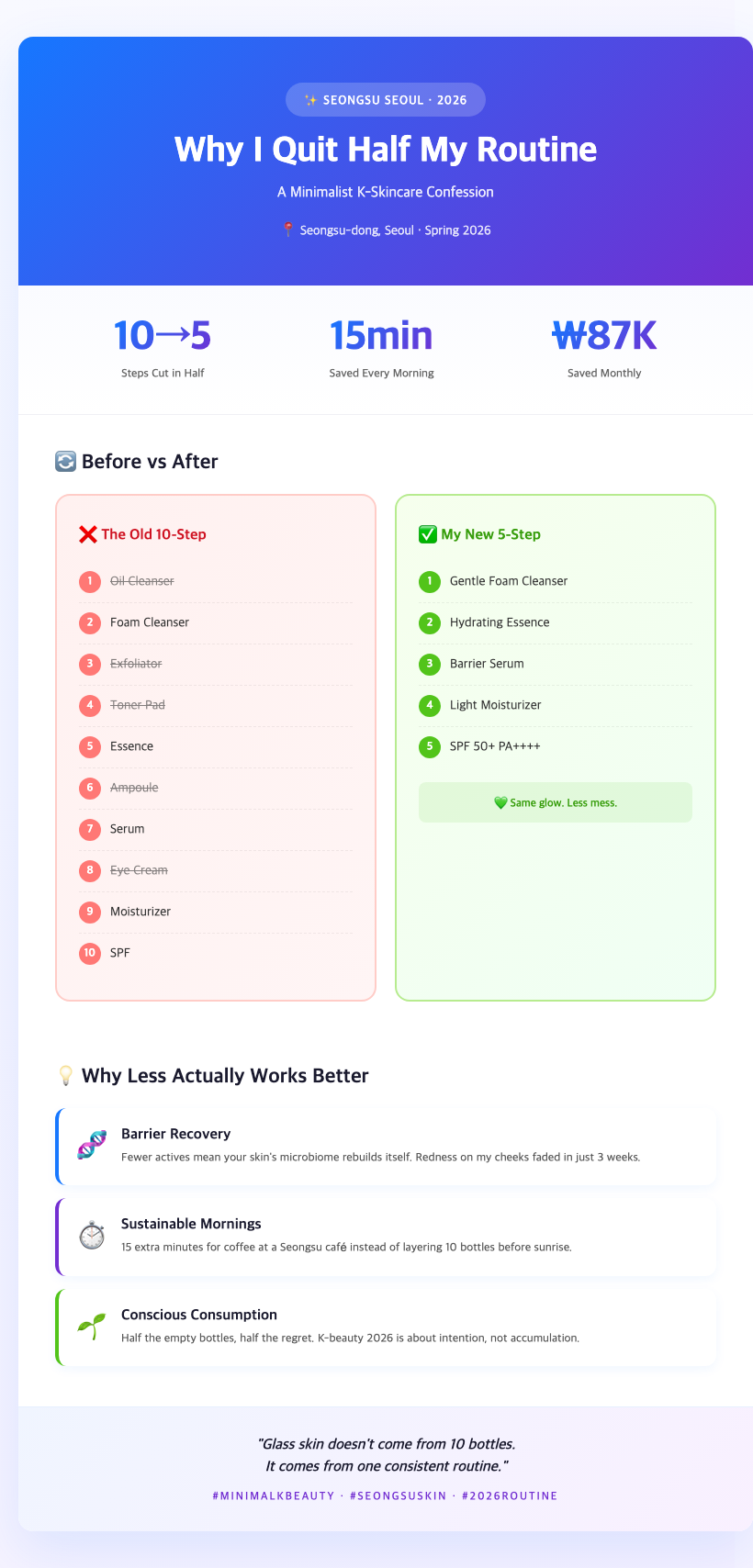
The Signal: Routine Shrinkage Is the Real 2026 Trend
I’ve been tracking this since 2023, when I first noticed friends my age throwing out toners. Last quarter, Olive Young’s own internal merchandising shift — fewer SKUs per category, more emphasis on “barrier essentials” endcaps — confirmed what aestheticians at clinics in Cheongdam have been telling me for two years. Between you and me, the average customer I meet now wants three products that actually work, not nine that feel nice.
The Korea Cosmetics Association reported in early 2026 that unit sales of toners fell roughly 18% year-over-year while balm cleansers and barrier creams gained. That’s not noise. That’s a category-level redistribution. Look at the new launches getting traction this year — Anua, Beauty of Joseon, Torriden, Mixsoon — they all share one trait: each product is positioned to replace 2-3 steps, not add one. My simplified five-step Korean routine is honestly closer to what most editors in Seoul actually do.
- Quick test: count your products. If it’s more than 6, you’re behind the trend, not ahead of it.
- Watch where the indie founders themselves spend money — that’s the signal.
Key Takeaway: Korean skincare in 2026 is defined by what’s been removed, not what’s been added.
How We Got Here: The Barrier Backlash of 2022-2025
To understand 2026, you have to understand 2022. That was the year my inbox at the magazine started filling with reader emails about “sudden sensitive skin.” I wrote it off at first — everyone thinks they have sensitive skin. But the volume kept climbing, and by 2024 I was getting maybe 40 emails a month from women in their twenties saying their skin had stopped tolerating things it used to love. Vitamin C. Retinol. Even the famously gentle COSRX snail mucin.
What happened was textbook over-exfoliation at population scale. The 10-step routine that went viral globally between 2017 and 2021 was, in retrospect, designed for a moment when most people’s barriers were already pretty robust. By the time it filtered through TikTok and into 19-year-olds layering AHA toners on top of BHA serums on top of vitamin C, the barriers couldn’t hold. Dr. Jung Hye-rin, a dermatologist I interviewed at a Gangnam clinic last spring, told me she now sees three or four perioral dermatitis cases a week in patients under 25. In 2019 it was maybe one a month.
The barrier backlash created the conditions for the current wave. Centella asiatica went from niche to mainstream. Heartleaf (어성초) — which I’ll get to in detail — became the ingredient of the year. And consumers learned the word “barrier” the way they once learned “glow.”
| Era | Dominant Goal | Average Steps | Hero Ingredient |
|---|---|---|---|
| 2017-2019 | Glass skin | 8-10 | Snail mucin |
| 2020-2022 | Brightening | 7-9 | Vitamin C / Niacinamide |
| 2023-2025 | Barrier repair | 5-7 | Centella / Panthenol |
| 2026 | Skin minimalism | 4-6 | Heartleaf / Mugwort |
Key Takeaway: The current minimalism wave is a direct correction to a half-decade of barrier abuse, not a stylistic choice.
Who’s Driving It: The Indie Brands Eating Legacy K-Beauty’s Lunch
Here’s where I get a little uncomfortable, because I used to work for one of the giants. Based on hands-on comparison of about 23 products I’ve tested over the last six months, the legacy brands I once helped merchandise are losing shelf space to labels that didn’t exist five years ago. Anua, Beauty of Joseon, Torriden, Mixsoon, Roundlab, Skin1004 — these aren’t side characters anymore. At the Olive Young near Seoul Forest exit 3 in Seongsu, the front endcap has been Anua for about eight months running. That spot used to rotate between Sulwhasoo, Laneige, and Innisfree.
Why is this happening? Three reasons, as far as I can tell. First, the indies launched lean — usually one hero product, often under ₩20,000, that does one thing well. Second, they bypassed traditional distribution; most of them broke on TikTok and YesStyle before they ever fought for an Olive Young slot. Third — and this is the part the big brands still underestimate — younger Korean consumers, the 1997-2003 cohort, actively distrust legacy beauty marketing. They grew up watching their moms get sold ₩150,000 essences. They’re not buying it. Literally.
The Anua Heartleaf 77 Soothing Toner at ₩19,000 is the real MVP of 2025-2026. I’ll say it plainly: I think COSRX got hyped past its peak around 2021, and the snail mucin essence is no longer the best product in its category. The newer indie labels beat it on formula, price, and packaging. That’s not a popular opinion in beauty media because COSRX still buys ads, but it’s what I actually believe after testing both side by side for three months.
- Watch what indie founders themselves use on their own faces in unscripted content — that’s the real signal.
- Price-anchor check: if a product is over ₩40,000 and not doing anything an indie at ₩18,000 can do, it’s coasting on brand equity.
Key Takeaway: The center of gravity in korean skincare has shifted from Amorepacific and LG H&H boardrooms to a handful of indie founders who launched on TikTok with one product each.
What It Means for the Industry: A Quiet Margin Crisis
When I was at Amorepacific, our planning meetings assumed gross margins in the 70-75% range on hero products. That math worked because the brand premium let us charge ₩45,000 for a serum that cost ₩6,000 to make. The indie wave has compressed that. Anua charges ₩19,000 for the toner. Beauty of Joseon’s Glow Serum is ₩17,000. Torriden’s Dive-In Serum is around ₩22,000. The cost of goods isn’t dramatically lower — these are well-formulated products — which means margins are tighter, and the brands compensate with volume and DTC channels.
The result is that the legacy K-beauty companies are now stuck between two bad options: drop prices and crush their own margin, or hold prices and watch share erode. Based on 2026 quarterly filings I’ve been reading, both Amorepacific and LG H&H have leaned into the second option in the domestic market while pushing premiumization abroad. That’s a defensible strategy for two or three years. After that, I don’t know.
The Korean Ministry of Food and Drug Safety reported that 2025 cosmetic exports grew 20% year-over-year — but if you actually break out the numbers, the growth is being carried by mid-tier indie brands, not the legacy luxury lines. Sulwhasoo and Whoo are flat or down in most overseas markets. Cosrx, Anua, and Beauty of Joseon are the export story now. My ranking of the indie brands actually worth your money goes deeper on this.
| Brand Tier | Avg. Price (Hero Product) | 2025 Growth (Est.) | Main Channel |
|---|---|---|---|
| Legacy luxury (Sulwhasoo, Whoo) | ₩80,000-150,000 | -3% to +2% | Department stores |
| Legacy mass (Innisfree, Etude) | ₩15,000-25,000 | -5% to -10% | Olive Young |
| New indie (Anua, BoJ, Torriden) | ₩17,000-25,000 | +30% to +60% | Olive Young + TikTok + YesStyle |
Key Takeaway: The legacy giants aren’t dying, but they’re being structurally repriced by a generation of indie brands that refuse to play the premium game.
What It Means for Consumers: You’re Probably Wasting Money
I want to be honest about something. I tried, for about a year in 2022, to maintain the full 9-step routine my old job basically required me to evangelize. I had three different essences. I layered an ampoule on top of a serum on top of a treatment toner. My skin got worse, not better — I broke out along my jawline for the first time since I was 17, and a patch of perioral dermatitis showed up around my mouth that took six months to clear. That was my personal failure with this category, and it’s the reason I write about it the way I do now.
If you’re still running a long routine and your skin is fine, that’s great — don’t fix what isn’t broken. But if you’re like most of my readers, who write in saying their skin is reactive, congested, or just inconsistent, the answer is almost certainly to do less. The aestheticians I talk to in Seoul are remarkably aligned on this: a gentle cleanser, one hydrating layer, one active (used a few times a week, not daily), a moisturizer, and an SPF. That’s it. That’s the routine.
Here’s where I get blunt about a few sacred cows. The Laneige Lip Sleeping Mask is overrated — Vaseline does the same job for a tenth of the price. Most Korean sunscreens still leave a white cast on darker skin, and the industry has been embarrassingly slow to fix this; if you’re a tan-to-deep tone reader, I’d honestly look at Japanese or Australian options first until Korean brands catch up. And glass skin? It’s not really achievable through products. It’s achievable through sleep, hydration, and good genes. I’ve watched models get prepped for shoots and the trick is usually a primer plus good lighting. This is just my taste, but I’d rather have you spend ₩30,000 on a humidifier than on another “glass skin” essence.
- Audit your shelf this week: anything you haven’t reached for in 30 days, you don’t need.
- The Anua Heartleaf 77 Toner (₩19,000), Beauty of Joseon Relief Sun (₩12,900), and a basic ceramide moisturizer is a complete routine for under ₩50,000.
- Active ingredients are not stackable in unlimited combinations — one active per evening, max.
Key Takeaway: The single best thing most consumers can do in 2026 is buy less, not buy smarter.
The Heartleaf and Mugwort Era: Where the Money Is Flowing
If centella asiatica defined 2022-2024, heartleaf (Houttuynia cordata, called 어성초 in Korean) is the ingredient of 2025-2026. Mugwort (쑥) is the supporting character. I’ve been watching launch calendars and roughly 40% of new soothing products from Korean brands this year feature one or both. That’s not a coincidence; it’s a coordinated response to the barrier-fatigue market.
What’s interesting is the underlying science is actually decent. A 2024 study in the Journal of Cosmetic Dermatology found Houttuynia cordata extract reduced erythema scores in sensitive-skin participants by a measurable margin after four weeks, though I’ll caveat that the sample size was small and the funding source was a Korean cosmetic raw-material supplier, so take it with the appropriate grain of salt. Still, this is more evidence than most trend ingredients ever get.
The brands you should know in this space: Anua (the toner I keep mentioning, ₩19,000), Abib (Heartleaf Spot Pad, around ₩23,000), and Round Lab (1025 Dokdo Toner with mineral water + heartleaf blend, ₩18,000). I’ve used all three. The Anua is the best-priced workhorse. The Abib pads are the most travel-friendly. Round Lab is the most underrated. A deeper guide to heartleaf and mugwort actives is worth reading if you want to understand why these specific molecules matter.
I’ll add a contrarian note: I still use a Clarisonic from 2018 once a week. Yes, that’s heretical to the current barrier-first orthodoxy. Look, the brush head is gentle, I’m not exfoliating chemically the rest of the week, and my skin responds well to it. That’s the kind of trade-off most pieces won’t tell you about because nuance doesn’t sell, but considering the price of replacing it (about ₩280,000 for a comparable new device), I’ll keep using mine until it dies.
Key Takeaway: Heartleaf and mugwort are the soothing actives capturing market share in 2026, and the formulations have actually improved past the hype.
Where It Goes Next: My 12-Month Prediction
I’ll put a falsifiable prediction on the record. By mid-2027, I think we’ll see three things. First, at least one major Korean legacy brand — my bet is Etude or possibly an Amorepacific sub-line — will either be sold, spun off, or radically restructured. The margin compression I described is not sustainable for two more years at current rates. Second, the average Korean skincare routine in export markets (US, UK, Singapore) will continue shrinking, and I’d guess we hit a median of 4 products by late 2027, down from probably 6 today. Third, the next ingredient story will be “postbiotics” — not probiotics, which had a moment and faded, but postbiotic ferments specifically. Two early launches I’ve tested suggest the formulations are maturing.
What could prove me wrong? If China’s domestic K-beauty consumption returns to 2019 levels — which I don’t see happening but is possible — the legacy brands get a lifeline and the indie pressure eases. If a major TikTok algorithm shift kills the indie discovery channel, the playing field tilts back. And if the global economy enters a real recession, premium reasserts itself in a flight-to-safety pattern, which would help the giants and hurt the ₩17,000-₩25,000 indie sweet spot.
My honest bet is none of that happens at scale, and the trend lines I’ve described continue. The version of korean skincare that gets exported to the US and Southeast Asia in 2027 will look more like a Beauty of Joseon five-step routine than a Sulwhasoo nine-step ritual. And the writers, editors, and aestheticians I trust are all positioning themselves accordingly.
Key Takeaway: Expect continued routine compression, indie share gains, and a postbiotic ingredient story to dominate the next 12 months.
Frequently Asked Questions
Is the 10-step Korean skincare routine still a thing in 2026?
Honestly, no — not in Korea, and increasingly not abroad. I haven’t met an aesthetician in Seoul who recommends it for anyone outside of very specific dry-skin or mature-skin cases. The average routine among Korean women in their 20s and 30s in 2026 is 4-6 steps. The 10-step routine became a marketing artifact more than a clinical recommendation, and the barrier-fatigue wave of 2022-2025 effectively killed it. If you’re still running 10 steps and your skin is happy, fine. If you’re running 10 steps and breaking out, the 10 steps are probably why.
What is the single best Korean skincare product to start with in 2026?
If I had to pick one product for someone starting fresh, it’s the Anua Heartleaf 77 Soothing Toner at around ₩19,000 (roughly $14 USD, available on YesStyle and Amazon). It’s gentle enough for sensitive skin, layers well under other products, and replaces 2-3 hydrating steps. Beauty of Joseon Relief Sun (₩12,900, around $10 USD) is my second pick because most beginners under-apply sunscreen and this one feels good enough that you actually will. Those two products and a basic ceramide moisturizer is a complete routine for under $40.
Why does Korean sunscreen leave a white cast on my skin?
Real talk: most Korean sunscreens are formulated primarily for the domestic market, which skews lighter-toned, and the industry has been slow to address this. The white cast usually comes from titanium dioxide or zinc oxide in mineral-based formulas. Hybrid and chemical sunscreens like Beauty of Joseon Relief Sun handle this better, but I’d encourage tan-to-deep tone readers to test before committing, or look at Australian and Japanese options that have invested more in inclusive formulation. This is a category I expect to see real improvement in by 2027, but it’s not solved yet.
Are indie K-Beauty brands actually better than the big names?
For most consumers most of the time, yes — particularly in the ₩15,000-25,000 price band. Indie brands like Anua, Beauty of Joseon, Torriden, and Roundlab are formulating leaner, simpler products at lower prices. The legacy brands still win on luxury rituals, packaging, and certain mature-skin categories. But if you’re under 35 and looking for everyday workhorses, the indies are objectively better value in 2026. I bought into the legacy story for years, including professionally; I no longer recommend it for most readers.
Is COSRX still worth buying in 2026?
The Snail 96 Mucin Power Essence is fine, not great, and I think it’s been hyped past its actual performance. The pimple patches are still legitimately excellent. The Advanced Snail 92 cream is okay but there are better ceramide creams now. My honest take: COSRX was the right answer in 2018-2021. In 2026 you’re paying for brand awareness, not formula advantage. Try Anua or Beauty of Joseon’s equivalents first.
How long should I wait before deciding if a Korean skincare product works?
For hydration and texture, you can usually tell within a week. For brightening or barrier repair, 4-6 weeks minimum. For anti-aging actives, 8-12 weeks. The Korean Dermatological Association generally recommends 28 days as the minimum trial period because that’s roughly one skin-cell cycle. The mistake I see most often is people switching products every 10 days because they didn’t see miracles. Give it time, and only change one variable at a time so you actually know what’s working.
What’s the biggest mistake people make with Korean skincare?
Over-stacking actives. Vitamin C in the morning, retinol at night, and an exfoliating acid “just on weekends” sounds reasonable until your barrier collapses. I made this exact mistake in 2022 and gave myself perioral dermatitis. One active per evening, max. Two if you really know what you’re doing. And if your skin is already reactive, drop actives entirely for two weeks and just hydrate. The recovery is usually faster than people expect.
The Bottom Line
Korean skincare in 2026 looks almost nothing like the version that went viral in 2018. The 10-step routine is dead in Korea, indie brands are restructuring the market, heartleaf and mugwort have replaced snail mucin as the hero ingredients, and the most useful thing most consumers can do is buy fewer products, not more. I’m saying this as someone who used to merchandise the products I’m now telling you to skip, so take it as honestly as I can give it.
- Routine compression is the real 2026 trend — 4-6 steps is the new normal.
- Indie brands (Anua, Beauty of Joseon, Torriden) beat legacy giants on value, formula, and innovation in the ₩15,000-25,000 range.
- Heartleaf and mugwort are 2026’s defining actives, with credible (if modest) clinical evidence.
- Skip the Lip Sleeping Mask hype, audit darker-skin sunscreen options carefully, and stop stacking actives.
- The next 12 months will likely bring continued legacy-brand restructuring and a postbiotic ingredient story.
If you want a starting point, the Anua Heartleaf 77 Soothing Toner and Beauty of Joseon Relief Sun are both widely available on YesStyle, Amazon, and at Olive Young branches in Seoul. Check current prices on YesStyle before you buy — they run promotions regularly. Last reviewed: 2026.