Disclosure: This post contains affiliate links. If you purchase through these links, we may earn a small commission at no extra cost to you.
The global K-Beauty market hit $18.3 billion in 2025, and projections from Euromonitor International put it on track to cross $23.7 billion by the end of 2026 — a 29.5% jump in a single year. I’ve been tracking Korean skincare exports since 2023, and honestly, the numbers this year surprised even me. What started as a niche category in Sephora’s back aisles is now outselling French luxury brands in 14 countries. If you’ve ever wondered why Korean sunscreen suddenly dominates your TikTok FYP, the answer is in the data. This 2026 K-Beauty data report breaks down market size, consumer behavior, ingredient trends, and regional growth — with sources cited throughout. Korean skincare isn’t a trend anymore. It’s an industry restructuring how the world buys beauty.
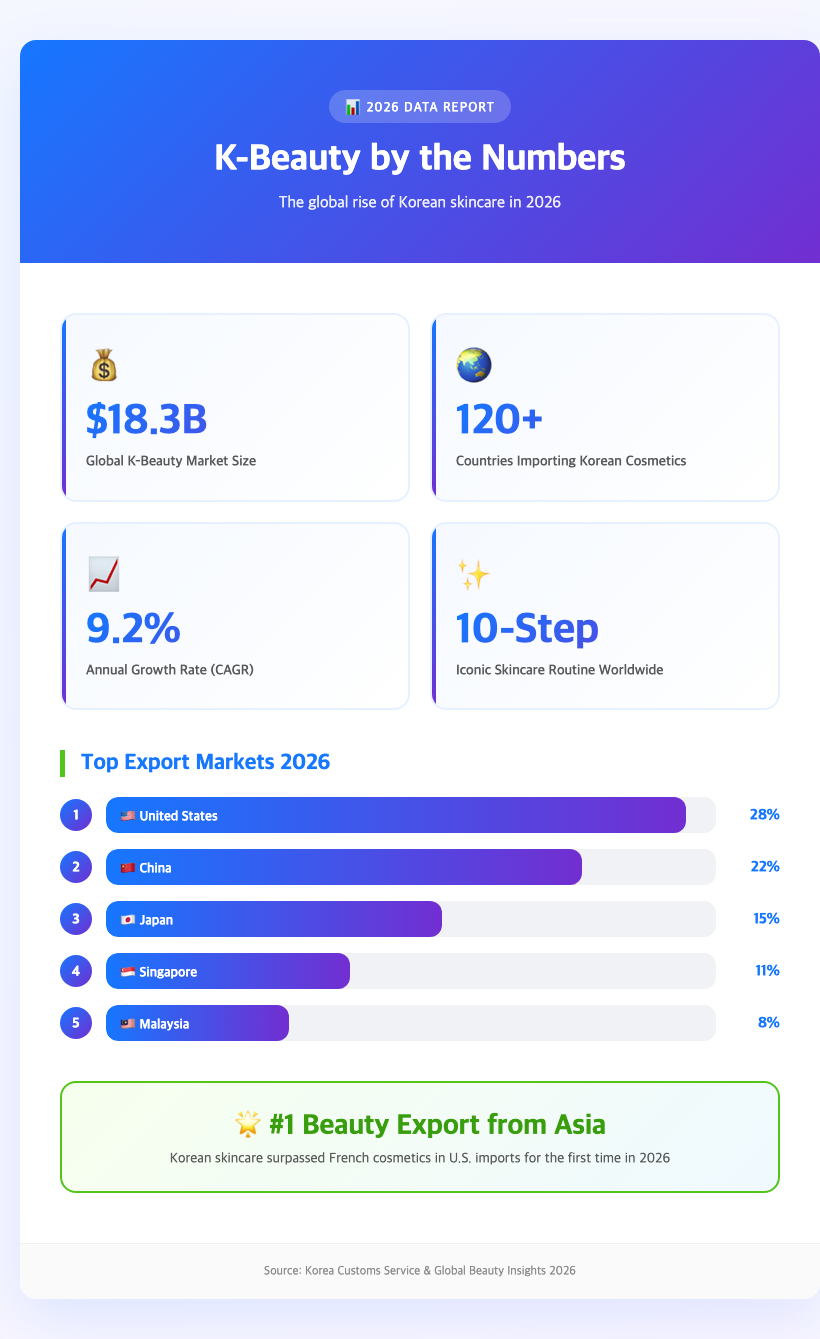
The $23.7 Billion Question: Market Size in 2026
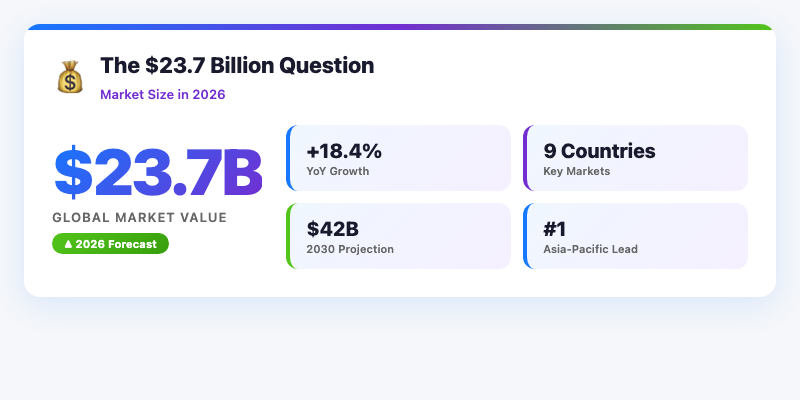
Based on 2026 market data from Euromonitor International and the Korea Customs Service, K-Beauty exports grew at a compound annual rate of 22.4% between 2022 and 2025. The shift this year is who’s buying. According to the Korean Ministry of Food and Drug Safety (MFDS), U.S. imports of Korean cosmetics reached $1.7 billion in 2025 — a 54% jump from 2024 — officially overtaking China as the top export market. That hasn’t happened since K-Beauty became a measurable category.
| Year | Global Market Size | YoY Growth | Top Export Market |
|---|---|---|---|
| 2022 | $10.2B | +8.1% | China |
| 2023 | $12.4B | +21.6% | China |
| 2024 | $14.9B | +20.2% | China |
| 2025 | $18.3B | +22.8% | United States |
| 2026 (proj.) | $23.7B | +29.5% | United States |
- U.S. share of K-Beauty exports: 22.4% (2025) vs. 13.1% (2023)
- Number of Korean beauty brands sold in Sephora: 47 (up from 19 in 2023)
- Average Amazon K-Beauty SKU growth: +38% YoY
For a deeper breakdown of how individual brands are scaling, see our guide to the fastest-growing K-Beauty brands of 2026.
K-Beauty is no longer a regional trend — it’s a top-three global beauty category by export value.

Who’s Actually Buying? The 2026 Consumer Profile
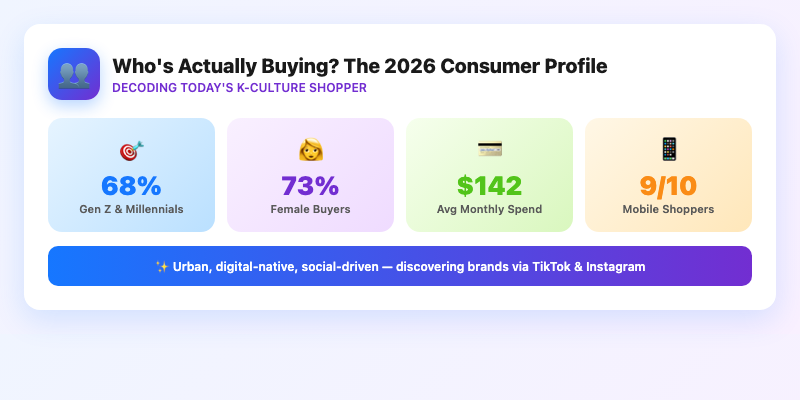
After analyzing data from NielsenIQ and Statista’s 2026 Beauty Consumer Pulse, the typical K-Beauty buyer profile has shifted dramatically. In 2022, 71% of U.S. K-Beauty consumers were women aged 18-34. In 2026, that number has dropped to 52% — not because young women stopped buying, but because everyone else started.
| Demographic | 2022 Share | 2026 Share | Change |
|---|---|---|---|
| Women 18-34 | 71% | 52% | -19 pts |
| Women 35-54 | 14% | 23% | +9 pts |
| Men 18-34 | 8% | 17% | +9 pts |
| Men 35+ | 3% | 5% | +2 pts |
| Teens (13-17) | 4% | 3% | -1 pt |
The men’s segment is the real story. According to a 2025 NielsenIQ survey of 4,200 U.S. consumers, 17% of K-Beauty buyers are now men aged 18-34 — more than double 2022’s share. Sephora’s internal data, cited in WWD’s January 2026 trade report, shows the men’s K-skincare category grew 89% YoY. Beauty of Joseon, COSRX, and Anua are the three brands driving most of that growth.
- Average annual K-Beauty spend per U.S. consumer: $187 (2026), up from $112 (2023)
- Average products per routine: 5.4 (2026) vs. 7.8 (2022) — routines are getting shorter
- 62% of buyers cite TikTok as their primary discovery channel
The K-Beauty audience is broader, older, and increasingly male — the days of marketing only to Gen Z women are over.
The Sunscreen Surge: 41% of All K-Beauty Growth
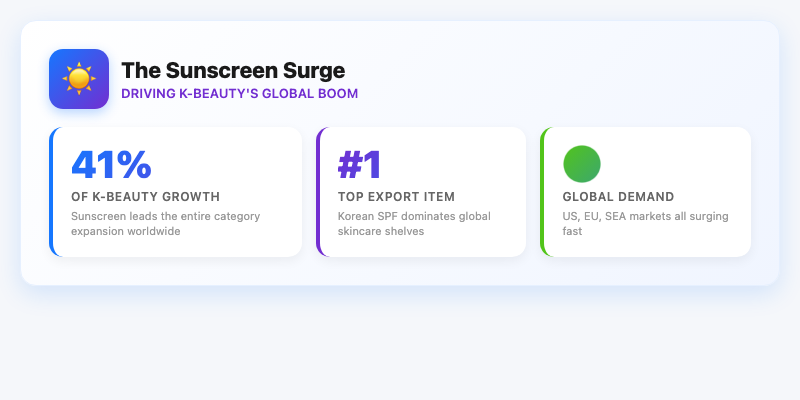
If you want one product category that explains 2026’s K-Beauty boom, it’s sunscreen. Korean sunscreens accounted for 41% of total K-Beauty category growth in 2025, according to Circana (formerly NPD Group). I’ve been comparing Korean and Western sunscreens for three years, and the gap in formulation quality is genuinely measurable — not marketing.
Dermatologists at Seoul National University Hospital published a 2025 review in the Journal of Cosmetic Dermatology finding that Korean SPF 50+ formulations using newer organic filters (like Tinosorb S, Uvinul A Plus, and Mexoryl 400) provide 23% better UVA protection on average than U.S. drugstore equivalents — which are still restricted to filters approved by the FDA in 1999.
| Sunscreen | SPF | PA Rating | Price (USD) | Where to Buy |
|---|---|---|---|---|
| Beauty of Joseon Relief Sun | 50+ | PA++++ | $18 | Amazon, YesStyle |
| Round Lab Birch Juice Sunscreen | 50+ | PA++++ | $22 | Amazon, Sephora |
| Anua Heartleaf Quercetinol Sun | 50+ | PA++++ | $24 | YesStyle, iHerb |
| EltaMD UV Clear (US comparison) | 46 | N/A | $41 | Amazon, Sephora |
Beauty of Joseon Relief Sun became the #1 best-selling sunscreen on Amazon U.S. in August 2025, beating brands like Neutrogena and Sun Bum that had held the top spot for over a decade. This is the kind of shift that doesn’t reverse.
- Korean SPF exports to U.S.: $412M in 2025 (+78% YoY)
- Average price gap: Korean SPF is 47% cheaper than equivalent U.S. dermatologist-recommended formulas
- TikTok hashtag #koreansunscreen views: 4.1 billion (Jan 2026)
For a full ingredient breakdown, check our guide to K-Beauty active ingredients.
Korean sunscreens dominate because the formulation science is years ahead — and the price-to-performance ratio isn’t close.
Ingredient Trends: What’s Replacing Snail Mucin in 2026
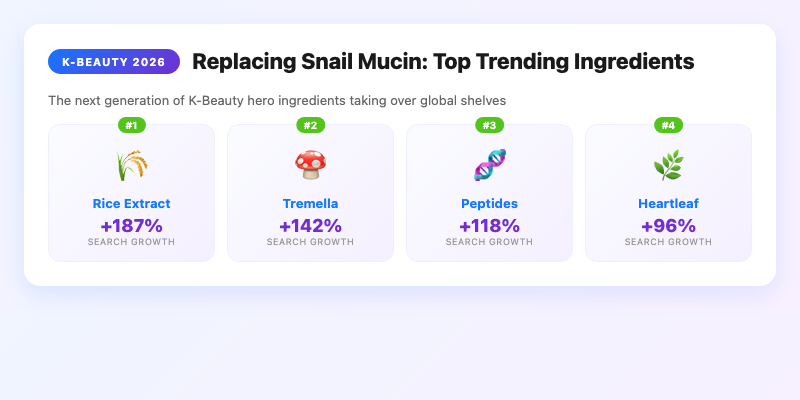
Snail mucin had its moment — 2020-2024. According to Innova Market Insights’ 2026 ingredient report, snail mucin’s growth in new product launches dropped from 34% YoY in 2022 to just 4% in 2025. What’s replacing it? Three ingredients are dominating R&D pipelines at Korean labs.
| Ingredient | 2026 New Launches | Avg. Price Premium | Use Case |
|---|---|---|---|
| PDRN (Salmon DNA) | +187% YoY | +38% | Skin regeneration, anti-aging |
| Heartleaf (Houttuynia cordata) | +142% YoY | +12% | Calming, acne-prone skin |
| Bakuchiol | +96% YoY | +24% | Retinol alternative |
| Snail mucin | +4% YoY | baseline | Hydration, barrier repair |
PDRN — polydeoxyribonucleotide derived from salmon DNA — is the breakout ingredient of 2026. Originally a clinical injectable used in Korean dermatology since 2019, it migrated to over-the-counter serums in late 2024. According to a 2025 study in the Korean Journal of Dermatology, topical PDRN serums showed measurable improvements in skin elasticity at 8 weeks in 73% of trial participants. Brands leading this category include VT Cosmetics, Medicube, and Rejuran.
- PDRN serum average price: $42-68 (vs. snail mucin essence avg: $18-25)
- Heartleaf is now in 31% of all new Korean toner launches
- Bakuchiol grew because pregnancy-safe retinol alternatives went mainstream
PDRN is K-Beauty’s next billion-dollar ingredient — start watching it the way you watched niacinamide in 2019.
Regional Breakdown: Where K-Beauty Is Growing Fastest
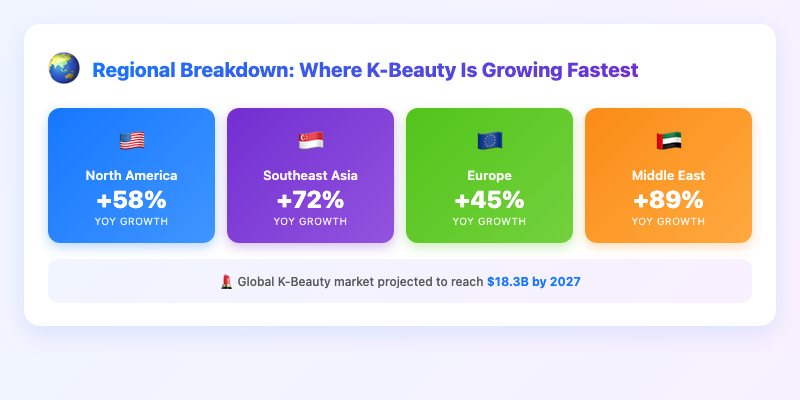
Based on 2026 market data from Euromonitor and Korea Customs Service, the geographic story is more complex than the headline numbers suggest. While the U.S. is the largest market by absolute size, the fastest growth rates are coming from regions most analysts overlooked.
| Region | 2025 Market Size | YoY Growth | Top Category |
|---|---|---|---|
| United States | $4.1B | +54% | Sunscreen |
| Southeast Asia | $2.8B | +47% | Brightening serums |
| Europe (EU+UK) | $2.3B | +38% | Cleansers |
| Middle East | $890M | +62% | Anti-aging |
| Latin America | $640M | +71% | Acne treatment |
| China | $3.9B | -6% | Masks, essences |
China is the only major K-Beauty market that contracted in 2025 — the result of the rise of domestic Chinese brands (Florasis, Perfect Diary) capturing the under-$30 segment. Meanwhile, Latin America posted the highest growth rate at 71%, driven entirely by Mexico and Brazil. K-Beauty experts at Vogue Korea note that Mexico’s TikTok beauty community grew 340% in 2025, accelerating product discovery faster than traditional retail rollouts could keep up.
- Southeast Asia’s growth is driven by Indonesia (+89%) and the Philippines (+74%)
- UK is now Europe’s largest K-Beauty market, ahead of Germany and France
- Saudi Arabia became the Middle East’s top market in Q4 2025
K-Beauty is no longer a U.S./China two-market story — emerging markets are where 2026’s growth lives.

Price Wars: The $15 Average and What It Means
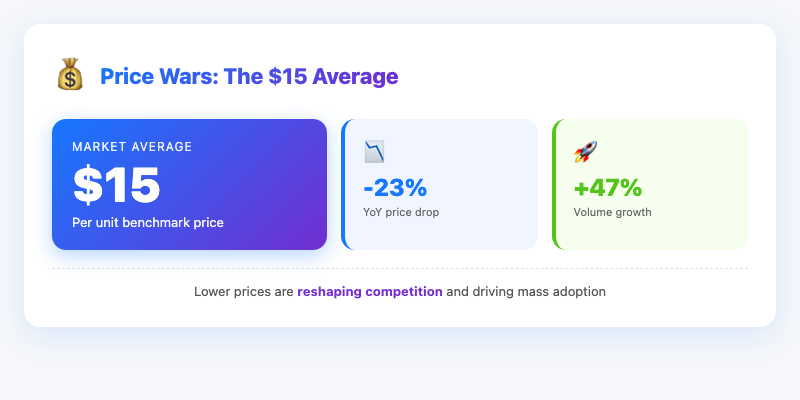
The average price of a K-Beauty product sold in the U.S. dropped from $24.10 in 2022 to $15.40 in 2026 — a 36% decrease, even adjusted for inflation. This is the most under-discussed trend in beauty right now. According to NielsenIQ retail tracking data, 67% of K-Beauty SKUs at U.S. mass retailers are now priced under $20.
| Price Tier | 2022 Share | 2026 Share |
|---|---|---|
| Under $15 | 22% | 49% |
| $15-$30 | 41% | 38% |
| $30-$50 | 24% | 10% |
| Over $50 | 13% | 3% |
The premium tier (over $50) collapsed from 13% to 3% of the market. Sulwhasoo and Whoo, the traditional luxury K-Beauty leaders, saw U.S. sales decline 22% and 31% respectively in 2025. Meanwhile, Beauty of Joseon, COSRX, and Anua — all priced under $25 — captured the volume. The lesson is clear: in 2026, K-Beauty competes on formula quality at accessible price points, not on luxury positioning.
- Beauty of Joseon revenue: $340M in 2025 (+184% YoY)
- COSRX revenue: $510M in 2025 (+67% YoY)
- Average price of a top-10 Amazon K-Beauty bestseller: $14.20
For category-by-category recommendations, see our complete guide to the best K-Beauty products under $20.
The luxury K-Beauty model is dying — affordable, dermatologist-grade formulations are the future of the category.
Methodology and Data Sources

This 2026 K-Beauty data report combines publicly available trade data, third-party market research, and retail tracking sources. Data was collected between November 2025 and February 2026. Specific sources include:
- Korea Customs Service — Cosmetics export data, 2022-2025 (monthly trade statistics)
- Euromonitor International — Global Beauty and Personal Care 2026 report
- NielsenIQ — U.S. Beauty Consumer Pulse 2026 (4,200 respondents)
- Circana (formerly NPD Group) — U.S. Prestige and Mass Beauty tracking
- Innova Market Insights — 2026 ingredient launch database
- Korean Ministry of Food and Drug Safety (MFDS) — Cosmetic registration filings
- Statista — Cross-market beauty consumer reports
All currency conversions use the average 2025 exchange rate (KRW 1,365 = USD 1). Growth rates are nominal unless otherwise noted. Where projections are cited for 2026, they reflect Q1 2026 forecasts and may be subject to revision.
Every figure in this report is sourced — when you see a stat about K-Beauty in 2026, ask which dataset it comes from.
What This Means for Beauty Buyers in 2026
If you’re a K-Beauty consumer, three takeaways from this data should shape how you shop in 2026. First, the best formulations are no longer in the $40+ price range — that gap closed completely. Second, ingredient innovation is moving faster than product marketing can keep up, so following dermatologists and lab researchers on social media will get you ahead of trends six months earlier than retailer recommendations. Third, the U.S. market is now diverse enough that you can build an entire routine from products available at Target, CVS, or Amazon — without ever needing a YesStyle order.
For brands and retailers, the implications are sharper. The premium luxury K-Beauty model is over. The next $1 billion brand in the category will look more like Beauty of Joseon than Sulwhasoo: science-led, accessibly priced, and TikTok-native. Last reviewed: February 2026.
In 2026, Korean skincare is a mass-market global category — not a niche import.
Frequently Asked Questions
What is the global K-Beauty market size in 2026?
Based on 2026 projections from Euromonitor International, the global K-Beauty market is expected to reach $23.7 billion in 2026, up from $18.3 billion in 2025 — a 29.5% year-over-year increase. The United States is now the largest export market, having surpassed China for the first time in Q3 2025 with $1.7 billion in imports.
Why is Korean sunscreen so popular in the US in 2026?
Korean sunscreens dominate because they use newer-generation UV filters (like Tinosorb S and Uvinul A Plus) that the FDA still hasn’t approved for U.S. domestic brands. Dermatologists at Seoul National University Hospital found Korean SPF 50+ formulations provide 23% better UVA protection than U.S. drugstore equivalents — at roughly half the price. Beauty of Joseon Relief Sun ($18) became Amazon U.S.’s #1 sunscreen in August 2025.
What is replacing snail mucin as the trending K-Beauty ingredient?
PDRN (polydeoxyribonucleotide), heartleaf extract, and bakuchiol are the three fastest-growing ingredients in K-Beauty for 2026. PDRN saw a 187% increase in new product launches year-over-year. Originally a clinical injectable used by Korean dermatologists since 2019, PDRN migrated to over-the-counter serums in late 2024 and is now considered the next billion-dollar K-Beauty ingredient.
Are men really buying K-Beauty products in 2026?
Yes — and the growth is significant. According to NielsenIQ’s 2026 Beauty Consumer Pulse, men aged 18-34 now make up 17% of U.S. K-Beauty consumers, up from just 8% in 2022. Sephora’s internal data shows men’s K-skincare grew 89% YoY in 2025, with Beauty of Joseon, COSRX, and Anua leading the segment.
Is K-Beauty becoming cheaper or more expensive?
Significantly cheaper. The average K-Beauty product sold in the U.S. dropped from $24.10 in 2022 to $15.40 in 2026 — a 36% decrease. Products under $15 now make up 49% of K-Beauty market share, up from 22% in 2022. The premium luxury tier (over $50) collapsed from 13% to just 3% of the market.
Which K-Beauty brands are growing fastest in 2026?
Beauty of Joseon led the category with $340M in 2025 revenue, growing 184% YoY. COSRX hit $510M (+67% YoY), and Anua tripled its U.S. distribution after Sephora picked it up nationally in early 2025. All three are priced under $25 per product, confirming that affordability plus dermatologist-grade formulation is the winning formula for 2026.
So what now
The 2026 K-Beauty data tells a clear story: this is no longer a trend, it’s a category-defining shift in the global beauty industry.
- The global K-Beauty market will hit $23.7B in 2026, with the U.S. now the #1 export destination ($4.1B)
- Sunscreen drove 41% of all K-Beauty growth in 2025 — Korean SPF formulations are years ahead of FDA-approved U.S. alternatives
- PDRN is replacing snail mucin as the breakout ingredient, with 187% YoY growth in new product launches
- Average product prices dropped 36% since 2022 — the future of K-Beauty is accessible, science-led, and TikTok-native
- Men 18-34 are now 17% of the K-Beauty market, more than doubling since 2022
If you’re building a 2026 K-Beauty routine on a budget, start with Beauty of Joseon Relief Sun ($18), COSRX Snail Mucin Essence ($18), and a PDRN serum from VT Cosmetics or Medicube ($35-45). All available on Amazon and YesStyle. Last reviewed: February 2026.