Disclosure: This post contains affiliate links. If you purchase through these links, we may earn a small commission at no extra cost to you.
Something is shifting in Korean food, and I can see it from my kitchen in Haeundae. For years, foreign guests walked in asking for bulgogi and bibimbap. Now they walk in holding their phones. They show me a map. They say one thing: korean fried chicken near me. That is what they typed in Singapore, in London, in Kuala Lumpur, in Texas. Now they are on holiday in Busan and they want to know if the real thing is different.
Listen, I’ll tell you, it is different. Not always better. Different.
I am Park Eun-ho. I have cooked for 22 years. I grew up in my mother’s banchan shop. I opened my own small kitchen in 2010. I do not sell fried chicken. I tried once and failed, and I will tell you about that later. But I eat it every week, like every Korean does. I have watched the search for korean fried chicken near me go from a curiosity to a habit. My nephew runs our little website, and he showed me that this phrase gets searched in English more than almost any Korean dish name.
So this is not a list of the ten best shops. Plenty of those already exist, and most were written by people who never stood at a fryer. This is my read on why fried chicken became the front door to Korean food, who pushed it there, what it means for the shop down your street, and where I think it goes in the next 12 months. At the end I make one prediction you can check me on.
The Signal: What ‘Korean Fried Chicken Near Me’ Really Tells Us
Here is the signal as I see it. Ten years ago, a foreigner’s first Korean meal was barbecue. You sat at a grill, somebody cut meat with scissors, it was a show. Today the first Korean meal is a box of chicken and a beer. That is a big change. Barbecue needs a table with a grill. Chicken needs a fryer and a delivery bike. One of those scales. One does not.
I’ve been watching this since 2023. Every summer, the tourists on Haeundae beach get younger. Every summer, more of them are eating chicken out of a box on the sand. The delivery riders know the beach better than the lifeguards do. In Korea we call it chimaek, chicken plus maekju, beer. Daegu even runs a whole festival for it every July, the Daegu Chimaek Festival, which has been going since 2013. When a city builds a festival around a snack, you know the snack is not a fad.
The Michelin Guide added Busan to its Korean edition for 2024, renaming it the Michelin Guide Seoul and Busan. People in my neighbourhood were proud. But listen, the inspectors were not the ones changing how the world eats Korean food. The kids with phones were. The fine dining story and the fried chicken story are happening at the same time. They are the same story from two ends. Korean food is getting taken seriously at the top, and it is getting eaten casually at the bottom. Fried chicken owns the bottom.
What the search phrase really tells me is this. People do not type a brand name. They do not type yangnyeom or dakgangjeong. They type a category and the words near me. That means they trust the category more than any one shop. That trust is the most valuable thing in this business, and it is easy to waste. One soggy box and a customer decides Korean chicken is overrated. If you want the bigger picture of what street food in my city looks like beyond chicken, read our kimchi jjigae recipe with properly aged kimchi.
One more thing about health, since readers ask. A Korean chicken order is heavy. A whole bird with sauce is easily over 2,000 calories for the box. Share it. Koreans do. Nobody here eats a whole chicken alone unless they are 19 or heartbroken.
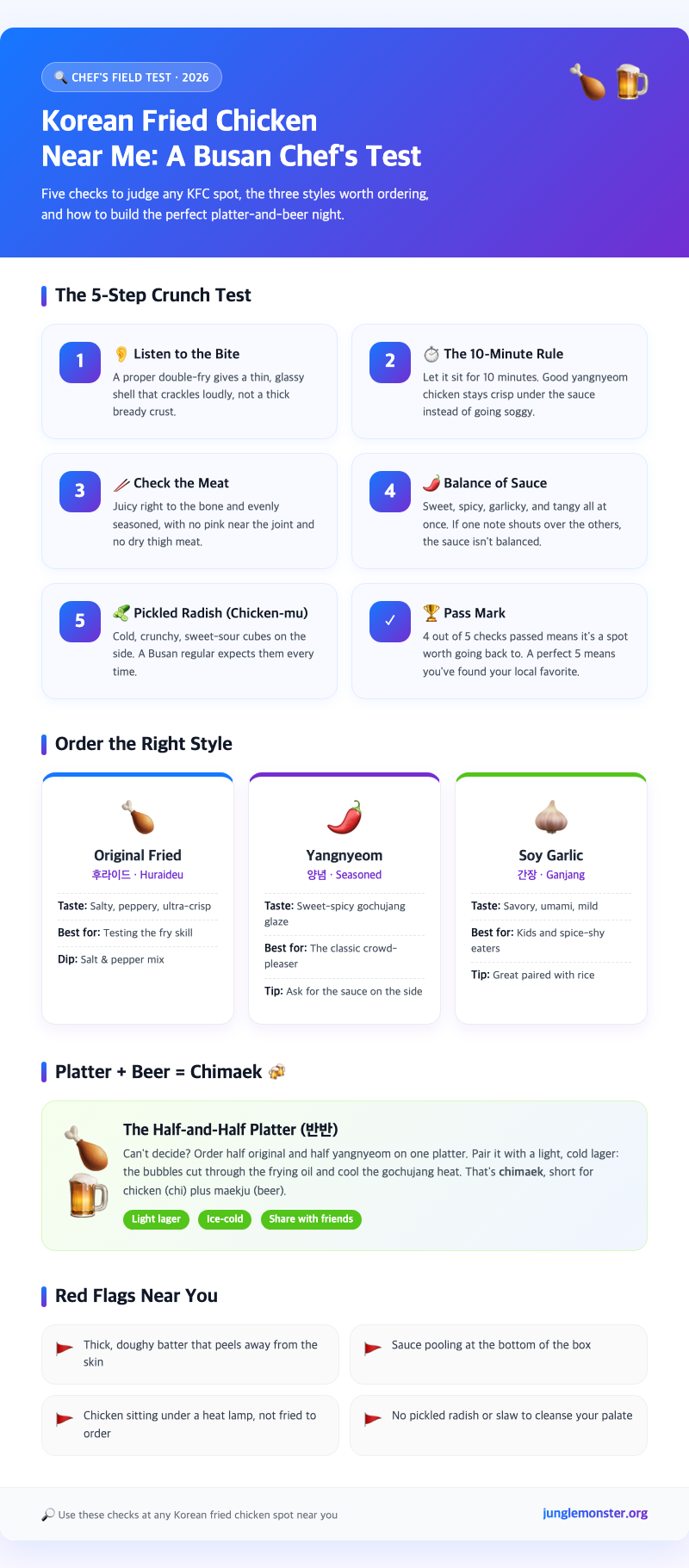
For today: order half and half, plain and yangnyeom. Eat the plain first. That single test tells you more than any star rating.
My Own Failure With Fried Chicken, and Why I Stopped Pretending
I promised a failure. Here it is.
In 2015, my kitchen in Haeundae was quiet in the summer evenings. The tourists were all out eating chicken on the beach. So I thought, fine, I will sell chicken too. I am a trained cook. How hard can it be?
Very hard, it turned out. I used my normal frying oil and my normal batter, the one I use for jeon and vegetable fritters. That batter is made to be soft and eggy. On chicken, it went limp in ten minutes. Then I tried double frying, but my small fryer could not recover its temperature between batches. The oil dropped too low, the crust drank oil, and the chicken came out greasy and heavy. A Korean office worker ate one piece, put his chopsticks down, and politely asked for the bill. That was worse than shouting.
I bought a second fryer, about ₩900,000 for a decent commercial one back then. I switched to a potato starch batter. It got better. But honestly, considering the price of chicken, oil, and boxes, and that there were four franchise shops within 300 metres of me, I could not compete. They buy chicken by the truckload. I buy it by the bag. After three months, I took it off the menu. My grandmother would have told me to stay in my lane, and she would have been right.
What did I learn? Fried chicken looks like simple food, but it is an equipment business. It is oil temperature and volume, not recipe. That is why the franchises won in Korea, and it is why the best chicken abroad usually comes from either a big brand or a tiny place with one obsessive owner who bought a serious fryer. The middle ground, the restaurant that adds chicken as a side line, is where the bad chicken lives. I was that middle ground.
I now tell my overseas guests to ignore chicken on the menu of a general Korean restaurant. Go to a place that does only chicken. If you want to cook Korean at home instead of chasing a shop, start with home-style dishes. Maangchi’s recipes are surprisingly accurate, better than most YouTubers. I have tested a few of hers against my own and I would serve the result in my kitchen.
A tip for home cooks: if you fry chicken at home, fry in small batches. Two or three pieces at a time. Crowding the pot is exactly the mistake I made in 2015.
Where It Goes Next: My Prediction for the Next 12 Months
Now the part where I put my name on something.
The fried chicken wave abroad has had its easy years. Opening a shop with a Korean name and a gochujang glaze was enough. That is ending. Customers have now eaten enough Korean chicken to know a soggy box when they get one. The next phase is about the sauce and the sides, not the crunch. Everybody can do crunch now.
I see three things coming. First, regional Korean flavours. Dakgangjeong from Sokcho, the sticky, sweet market chicken sold cold in boxes. Andong jjimdak, the braised chicken with glass noodles. Busan-style garlic chicken heavy with raw minced garlic. These are what Korean tourists hunt for at home, and I think overseas shops will copy them next.
Second, better gochujang. Shops that name their paste, Sunchang especially, will use it as a selling point, the same way Italian places name their tomatoes. Customers are learning that not all red paste is equal. Our Busan food travel itinerary walks through Jagalchi, Bupyeong Kkangtong night market and Haeundae.
Here is my prediction. You can check it in October 2027. Within the next 12 months, at least one of the big three Korean chicken franchises, Kyochon, BBQ, or BHC, will put a regional Korean dish that is not plain fried chicken, such as jjimdak or dakgangjeong, onto its permanent menu in an overseas market. Not a limited special. Permanent. If that does not happen by October 2027, I was wrong, and you can write to me and say so.
My reason is simple. The crunch is no longer special abroad. The franchises need something new to keep the search for korean fried chicken near me pointing at them rather than at the small specialists. Regional dishes are the cheapest new thing they can sell, because they already have the chicken supply.
For today: next time you find a good shop, order the one item on the menu you have never heard of. That is where the next trend is hiding.
Frequently Asked Questions
What is the difference between Korean fried chicken and American fried chicken?
Korean chicken is fried twice in a thin starch batter, so the crust is light, thin and crackly, almost like glass. American Southern chicken uses a thicker flour dredge, often with buttermilk, and is fried once, giving a craggy, heavier crust. Korean chicken is also usually sauced, with yangnyeom (sweet-spicy gochujang) or soy garlic. In my experience, the Korean style also holds its crunch longer in a delivery box, which is why it suits the way Koreans eat.
How do I find authentic korean fried chicken near me?
Search the phrase, then filter. Choose a shop that sells only chicken, not a general Korean restaurant. Check customer photos for a bumpy, matte crust. Look for half-and-half options and pickled radish in the photos. Read reviews written in Korean if your map app shows them, because Korean students abroad are the harshest judges. Avoid places where orders arrive in under ten minutes. Real double frying takes time.
Is Korean fried chicken spicy?
Not always. Plain fried and soy garlic are not spicy at all. Yangnyeom is mildly spicy and quite sweet. Most foreigners handle it fine. Some shops sell a hot version with extra chilli or capsaicin sauce, and that one is genuinely painful. If you are not sure, order half plain and half yangnyeom. Children in Korea eat the plain and soy garlic from about age four, so nobody will judge you for skipping the heat.
Why is Korean fried chicken so expensive abroad?
A box that costs around ₩21,000-₩23,000 (about $15-17) in Busan can be $25-35 in a US or UK city. Rent, wages, imported sauces and the brand fee all add up. Many shops also use smaller pieces or wings only, which cost more per kilo. Honestly, considering the labour in double frying, some markup is fair. But if you are paying premium prices for soggy chicken, that is not a cost issue. That is a skill issue.
Can I make Korean fried chicken at home?
Yes, but respect the oil. Use a starch-heavy batter, potato or corn starch with a little flour. Fry once at a moderate temperature until cooked, rest the pieces a few minutes, then fry again hotter until crisp. Work in small batches. Make the sauce separately and brush it on just before serving. For ingredients outside Korea, you can find Korean starch and gochujang on Amazon or iHerb in the US and UK, and on Shopee in Singapore and Malaysia.
What do Koreans drink with fried chicken?
Beer, almost always. That is chimaek. In Korea it is usually a light lager like Cass or Terra, around ₩5,000 (about $3.60) for a 500cc draft in a chicken pub. Some people prefer soju, and younger people sometimes order cola or a sweet fruit soda. The cold, fizzy drink cuts the fat, the same job the pickled radish does. I drink beer with chicken and soju with stew. That is just my rule.
Before You Type It Again
Korean fried chicken became the front door to my country’s food because it is cheap to scale, easy to film, and hard to dislike. That success is also its risk. Here is what I want you to remember:
- The search for korean fried chicken near me is rising because the category earned trust, so judge each shop hard to keep that trust honest.
- Double frying, thin starch batter, and late saucing are the real technique. No secret ingredient exists, whatever the videos say.
- Eat the plain piece first. It tells you everything about the kitchen.
- Sauce made with proper Sunchang gochujang tastes fermented and deep; cheap paste tastes like candy.
- Specialist chicken shops beat general Korean restaurants that sell chicken as a side line. I learned that one the expensive way.
If you want to try making the sauce at home, find Sunchang gochujang and Korean potato starch on Amazon or iHerb in the US and UK, or on Shopee in Singapore and Malaysia. And if you ever come to Haeundae, eat chicken on the beach on your first night. Then come find real banchan on your second. Last reviewed: 2026.