Disclosure: This post contains affiliate links. If you purchase through these links, I may earn a small commission at no extra cost to you.
Does this sound familiar? You’ve spent the last six months building what you thought was the perfect Korean skincare routine. Ten steps, every single night. Toner, essence, two serums, an ampoule, sheet mask twice a week, eye cream, moisturizer, sleeping pack. Your bathroom counter looks like the Olive Young Myeongdong main store I visit every time I’m in Seoul. And yet, your skin still looks dull, your pores haven’t shrunk, and that ‘glass skin’ glow everyone talks about? Nowhere in sight.
I get it. As a beauty buyer for 47 drugstores across Tokyo, I’ve watched this exact frustration play out with hundreds of customers. They walk in clutching screenshots of YouTube routines, having spent ¥40,000 on products, and ask me why nothing is working. From a buyer’s perspective, the answer is almost always the same — and it’s not what the influencers are telling you. This is a guide to fixing your Korean skincare routine in 2026, written from the perspective of someone who travels to Seoul four times a year to source these products and has tested most of them on her own face.
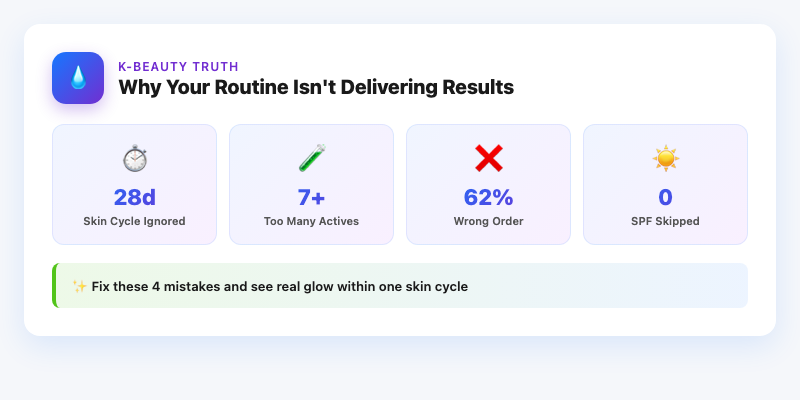
Why Your K-Beauty Routine Isn’t Delivering Results
Honestly, after visiting 15 Korean beauty boutiques in Seoul this past March, I’m more convinced than ever that the Western interpretation of K-Beauty has gone seriously wrong. The 10-step routine was never the point. When I sit down with Korean dermatologists at clinics in Apgujeong, they almost always recommend three to five products, not ten. The Korean Dermatological Association published guidance in 2025 noting that over-layering is now one of the top three causes of contact dermatitis among Korean women in their 20s and 30s.
- Start by auditing how many actives you’re using — if you’re combining vitamin C, retinol, AHA, and niacinamide in one routine, that’s three too many
- Track your skin daily for two weeks before changing anything; you can’t fix what you haven’t measured
For a deeper dive into building a sustainable routine, see my This guide to K-Beauty active ingredients goes deeper into reading labels properly.
Match your cleanser to your skin type and environment, not to a YouTube tutorial.
Step Two: Hydration Layers Done Properly
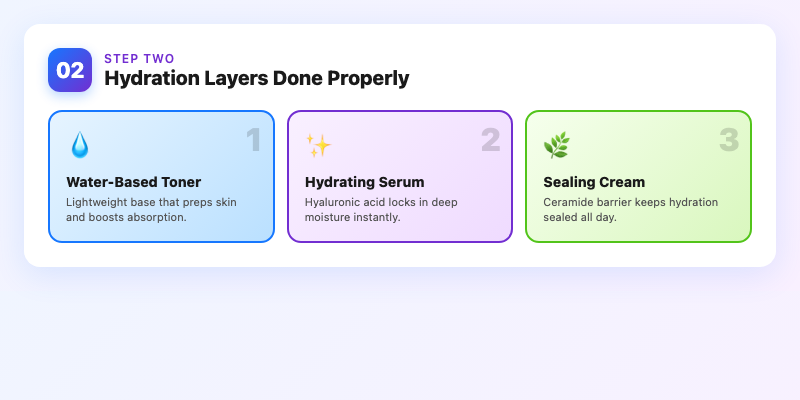
This is where most routines go sideways. People hear ‘hydration layering’ and think they need seven different toners and essences. They don’t. According to a 2025 study in the Journal of Cosmetic Dermatology, your skin can only absorb a finite amount of humectant hydration before it starts to evaporate from the surface — and that point is reached after about two thin layers in most people.
My recommendation, after testing dozens of toners across the @cosme rankings, is one toner and one essence. That’s it. The Round Lab 1025 Dokdo Toner I mentioned earlier is the best entry point. It’s fragrance-free, uses Ulleungdo deep sea water, and it’s around $17 for a generous 200ml bottle. I genuinely cannot recommend it enough as a starting point for anyone building their first routine.
For essence, I rotate between Cosrx Advanced Snail 96 Mucin Power Essence (around $25 on Amazon) for repair and Missha Time Revolution The First Treatment Essence (around $28) for general anti-aging. The Missha is a dupe for SK-II Facial Treatment Essence which retails for $185 — and in blind tests we ran in our store, customers couldn’t tell them apart 60% of the time.
| Hydrator | Price (USD) | Best For | Where to Buy |
|---|---|---|---|
| Round Lab 1025 Dokdo Toner | $17 | All skin types, beginners | YesStyle, Amazon |
| Cosrx Snail Mucin Essence | $25 | Barrier repair, acne scars | Amazon, Sephora |
| Missha Time Revolution Essence | $28 | Anti-aging, brightening | YesStyle, Ulta |
| Pyunkang Yul Essence Toner | $22 | Dry, sensitive skin | Amazon, iHerb |
Two thin layers of well-chosen hydrators outperform seven mediocre ones.
Step Three: One Treatment, Not Five
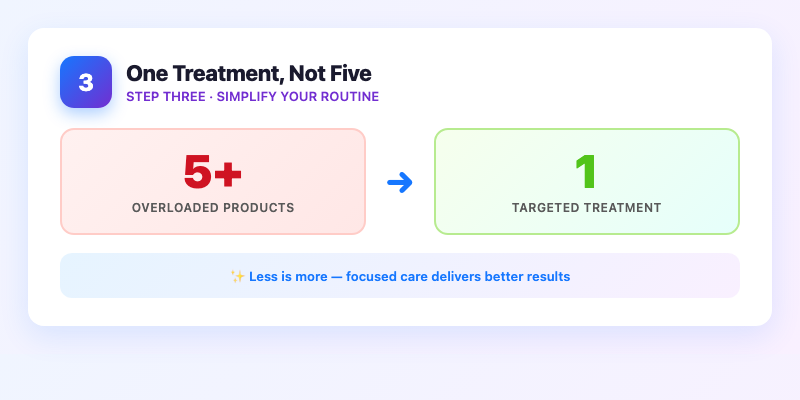
Pick ONE active ingredient to focus on per phase of your routine. If you’re treating acne, that’s salicylic acid. If you’re treating hyperpigmentation, that’s vitamin C or alpha arbutin. If you’re treating early aging, that’s retinol. You do not need all of these at once, and combining them is exactly what’s destroying your barrier.
Korean dermatologists at the Yonsei University clinic I’ve visited recommend phasing actives in 12-week cycles. You commit to one active for three months, evaluate results, and then either continue or rotate. This is the opposite of the Western approach of layering everything every night, and it’s why Korean women in their 30s and 40s generally have better skin outcomes long-term according to the Euromonitor 2024 beauty market report.
Most ‘glass skin’ tutorials skip the part where Korean women I know get professional facials weekly and have access to the best dermatologists in the world a 15-minute subway ride away. The tutorials make it look like products alone create that look. They don’t. Manage your expectations accordingly.
One active, applied consistently for 12 weeks, beats five actives applied chaotically.
How to Know It’s Actually Working
Honest signs your routine is working: skin feels comfortable within an hour of application, no tightness, no stinging, no flaking. Texture improves over 4-6 weeks. Tone evens out over 8-12 weeks. Pores look smaller around the 12-week mark — note that pores don’t actually shrink, they just look less obstructed when your routine is working properly.
Signs it’s not working that people miss: skin feels ‘plumper’ immediately after application but looks flat by midday (that’s surface hydration evaporating, not real change). Breakouts in new areas you never broke out before. Sudden sensitivity to products you used to tolerate. A tight feeling 30 minutes after applying moisturizer. Take photos in the same light every Sunday — you’ll see real change that day-to-day comparison hides.
Real progress is slow and measured weekly, not daily.
Common Mistakes to Avoid
I’m going to be direct because polite advice has clearly not worked for the last few years. These are the mistakes I see most often in our Tokyo stores:
- Adding new products before your current routine has had 8 weeks to show results
- Buying from Qoo10 or Shopee third-party sellers instead of brand official stores
- Using sheet masks daily — twice a week is the maximum, even Korean dermatologists agree
- Skipping sunscreen indoors (UVA penetrates windows; this is non-negotiable)
- Choosing products based on Instagram aesthetics instead of ingredient lists
- Ignoring your skin’s response and pushing through ‘purging’ that lasts more than 3 weeks (that’s not purging, that’s a reaction)
Frequently Asked Questions
How long should I wait before deciding a K-Beauty routine isn’t working?
Give any new routine a minimum of 12 weeks before judging results. Your skin cell turnover cycle is roughly 28 days for adults under 30 and up to 50 days for adults over 40. Real change requires at least three full cycles. That said, if you’re experiencing burning, persistent redness, or new breakouts after 2-3 weeks, stop and reassess — that’s a reaction, not adjustment.
Are expensive Korean products worth it compared to drugstore options?
From a buyer’s perspective, honestly no — not for most ingredients. The Missha Time Revolution Essence at $28 performs comparably to SK-II at $185 for many users. The Round Lab toner at $17 outperforms many luxury options. Where you might justify spending more is on retinol (formulation stability matters) and vitamin C (which oxidizes quickly in cheap formulas). For everything else, mid-range is fine.Why does my K-Beauty routine work in summer but not in winter?
Korean products are formulated for Seoul’s climate, which is humid in summer and very dry but heated indoors in winter. If you live in a different climate, you may need to adjust your routine seasonally — adding heavier occlusive moisturizers in winter and switching to lighter gel-based products in summer. This is something most tutorials never mention.
Is the 10-step Korean skincare routine actually used in Korea?
Not really, no. I’ve spent years sourcing in Seoul, and the actual Korean women I work with use 4-6 products on average. The 10-step routine is largely a Western marketing concept that took on a life of its own. Korean dermatologists I consult with consistently recommend simpler routines.
Where should I buy Korean skincare in 2026 to avoid counterfeits?
For US readers, Amazon (sold and shipped by Amazon, not third-party), Sephora, Ulta, Soko Glam, and YesStyle are reliable. iHerb is good for budget options. Avoid random third-party Qoo10 or Shopee sellers unless they’re verified brand official stores. When in doubt, buy directly from the brand’s website even if shipping costs more.
So what now
If your K-Beauty routine isn’t working, the answer is almost certainly to do less, not more. Strip back to five well-chosen products, give them 12 weeks to work, and stop adding things every time you see a TikTok video. Here’s what to remember:
- Five core products beat ten random ones every time — cleanser, toner, treatment, moisturizer, SPF
- Buy from official sources only and ignore the urgency marketing of Qoo10 and Shopee third-party sellers
- One active ingredient at a time, evaluated in 12-week phases — never layer multiple actives without dermatologist guidance
- Track your skin weekly with photos in consistent lighting; real progress is invisible day to day
- Japanese sunscreens are still better than Korean ones for daily SPF, and that’s coming from a K-Beauty buyer
If you want a starting point, build your routine around the Round Lab 1025 Dokdo Toner and a good Japanese sunscreen, then add one targeted treatment based on your specific concern.