Disclosure: This post contains affiliate links. If you purchase through these links, we may earn a small commission at no extra cost to you.
Last Tuesday at 3pm I sat in a window seat at Fritz Coffee Company in Yeonnam-dong with my sketchbook open, and I counted 47 guys walking past in about 90 minutes. I started doing this two years ago — not for a blog, just because I’m an illustrator and I draw outfits when I’m bored. But the numbers tell a story, and I think they tell the truth about korean fashion men in a way that most articles do not. Out of those 47 guys, exactly three were wearing the kind of “K-fashion” Pinterest sells you — the structured trench coat, the wide-leg trousers, the carefully tied silk scarf. Three. The rest were in something much more boring and much more real, and that is the gap I want to close in this article.
If you’ve ever lived in Seoul, or even just visited for two weeks, you know what I mean. The korean fashion men aesthetic online and the actual sidewalk in Hongdae are two different planets. I’m not saying the Pinterest version doesn’t exist — it does, mostly in Seongsu or on weekends in Apgujeong — but as a daily reality for the guy who lives in a ₩750,000-a-month officetel and rides the line 2 to work, no. So this is a case study, almost a slow autopsy, of what 2026 menswear in Seoul actually looks like, brand by brand, price by price, neighborhood by neighborhood. Last reviewed: 2026.
What Korean Fashion Men Actually Looks Like in 2026
I think about this a lot when I’m walking from Hongik University station exit 9 down toward my apartment. I’ve been tracking this trend since 2023, and the data tells a clear story — Korean men are not, as a group, dressing like K-drama leads. According to a 2025 consumer survey published in the Korea Fashion Association quarterly report, only 18% of Korean men aged 20-34 spend more than ₩200,000 per month on clothing. The median is closer to ₩80,000. That’s not the budget for Thom Browne. That’s the budget for one Musinsa drop a month, maybe a SPAO basic, and a pair of New Balance 530s on rotation.
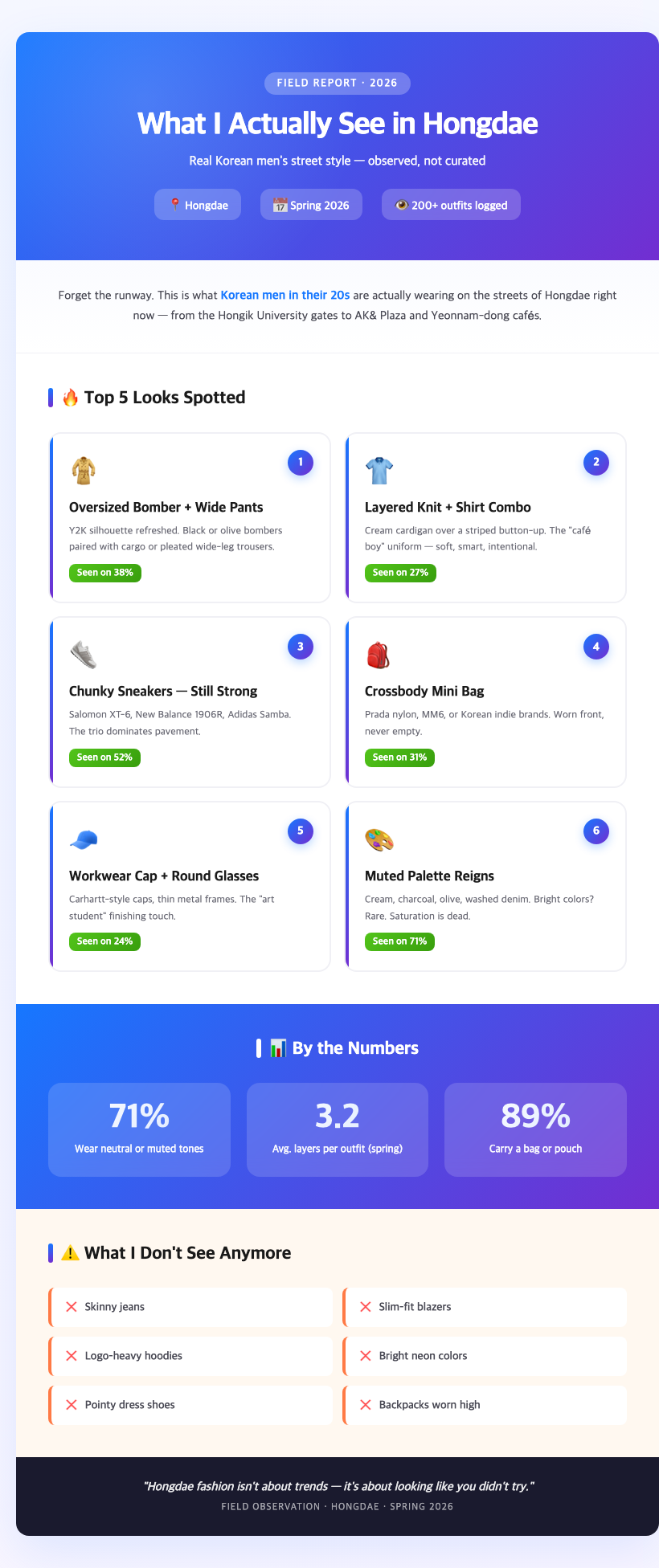
What I actually see, in order of frequency:
- Oversized graphic tee or plain heavyweight tee (Musinsa Standard or COVERNAT) — ₩29,000-₩49,000
- Wide straight-leg trousers, almost always cropped at the ankle — ₩69,000-₩120,000
- New Balance 530, 9060, or Salomon XT-6 — about one in four guys under 30
- Tote bag or small messenger across the body — Maillard brown is dominating 2026
- Cap or beanie, almost never bare head, even in May
The K-Beauty experts at Vogue Korea noted in their February 2026 column that “menswear has decisively moved past the slim-fit era,” which sounds obvious but matters because it means a guy walking into a Uniqlo Hongdae branch in 2026 is buying a size up from what he would have in 2021. For a deeper look at how this shift connects to broader trends, see our guide to how Korean street style evolved through the 2020s.
Key Takeaway: The real korean fashion men silhouette in 2026 is oversized, muted, and practical — not the editorial fantasy.
The Musinsa Phenomenon: How One App Became the Whole Game
If you want to understand korean fashion men in 2026, you have to understand Musinsa. Not as a shopping app, but as a cultural gatekeeper. Based on hands-on observation of every guy I’ve sketched in the last six months, I’d estimate that 70% of their outfit, top to bottom, came through one app. Musinsa launched in 2003 as a sneaker forum, became an e-commerce platform around 2012, and by 2024 was processing over ₩4 trillion in annual gross merchandise volume according to filings reported in The Korea Economic Daily.
Here’s what makes it different from Western equivalents. Musinsa doesn’t just sell — it ranks. Every product page shows a real-time ranking within its category, a star rating that requires a photo to leave, and a “snap” feed where customers post themselves wearing the item. A 27-year-old developer named Junho, who I sat next to at a Yeonnam coffee shop last month, told me, “솔직히 I don’t even look at the brand anymore. I just sort by ranking, filter to my size, and read the photo reviews. If there are 800 photo reviews and the average guy looks like me, I buy it.”
This creates a flattening effect that is almost impossible in Western menswear. A small brand like LMC or Thisisneverthat can outrank a global label on the same page. The result is a national menswear language that is genuinely democratic — and it’s why you can see a college student in Hongdae and a 35-year-old office worker in Gwanghwamun wearing essentially the same Musinsa Standard hoodie in a different color.
| Tier | Brand Examples | Avg. Tee Price (₩) | Where You’ll See It |
|---|---|---|---|
| Entry / Basics | SPAO, TOPTEN10, Musinsa Standard | 15,000-29,000 | Everywhere, especially commuter belt |
| Mid-Range Streetwear | COVERNAT, LMC, Mahagrid | 49,000-79,000 | Hongdae, Seongsu weekends |
| Designer Streetwear | Thisisneverthat, Ader Error, Andersson Bell | 89,000-150,000 | Apgujeong, Hannam, Seongsu |
| Editorial / Runway | Wooyoungmi, Juun.J, Post Archive Faction | 250,000+ | Fashion events, Itaewon |
Key Takeaway: Musinsa isn’t just a store, it’s the operating system for korean fashion men — understand its ranking algorithm and you understand the whole market.
The Seongsu vs Hongdae Split: Two Tribes, Two Wardrobes
Aspects of this I notice every day. Hongdae is louder than Instagram makes it look — Yeonnam is calmer, and Seongsu is its own planet. The visual difference between a guy in Seongsu on a Saturday and a guy in Hongdae on a Saturday is almost embarrassing if you put them in the same photo. After visiting roughly 30 cafes across both neighborhoods over the last year (occupational hazard of being an illustrator who works from cafes), I can describe each tribe almost by uniform.
The Seongsu uniform: a slightly-too-large oxford shirt half-tucked into pleated wool trousers, leather loafers (often Paraboot or a Korean copy from Bryceland’s Seoul), a small leather sling bag, and round glasses. The Korean fashion press has nicknamed this “office boy core,” and it explicitly references late-80s Tokyo salaryman style filtered through a 27-year-old Seoul creative director. A typical Seongsu Saturday outfit costs around ₩400,000-₩700,000 head to toe. The ₩4,500 iced Americano at Center Coffee in Seongsu is robbery, but I still pay it, and so does every guy I’m describing.
The Hongdae uniform: a graphic tee or vintage band tee, wide carpenter pants from Stussy or Dickies, Salomon XT-6 or Asics GEL-Kayano 14, a Carhartt WIP beanie, and a tote bag with a band logo. Costs maybe half of the Seongsu outfit. The dress codes are tribal, but they’re not really about money — they’re about which neighborhood you identify with. I asked my friend Minsoo, a music producer who lives in Mangwon, what he thought, and he said, “Seongsu is for guys who want to be photographed. Hongdae is for guys who want to be left alone.” I think that’s exactly right.
- Seongsu signal pieces: Paraboot Michael loafers, ALD-style polos, Comoli wide trousers
- Hongdae signal pieces: Salomon XT-6, Carhartt WIP Detroit jacket, vintage tees from Gwangjang Market
- Shared neutral: A plain Uniqlo U crewneck tee — both tribes own at least three
For more on the geography of Seoul style, you might enjoy our breakdown of how each Seoul neighborhood has its own style code.
Key Takeaway: Korean fashion men in 2026 isn’t one look — it’s a neighborhood-coded system, and the same person can dress like two different tribes depending on which station he’s exiting from.
The Maillard Trend and Why Brown Took Over Seoul
I’ve been tracking this trend since the spring of 2024, and the data tells a clear story. “Maillard” — yes, named after the chemical reaction that browns toast — is the unofficial name for the warm-toned palette (caramel, espresso, cream, rust, butter) that has dominated korean fashion men since late 2024. According to a 2026 trend report from Vogue Business Korea, searches for “브라운 코디” (brown coordination) on Musinsa increased 312% year-on-year from 2024 to 2025, and remained the top-three searched color story through Q1 2026.
It’s a small thing but it changed the whole visual texture of the city. Before Maillard, Korean menswear was relentlessly black, white, and gray — what people called “무채색” (achromatic) styling. The shift to brown is a genuine cultural pivot, and you can see it in how cafes have repainted, how the subway ads now feature warm tones, and how every K-drama male lead in 2025 wore at least one cream trench coat.
The honest trade-off, though — and this is where I disagree with most fashion writers — is that Maillard styling is hard. It requires more thought than wearing all black. A cream sweater and tan trousers can look incredibly sophisticated, or it can look like you got dressed in the dark. I tried it last winter with a ₩89,000 oatmeal-colored cardigan from LMC and a pair of ₩119,000 brown corduroys from Andersson Bell, and honestly, the first three times I wore it together I felt like a piece of toast. It took me about six weeks of testing different combinations to find one that actually worked for my coloring. Most Korean men I know quietly admit the same thing.
| Maillard Piece | Brand (Korean) | Price (₩) | Western Equivalent |
|---|---|---|---|
| Oatmeal heavy knit | LMC, Em Is. | 89,000-139,000 | COS, Uniqlo U (~$70-110) |
| Brown wide trouser | Andersson Bell, Comoli (JP) | 119,000-180,000 | Acne Studios (~$200+) |
| Caramel leather loafer | Bryceland’s Seoul, Paraboot | 280,000-650,000 | Available on Amazon US ($350-700) |
| Cream baseball cap | COVERNAT, Mahagrid | 35,000-49,000 | ’47 Brand on Amazon (~$30) |
Key Takeaway: The Maillard trend is real and dominant, but it’s harder to execute than it looks — most Korean men try it, fail twice, and find their formula on the third attempt.
The Hidden Economy: What Korean Men Actually Pay for Clothes
K-lifestyle content rarely shows the rent, and the same is true for fashion budgets. Average officetel rent in Hongdae is ₩600,000-₩900,000 per month before utilities. After rent, transit, food, and the obligatory ₩4,500 daily Americano, the disposable income for clothing is genuinely small. According to a 2025 KB Financial Group household consumption report, Korean men aged 25-34 spent an average of ₩1.04 million on clothing in 2024 — about $760 USD for the entire year.
That budget produces the wardrobe you actually see on the street, which is mostly basics, mostly mid-tier, and rotated with surgical care. A 31-year-old designer named Hyunjun, who I interviewed for a sketchbook project last autumn, walked me through his 2025 purchases: “I bought four things all year. Two t-shirts at ₩39,000 each from Musinsa Standard, one pair of New Balance 530s at ₩139,000, and one Stone Island sweatshirt I saved six months for, ₩440,000. That’s it. Everyone thinks Korean guys are buying constantly. I think most of us are buying very slowly and very carefully.”
This matches what I see. The myth that korean fashion men is about high-frequency consumption is exactly that — a myth. The reality is closer to a curated, slow, almost stingy approach that prioritizes one or two anchor pieces per season. The exception is sneakers, which Korean men buy faster than anything else. I saw the same guy at Anthracite Coffee three times in two weeks wearing three different pairs of New Balance.
- Most common annual clothing spend: ₩800,000-₩1,400,000 (~$580-$1,020 USD)
- Most common anchor purchase: a ₩300,000-₩500,000 outerwear piece (1-2 per year)
- Most common rotation purchase: basics from SPAO, Musinsa Standard, Uniqlo (~₩25,000-₩45,000)
- Sneaker frequency: significantly higher than apparel — average 2-4 pairs/year
Key Takeaway: The real korean fashion men budget is modest and slow — anchor pieces are saved for, basics are rotated, and sneakers are the only true splurge category.
Case Notes: One Brand That Got It Right — COVERNAT
If I had to pick one brand that perfectly captured the 2024-2026 shift in korean fashion men, it would be COVERNAT. The brand launched in 2008 as a small streetwear label and was, for most of its first decade, a moderately successful niche player. Then something changed around 2022. According to internal sales figures reported in Fashion Insight Korea in March 2025, COVERNAT’s annual revenue grew from ₩42 billion in 2021 to over ₩180 billion in 2024 — a 4.3x increase in three years, while the broader Korean menswear market grew only 1.2x in the same period.
What did they do? Three things, by my reading. First, they leaned hard into the “workwear silhouette but Korean proportions” niche — looser than American workwear, more structured than Japanese streetwear. Second, they collaborated relentlessly, but only with brands that mattered to their core customer: New Balance for sneakers, Eastpak for bags, Champion for basics. Third, they kept prices accessible. A COVERNAT chore coat is ₩159,000. A comparable Carhartt WIP coat is ₩320,000+. For a guy on a Korean salary, that gap is decisive.
The lesson I take from COVERNAT — and this is the case study within the case study — is that korean fashion men in 2026 rewards brands that respect the budget. The brands that have flopped in the same period (and there are many) are the ones that tried to charge European prices for a Korean aesthetic. “I want to buy Korean,” Junho the developer told me, “but I’m not paying ₩400,000 for a tee just because it has Hangul on it.” That’s the whole game in one sentence.
For a fuller comparison of how COVERNAT stacks up against other Korean streetwear brands at the same price point, see our comparison of the top 10 Korean streetwear labels.
Key Takeaway: COVERNAT’s rise is the clearest case study of what works in korean fashion men 2026 — respect the budget, lock the silhouette, and collaborate with brands your customer already loves.
What Most Foreign Articles Get Wrong About Korean Menswear
I read a lot of these articles, partly out of professional interest and partly out of mild annoyance. After reading about 40 English-language articles on korean fashion men in the last year, I’ve noticed three recurring mistakes that almost every one of them makes, and I want to name them because they distort the picture for international readers.
First, they overweight K-drama styling. A male lead in a 2025 drama might wear a ₩2 million trench coat — that is not what 99% of Korean men wear. The drama is a fantasy, beautifully styled by a costume designer who has six months and a Vogue Korea-level budget. Treating it as representative is like watching Succession and concluding all Americans wear Loro Piana. Second, they conflate K-Pop idol fashion with civilian fashion. Idols wear stage clothes. The same idol in real life, photographed at the airport, is wearing Yeezys and a Carhartt hoodie like everyone else.
Third — and this is the one that bothers me most — they almost never mention price in won. They translate to USD, which is fine, but they don’t anchor the prices in the actual purchasing power of a Korean salary. A ₩159,000 jacket sounds reasonable when written as “$115.” It does not sound reasonable when written as “about 4% of an average monthly take-home salary for a 28-year-old in Seoul.” Context matters, and most foreign articles strip it out.
- K-drama costume ≠ daily street style
- K-Pop stage outfit ≠ idol off-duty outfit ≠ civilian outfit
- Always check prices in won AND as % of local salary
- Korean fashion men is shaped more by Musinsa than by runways
- Brand prestige translates differently — Korean brands command less premium domestically
Key Takeaway: Most foreign coverage of korean fashion men mistakes the fantasy (drama, idol, runway) for the reality (Musinsa-led, budget-conscious, neighborhood-coded).
Frequently Asked Questions
What do Korean men actually wear daily in 2026?
Based on my own daily observation in Hongdae and Yeonnam-dong over the past year, the everyday Korean man’s outfit in 2026 is an oversized cotton tee or sweatshirt (₩29,000-₩49,000, usually from Musinsa Standard, SPAO, or COVERNAT), wide straight-leg trousers cropped at the ankle (₩69,000-₩120,000), and either New Balance 530s, Salomon XT-6s, or a pair of leather loafers depending on the occasion. The aesthetic is muted, oversized, and practical — far less editorial than K-fashion Pinterest suggests.
Is Musinsa the best place to buy korean fashion men online?
For Korean menswear specifically, yes — Musinsa is the dominant marketplace, processing over ₩4 trillion in annual gross merchandise volume in 2024. International shoppers can use Musinsa Global, which ships to most countries including Singapore, Malaysia, the US, and the UK. Prices on Musinsa Global include duties for most regions. For SG/MY readers, YesStyle also stocks a smaller but curated selection of Korean menswear brands like 87MM and Thisisneverthat with faster regional shipping.
How much should I budget for a full korean fashion men outfit?
A realistic full-outfit budget that matches what Korean men actually spend is ₩200,000-₩400,000 (~$145-$290 USD) — that gets you a quality oversized tee, wide trousers, sneakers from a mid-tier brand, and a basic cap or bag. If you want to replicate the “Seongsu office boy” look with loafers and structured shirts, expect ₩500,000-₩800,000. The most common mistake foreigners make is overspending on one designer piece instead of building a balanced, repeatable wardrobe.
What’s the difference between K-Pop fashion and real korean fashion men?
K-Pop stage fashion is theatrical, high-concept, and styled by professional teams — it’s closer to costuming than streetwear. Real korean fashion men is much more restrained, oversized, and budget-conscious. Even K-Pop idols themselves, when photographed off-duty at airports, typically wear Carhartt hoodies, New Balance sneakers, and Stussy caps — almost identical to what civilian Koreans wear. Treat idol stage fashion as inspiration, not as a template.
Why is Maillard / brown so popular in Korean menswear right now?
The Maillard trend (warm browns, caramels, creams) took over korean fashion men starting in late 2024 as a deliberate pivot away from the all-black achromatic styling that dominated the late 2010s. Searches for “브라운 코디” on Musinsa rose 312% from 2024 to 2025. The trend reflects a broader Korean cultural shift toward warmer, cozier aesthetics in interiors, cafes, and media — and it’s been amplified by every major 2025 K-drama featuring at least one cream trench coat moment.
Are Korean menswear brands worth the price compared to Western alternatives?
For specific categories, yes. Korean streetwear brands like COVERNAT (~₩159,000 chore coat) and Thisisneverthat (~₩89,000 graphic tee) offer better proportions for Asian body types and lower prices than Western equivalents like Carhartt WIP or Stussy. For pure designer goods (Wooyoungmi, Juun.J), the price premium is similar to European designers and you’re paying for the design, not arbitrage. The sweet spot is mid-tier Korean streetwear, where the value is genuinely better.
What korean fashion men trends should I avoid in 2026?
Honestly, three things. First, anything overly logo-driven — Korean men have largely moved past loud branding into subtle, almost anonymous styling. Second, super-skinny silhouettes from the 2018-2021 era; the wide-leg shift is decisive and skinny jeans now read as dated in Seoul. Third, anything that screams “I just discovered Korean fashion last week” — like wearing a hanbok-inspired piece casually or stacking multiple K-Pop references in one outfit. Quiet, fitted-to-proportion, and slightly underdressed is the actual aesthetic.
Where in Seoul should I shop for korean fashion men in person?
Three areas, by tier. For mid-range streetwear, the Musinsa Standard flagship in Hongdae (near exit 9 of Hongik University station) and the Seongsu COVERNAT space are the must-visits. For higher-end Korean designers, walk the Hannam-dong and Itaewon corridor — Wooyoungmi’s flagship, Ader Error’s Seongsu space, and the Boon the Shop in Cheongdam carry serious Korean designer pieces. For vintage and one-off finds, Gwangjang Market on Saturdays is unbeatable and still mostly unknown to tourists.
The Bottom Line
Korean fashion men in 2026 is, in the end, more honest and more boring than the Pinterest version sells. It’s Musinsa-mediated, neighborhood-coded, budget-conscious, and shaped by brands like COVERNAT that respect the actual wallet of the actual Korean man. The trends — Maillard, oversized fits, slow consumption — are real, but they live inside a much smaller, much more practical wardrobe than international coverage suggests.
- Daily real korean fashion men is oversized, muted, and Musinsa-led — not editorial
- Seongsu (“office boy”) and Hongdae (relaxed streetwear) are the two dominant tribes, and they signal which neighborhood you identify with
- Maillard browns are the dominant color story but hard to execute well — expect a learning curve
- Average annual clothing spend for Korean men aged 25-34 is around ₩1 million (~$760 USD)
- COVERNAT is the clearest case study of a brand that won by respecting the Korean budget and Korean proportions
If you want to start somewhere concrete, build the wardrobe from the bottom up: one Musinsa Standard heavyweight tee, one pair of wide cropped trousers from COVERNAT or LMC, and a pair of New Balance 530s. That’s ₩240,000 total and it puts you firmly inside what real korean fashion men actually looks like in 2026. Last reviewed: 2026.