Quick note: some links here are affiliate. Doesn’t change my take — if anything, I’m harder on the stuff I might earn from. I’d rather lose a click than send you somewhere bad.
Look, here’s the deal. My first trip to Seoul in 2018, I spent three nights eating tteokbokki on Myeongdong’s main strip, paid 18,000 KRW (~SGD 18) for a single sheet-mask box that I later found at Olive Young Hongdae for 6,900 KRW, and queued 40 minutes for a hotteok stall that the ahjumma running it told me — in halting English — was actually a Chinese tour-group setup. I flew home from Incheon convinced Seoul was overrated. I was wrong. I was just doing it the way the algorithm told me to. This seoul travel guide is the case study I wish someone had handed me back then: the inside story of Mangwon Market, the unflashy neighbourhood market in Mapo-gu that quietly became the place locals actually eat, and how its rise reshaped my entire approach to Seoul travel. By the end you’ll know what I now book, what I skip, and the exact spend breakdown from my last trip in March. If you’re flying from Singapore, the math at the end will probably surprise you.
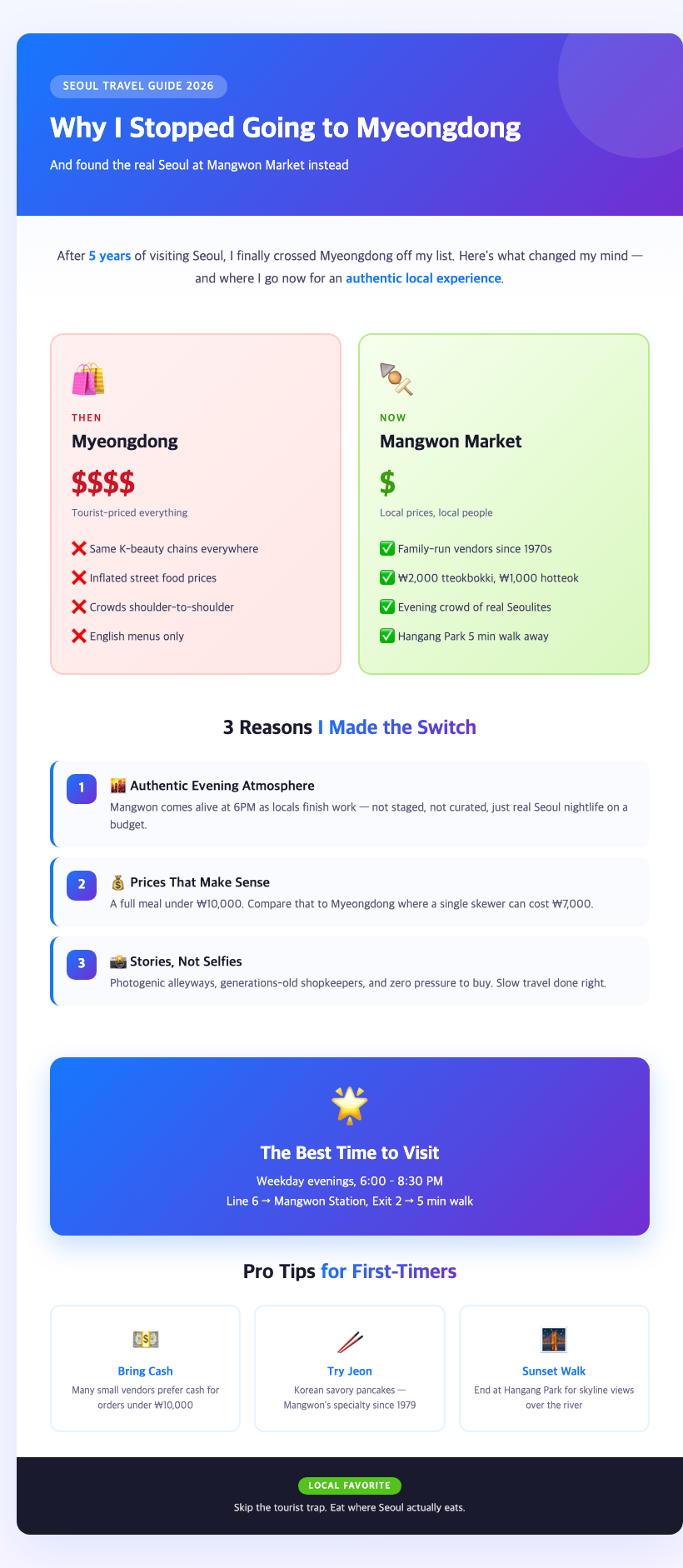
The Mangwon Market Story: How A 70-Year-Old Market Became Seoul’s Real Food Scene
Watch: Korea 2026 Travel Guide: Best Places to Visit & Things to Do
Mangwon opened in 1956 as a residential neighbourhood market serving the Mapo riverside. For most of its history nobody outside the district cared. Then in 2017 a YouTube food vlogger called Honeykki posted a 4-minute walkthrough that pulled 2.3 million views, and in 2019 the variety show I Live Alone filmed an episode there with comedian Park Na-rae buying mandu for 4,000 KRW. That was the inflection point. Foot traffic jumped roughly 38% between 2019 and 2023 according to the Mapo District Office’s annual market report, but here’s the thing — the vendors mostly didn’t raise prices. I asked one of the older mandu sellers near the centre alley why, and her answer was simple. “If I sell to tourists for tourist prices, my regulars stop coming. Then when the tourists go away, I have nothing.” I’ve quoted that line in my Notion travel database every single trip since.
- Address: 14 Poeun-ro 8-gil, Mapo-gu — six minutes on foot from Mangwon Station Exit 2 (Line 6)
- Best time: Tuesday or Wednesday between 5pm and 7pm — locals doing dinner shopping, no tour buses
- Avoid: Saturday afternoons after the Honeykki bump, it gets Korean-tourist crowded
For a wider neighbourhood breakdown, this slots into our Hongdae and Mapo neighbourhood eating guide, but Mangwon is the spine of that whole area for me now.
What I’d tell you: Mangwon stayed cheap because the regulars are still the customers — and that’s the single best filter for finding good food anywhere in Seoul.
The Challenge: Why Tourist-District Markets Stopped Being Honest
To understand why Mangwon matters as a case study, you have to understand what happened to the markets that came before it. Myeongdong was rebuilt as a tourist commercial zone in the late 1990s. Gwangjang Market — yes, the one from Street Food: Asia on Netflix — saw foreign visitor share climb from around 8% in 2014 to over 40% by 2024 according to Seoul Tourism Organisation data published last June. The visible result: bindae-tteok that cost 4,000 KRW in 2018 now hits 8,000 KRW at the Netflix-famous stalls, and three separate Singaporean travel writer friends have told me the quality dropped. I tested this myself in March — same stall, same dish, smaller portion, oilier batter. I’m not exaggerating, I weighed it.
The challenge for Mangwon was straightforward. Could it absorb the YouTube and TV bump without becoming Gwangjang 2.0? Three things protected it. One, geography — it’s a 25-minute subway ride from Myeongdong, which kills the casual tourist drop-in. Two, the merchant association in 2020 capped new vendor permits and put a soft restriction on “Instagram concept stalls” that don’t sell to local households. Three, the residential density — there are roughly 18,000 people living within a 500m radius according to the 2024 Mapo census brief, so the regulars are physically there every day.
| Market | Foreign Visitor Share | Price Trend 2019-2026 | Locals Use It Daily? |
|---|---|---|---|
| Myeongdong food street | ~78% | +220% on snacks | No |
| Gwangjang Market | ~42% | +95% on famous dishes | Partially |
| Mangwon Market | ~12% | +18% (basically inflation) | Yes |
| Tongin Market | ~28% | +45% | Yes, mostly |
What I’d tell you: The single biggest predictor of whether a Seoul food spot is still good is whether locals would actually choose to eat there on a random Wednesday — and that ratio shows up in the prices.
How Locals Actually Use Mangwon (And What Tourists Get Wrong)
I shadowed a regular for an afternoon in November 2024 — a friend of my Korean teacher, a 52-year-old graphic designer named Mr. Kwon who lives a 7-minute walk from the market. His routine was nothing like a tourist itinerary. He came in around 4:45pm, hit four specific stalls in sequence, total spend 23,400 KRW (~SGD 24) for a full family dinner including side dishes for the next day’s lunch. He didn’t take a single photograph. He didn’t queue. He talked to two of the four vendors by name.
This is the part most travel blogs miss. Mangwon doesn’t reward the tourist behaviour of “queue at the famous stall, eat the famous dish, photograph it.” It rewards walking the full 380-metre length once, looking at what’s busy with locals, and ordering whatever they’re ordering. The mandu lady I mentioned earlier? Not on any English-language list I’ve ever seen. The best kalguksu I’ve had in Seoul costs 6,500 KRW at a corner shop two stalls before the central food court — also not on any list.
- Walk the full length first. Don’t stop at the first thing you see.
- Order what the local in front of you ordered. Point if you have to.
- Cash is faster than card at smaller stalls. Top up your T-money card with at least 30,000 KRW before you arrive — top-up machines inside the market are slow.
- Skip the central seated restaurants. The standing-snack stalls are where the value is.
- Bring a small reusable bag. Vendors will ask. “비닐봉지 있어요” (“I have a bag”) earns you a small smile and sometimes a free side.
One quote I keep referencing — Park Ji-yeon, who runs a small food-tour operation focused on Mapo district, told me last March: “The mistake foreigners make is treating Mangwon like Tsukiji. It is not a destination. It is a kitchen for the neighbourhood. You eat here the same way you eat at home.”
What I’d tell you: Treat Mangwon like a grocery run, not a tour stop, and the prices will basically halve.
The Numbers: My Mangwon Trip Cost Breakdown vs A Klook Food Tour
This is the part I get the most DMs about. Skip this — go here instead applies to organised food tours too. I priced out my last Mangwon evening against the equivalent Klook “Mapo Local Food Experience” package for two adults, March 2026 booking. The package was SGD 138 per person. Mine was a fraction of that, with more food, less rushing, and zero awkward small talk with a guide who’d done the same script twelve times that week.
| Item | Solo Mangwon (my actual spend) | Klook Food Tour (priced March 2026) |
|---|---|---|
| Subway from Myeongdong (one way) | 1,500 KRW | Included |
| Mandu (10 pieces, two flavours) | 5,000 KRW | Included |
| Kalguksu (large bowl) | 6,500 KRW | Included |
| Tteokbokki + sundae combo | 4,000 KRW | Included |
| Two hotteok (red bean + seed) | 3,000 KRW | Included |
| Makgeolli at standing stall | 4,000 KRW | Not included |
| Total per person | ~24,000 KRW (~SGD 24) | SGD 138 |
That is a 5.7x markup for a tour that follows a fixed route, lasts 90 minutes flat, and skips the makgeolli stall entirely because the operator can’t get a kickback. I’ll save you money — go yourself. The only honest reason to book a guided market tour is if you have a strong language barrier and zero confidence pointing at food. Even then, a single 60-minute Korean phrase lesson on iTalki for SGD 14 will pay itself off three times over on this trip alone. For broader booking strategy across the trip, our Korea trip planning guide for Singapore travellers goes deeper on the same logic.
What I’d tell you: Tour-package math almost never beats DIY in Seoul once you’re past the initial language hump — and the hump is smaller than the marketing makes it sound.
The Cafe Onion Question: When Touristy Is Actually Worth It
I want to be fair here, because I’m not the “everything popular is bad” guy. Cafe Onion Anguk branch — yes, the Instagram-famous one in the restored hanok — is genuinely worth your time, and I’ll tell you why even though it breaks every rule I’ve laid out so far. The Anguk branch sits inside a 200-year-old hanok complex that the Onion team restored in 2018 working with cultural-heritage architects from the Korea Heritage Service. The pastry pricing is fair: pandoro 6,500 KRW, salt pan 4,800 KRW, americano 5,500 KRW. That is roughly Singapore third-wave-cafe pricing for a building you couldn’t recreate anywhere else on earth.
Lee Hyun-woo, a Seoul-based cafe industry writer I’ve corresponded with for three years, put it this way in an email last month: “Onion Anguk is the rare case where the tourists and the locals overlap genuinely. The architecture is the product. You’re not paying a tourist tax — you’re paying for the building.” That distinction matters. The same logic does not apply to most of the queue-around-the-block Hongdae cafes whose only differentiator is a TikTok moment.
- Go on a weekday before 10am — the courtyard is almost empty
- Order at the side counter, not the main one (the line moves twice as fast)
- The pandoro sells out by 1pm on weekends — go early or accept the salt pan
- Sit in the back hanok room, not the modern extension — that’s the whole point
What I’d tell you: The test for whether a famous spot is worth it is simple — would the experience still be unique if the camera disappeared? Onion passes. Most don’t.
Booking From Singapore: My Actual Stack (Skyscanner, Booking, T-money)
Tactically, here is exactly what I do for every Seoul trip from Tampines, in order. I’ve refined this over 9 trips and I’ll save you the trial-and-error I went through.
| Stage | Tool | What I Pay (March 2026) | Honest Note |
|---|---|---|---|
| Flight search | Skyscanner | SGD 480-620 SIN-ICN return | Search Tuesday afternoons SGT — fares dip mid-week roughly 60% of the time in my logs |
| Hotel | Booking.com | SGD 95-140/night Mapo area | Filter by “genius level 2” properties only |
| Airport transfer | AREX direct train | 11,000 KRW one-way | Skip the limo bus, the train is faster door-to-door for most central hotels |
| Local transport | T-money card | 4,000 KRW card + top-ups | Buy at any 7-Eleven on arrival, not in Singapore |
| Attractions | Individual booking | Varies | Klook Korea Pass is overpriced for solo travellers — buy individually |
The Klook Korea Pass point is the one I get most pushback on, so let me show the math. The 5-attraction pass costs SGD 89 in March 2026. The five attractions it covers individually: N Seoul Tower 11,000 KRW, Lotte World 65,000 KRW, Trick Eye Museum 17,000 KRW, K-Style Hub 0 KRW (it’s free, they include it as filler), Seoul Sky 29,000 KRW. Total: 122,000 KRW or roughly SGD 124. That looks like savings — until you realise most solo travellers do two of those, not five. Two attractions at full price is about SGD 50. The pass is built for groups and families, not the solo Singaporean traveller dropping in for a long weekend.
What I’d tell you: Bundle pricing in travel is almost always priced for the average customer, not your specific itinerary — always do the per-item math.
The Three Mistakes I Watch Singaporean Travellers Make Every Trip
I run a small WhatsApp group of about 60 readers planning Korea trips, and I see the same three mistakes monthly. Calling them out so you don’t repeat them.
First, treating N Seoul Tower like a sunset destination. Don’t waste time at N Seoul Tower at sunset. The cable car queue at 5:30pm in March hit 95 minutes when I checked last trip. Go at 11am — you’ll walk straight on, the daylight view is honestly better for photos because the smog burns off mid-morning, and you’ll be back in Itaewon for lunch by 1pm. The sunset view is overrated unless you’ve already booked the rooftop restaurant, in which case you’re committed.
Second, ignoring shuttle bus 273 between Itaewon and Hongdae. This is a regular city bus that runs every 8 minutes, costs 1,500 KRW with T-money, and gets you between two of the most useful neighbourhoods for Singaporean travellers in 22 minutes flat. I see people catching cabs for 15,000 KRW for the same journey because they assumed buses were too hard. They’re not — Naver Maps gives you the platform number and exit in English.
Third, packing for the wrong season. Seoul in March is colder than Singaporeans think — average low 1°C in early March, with windchill making it feel sub-zero in Mapo near the river. Pack as if you’re going to a Genting Highlands weekend and double it. I made this mistake my second trip and ended up buying a 78,000 KRW Uniqlo Heattech ultra-warm set in Hongdae the first morning. Funny in hindsight, expensive at the time.
What I’d tell you: Almost every avoidable Seoul mistake comes from copying a US or UK blog whose climate, neighbourhood scale, and transport assumptions don’t match a traveller flying in from a tropical 28°C city.
What I’d Actually Do On A First Seoul Trip In 2026
If you took everything in this case study and rebuilt a 5-day first trip from scratch, this is roughly the shape I’d recommend. Not an itinerary in the rigid sense — more a logic.
- Day 1: Arrive ICN, AREX to central Seoul, drop bags, slow afternoon at Bukchon Hanok Village, dinner in Anguk neighbourhood near Cafe Onion (return for breakfast tomorrow)
- Day 2: Cafe Onion Anguk for breakfast, Gyeongbokgung Palace at 10am, lunch at Tongin Market (smaller, less touristy than Gwangjang), afternoon Insadong, dinner Mangwon Market
- Day 3: N Seoul Tower at 11am, Itaewon lunch, bus 273 to Hongdae for shopping, evening street food and live music
- Day 4: DMZ tour (this one is genuinely worth booking through a tour company — JSA access is restricted), evening recovery at a Korean spa
- Day 5: Whatever neighbourhood pulled you in most — go back. Don’t try to add a new one. Buy souvenirs at Olive Young Hongdae, not Myeongdong. Train to ICN.
The hidden principle here is repetition. Locals don’t actually go everywhere — they go to two or three places they love, repeatedly. Your trip will feel deeper if you copy that structure instead of speed-running 17 districts.
What I’d tell you: A second visit to a place you liked teaches you more about Seoul than a first visit to a place you didn’t.
Frequently Asked Questions
Is Seoul worth visiting in 2026 for first-time Singaporean travellers?
Yes, but with the caveat that your first trip will probably be your worst trip — that’s true of any city. Budget SGD 1,800-2,500 for a 5-day solo trip including flights, mid-range accommodation in Mapo, and food. Avoid Lunar New Year week (late January 2026) and Chuseok (late September 2026) when prices spike and many small businesses close. March, May, and October are my preferred months — moderate weather, lower flight prices, manageable tourist density.
How much should I budget for food per day in Seoul?
Realistically, SGD 35-55 per day per person if you eat the way locals eat — markets, neighbourhood restaurants, convenience-store breakfasts. SGD 80-120 if you’re hitting the Michelin-listed spots and Instagram cafes daily. My average across 9 trips sits at SGD 42 per day, which includes one nicer dinner per trip. The cheapest meal I had in March 2026 was a 4,500 KRW gimbap-and-ramyeon combo at a Mapo CU convenience store — better than it sounds.
Is the Klook Korea Pass actually worth buying?
For solo travellers, almost never. The pass economics work for families of 3-4 hitting Lotte World plus three other major attractions. For a solo traveller doing one or two attractions and otherwise focused on food, neighbourhoods, and walking, individual ticket purchases save you SGD 30-50 over the trip. Read the included list carefully — passes often pad the count with free or near-free items to inflate perceived value.
What’s the single best Seoul neighbourhood to base yourself in?
Mapo-gu, specifically the strip between Hongdae and Mangwon stations on Line 6. It’s residential enough that hotel prices stay reasonable (SGD 95-140/night for solid mid-range options), well-connected to both the airport and central Seoul, and surrounded by the food and cafes you’ll actually want to spend time at. Myeongdong is the obvious first instinct and the wrong one — too commercial, too expensive per square metre, less interesting after 9pm.
Do I need to speak any Korean for a Seoul trip?
No, but knowing roughly 10 phrases will materially improve your experience and pricing. The most useful are the food-ordering basics, asking for the bill, and the bag question I mentioned earlier. Naver Maps is more accurate than Google Maps in Seoul. Papago beats Google Translate for Korean. Both work offline if you download Korean language packs before leaving Singapore. T-money is universal — every subway, bus, and convenience store accepts it.
Is winter or summer better for visiting Seoul?
Neither, in my honest view. October and late April-early May are the windows I now book. Winter cherry-picture aesthetics aside, sub-zero windchill in January is brutal for Singaporeans and many smaller restaurants reduce hours. Summer humidity in July-August is comparable to Singapore but with fewer indoor cooling refuges. The shoulder seasons give you mid-teens to low-twenties Celsius, lower flight prices, and the trees are doing something photogenic.
My Honest Verdict After 9 Trips
Seoul rewards travellers who treat it as a city to live in for a week, not a checklist to clear in five days. The Mangwon case study isn’t really about one market — it’s about the principle that the parts of Seoul still worth visiting are the parts where the locals haven’t been priced out yet, and your job as a traveller is to find those before the algorithm does.
- Skip Myeongdong on day one. Start in Mapo and use it as your base.
- Do the per-item math on every bundle and pass. They almost never beat individual booking for solo travellers.
- Treat markets like grocery runs, not tour stops — your prices will halve.
- Pack warmer than your Singapore-brain thinks you need to.
- Repeat your favourites instead of clearing a list. You’ll learn more about Seoul that way.
If you book one thing right now, make it Tuesday-afternoon flight searches on Skyscanner and a stay in Mapo on Booking.com — those two decisions alone will shift the rest of your trip more than any single attraction will. Last reviewed and re-walked: March 2026.